Visibility Is an Act of Service

Personal branding has become one of those phrases that can make thoughtful people uncomfortable.
For some, it sounds like self-promotion. For others, it brings up images of influencers, vanity metrics, algorithm chasing, and the pressure to constantly be visible. It can feel like the work of turning yourself into a product.
But what if personal branding is not really about ego?
What if visibility is an act of service?
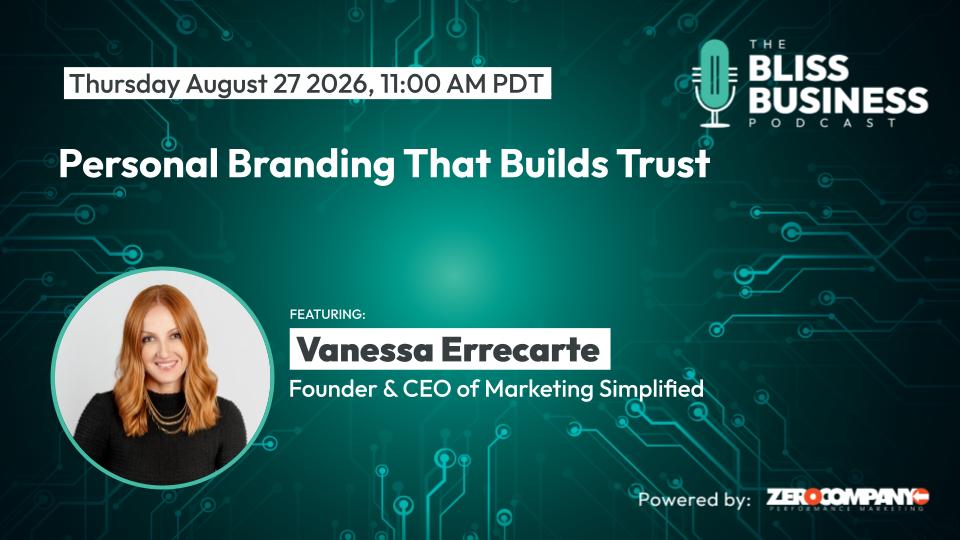
On The Bliss Business Podcast, we sat down with Vanessa Errecarte, CEO of Marketing Simplified, author of Valuable and Visible, and lecturer at the UC Davis Graduate School of Management. Vanessa teaches strategic branding, digital marketing, and personal branding, and her book, Valuable and Visible: Redefining Personal Branding by Leading With Impact Over Image, was inspired by the lessons she teaches her students. Her approach reframes personal branding as service first, helping students, leaders, entrepreneurs, and professionals clarify what they know, who they help, and how their ideas can create meaningful impact.
Her message was clear: visibility is not the goal. Impact is the goal. Visibility simply helps the right people find the value you are here to share.
Personal Branding Is Not About Becoming Famous
Vanessa believes one of the biggest misunderstandings about personal branding starts with how people define a brand.
In corporate branding, a brand exists to relate to customers. It helps a product or service become meaningful to people. It creates connection, distinction, trust, and relevance. But when the word personal gets added in front of branding, people often assume it suddenly has to be all about them.
That is where the discomfort begins.
People imagine they have to become influencers. They think they need to build massive audiences, entertain strangers, chase attention, or become famous for being famous.
Vanessa makes an important distinction. Influencers often build large audiences so they can monetize attention. That is a valid media model, but it is not the only model. Personal branding for professionals is different. It is not about becoming broadly known by everyone. It is about becoming meaningfully known by the right people.
A personal brand should help others understand what you know, who you serve, and what kind of transformation your ideas can create.
Thought Leadership Begins With Usefulness
Vanessa’s approach to personal branding begins with service.
Instead of asking, “How do I promote myself?” she encourages people to ask, “Who can I help right now?”
That question changes everything.
It moves the focus away from image and toward usefulness. It helps professionals stop obsessing over how they are perceived and start clarifying what they can contribute.
Most people are more comfortable helping than promoting. They may not want to talk about themselves, but they can usually identify someone who could benefit from what they know.
That is the doorway into a healthier form of visibility.
You are not posting to impress people.
You are sharing to serve people.
Distinction Can Be Learned
Many students and professionals struggle because they are trying to fit themselves into a generalist box.
They assume credibility comes from sounding like everyone else in their field. They worry that their ideas are not original enough, their experience is not impressive enough, or their voice does not belong in the conversation.
Vanessa pushes back on that.
She believes distinction can be learned. People can be taught how to identify what makes their perspective different, what transformation they can create for others, and how to communicate that in a way that feels both authentic and useful.
That is especially important for high-achieving people.
The more someone advances, the more they often realize what they do not know. That awareness can create humility, but it can also create hesitation. People with valuable knowledge may stay silent because they do not feel like enough of an expert yet.
But personal branding does not require knowing everything.
It requires helping someone with something you already understand.
The Personal Can Reveal the Professional
Vanessa shared the story of one of her students who came from the Sikh culture and used personal branding to preserve, humanize, and celebrate that heritage.
He had experienced verbal and physical attacks while traveling for work. He also saw younger generations becoming hesitant or embarrassed to dress traditionally because of fear or misunderstanding. So he began creating art and clothing connected to Sikh festivals and culture, while also educating others online about the beauty, service, and humanity within that tradition.
At first glance, that may seem separate from professional branding.
But Vanessa showed how it connected directly to leadership. His work around culture, dignity, tolerance, and understanding made him a stronger manager. It demonstrated his ability to promote inclusion, humanize difference, and lead across diverse perspectives.
That is where personal branding becomes powerful.
It is not a resume summary. It is a fuller picture of how someone sees the world, what they stand for, and how that perspective shapes the way they lead.
Service Creates the Emotional Connection
Vanessa used a helpful metaphor to explain service-first branding.
She described an ideal audience member standing before a tightrope. Crossing that tightrope represents giving up time, attention, trust, or money. People are naturally cautious with those resources because they are finite.
So the question becomes: what is waiting on the other side that makes the crossing worthwhile?
In marketing, that is the offer. It is the transformation someone receives. The proof points, credentials, awards, and qualifications are the safety net underneath. They reassure the audience that the person is credible, but they are not usually what creates the first emotional connection.
This is where many professionals get personal branding backwards.
They lead with credentials. They post awards, certifications, bios, and achievements. Those things may matter, but they are not usually the reason someone stops scrolling.
People stop because they see something that can help them.
Credentials Support Trust, But Value Earns Attention
Vanessa believes professionals need an online ecosystem that supports credibility.
A strong LinkedIn profile, website, biography, articles, awards, and other proof points help people confirm that you are who you say you are. Vanessa even recommends that professionals own a personal website because so much professional life now happens online.
But those credibility assets should support the brand, not replace the value.
If every post is about an award, title, certification, or behind-the-scenes moment, the audience may not understand how the person can help them. The deeper opportunity is to teach, reframe, challenge, clarify, and share insight that gives people a new way to think or act.
Credentials can help people trust you after they are interested.
But value is what gets them interested in the first place.
Make the Invisible Problem Visible
Vanessa shared the example of an optometrist who was passionate about dry eye disease.
Many people assume dry eye is solved with eye drops. But this student explained that dry eye disease can be progressive and may be connected to underlying conditions or modern behaviors such as screen use. She began educating other practitioners by reframing the issue with a provocative question: would you treat diabetes with an eye drop?
That question changed the conversation.
It helped other practitioners see that dry eye disease might require deeper investigation, collaboration with primary care physicians, and attention to underlying causes. By educating physicians, she could indirectly help millions of patients.
That is service-first personal branding at its best.
It takes something overlooked, misunderstood, or minimized and helps the right audience see it differently.
Engagement Matters More Than Vanity Metrics
Many people believe they need a massive audience for personal branding to matter.
Vanessa disagrees.
A large audience is not always the right audience. If someone builds visibility through overly broad, generalist content, they may attract followers who are not aligned with the work, message, or opportunities they actually want.
Instead, Vanessa encourages people to pay attention to engagement quality. Are the right people responding? Are they saving, commenting, sharing, asking questions, or reaching out? Are they learning something useful? Are they building trust with you over time?
The goal is not to become visible to everyone.
The goal is to become valuable to the people you are meant to serve.
When value is clear, the right audience can grow naturally.
Visibility Feels Uncomfortable Because It Feels Like Public Speaking
Many thoughtful professionals struggle with visibility because it feels exposed.
Vanessa compares personal branding to the modern version of public speaking. It can be scary to turn a phone toward your face, share an idea, and put it online where others can react. People may fear judgment, criticism, embarrassment, or simply the discomfort of being seen.
That fear is real.
But Vanessa also believes the skill can be learned. Just as people can learn public speaking, they can learn how to show up online with clarity, confidence, and purpose.
The key is to stop thinking about visibility as self-display and start thinking about it as contribution.
When the focus is service, the fear does not disappear completely, but it becomes easier to move through.
Authenticity Matters More in the Age of AI
Vanessa demonstrated during the conversation how quickly a simple video idea can be captured and shared.
It does not have to be overly polished. In fact, she pointed out that authenticity often performs better because people are craving real human presence, especially in the age of AI.
That matters because the internet is filling with more automated content, more generic advice, and more polished sameness.
The advantage for professionals is not perfection.
It is humanity.
A real person with a real perspective, speaking from lived experience and genuine conviction, can stand out precisely because they are not trying to sound like everyone else.
Frameworks Make Visibility Less Overwhelming
Vanessa’s book includes frameworks such as the EPIC Framework, the TRUTH Framework, and the SERVE Script to help people clarify positioning, package knowledge, and create authentic content.
Frameworks matter because they reduce overwhelm.
Vanessa compared them to recipes. Someone may not instinctively know how much salt or sugar belongs in a cookie, but they can follow a recipe until they understand the pattern. The same is true for personal branding.
People do not need to magically know how to express their ideas. They can learn steps. They can practice structure. They can develop a repeatable way of turning knowledge into useful content.
Over time, the framework becomes a skill.
Frameworks Turn Knowledge Into Intellectual Property
One of the most valuable things professionals can do is organize their knowledge into frameworks.
A framework takes what someone knows and makes it teachable, repeatable, and memorable. It gives others a way to apply the idea. It also helps the professional clarify their own point of view.
Vanessa believes creating frameworks is part of thought leadership because it turns expertise into intellectual property.
That is important for any leader, consultant, entrepreneur, educator, or professional who wants their ideas to travel.
A good framework gives people language.
And when people have language, they can share the idea with others.
Your Website Teaches the Internet Who You Are
Vanessa also emphasized the importance of a personal website.
In a world increasingly shaped by AI and large language models, professionals need places where their ideas, positioning, and credibility are clearly expressed. A website becomes a home base that helps the internet understand who you are and what patterns define your work.
This is no longer just about having a digital brochure.
It is about being accurately understood.
As AI systems summarize people, businesses, and ideas, the content you publish helps shape how you are represented. If you do not define your own expertise clearly, others, or machines, may define it for you.
Visibility is becoming part of reputation management.
Passion Creates Dimension
The conversation also explored the example of Dolly Parton and how her public identity evolved over time.
Vanessa pointed out that Dolly did not only become known for her music, style, or iconic image. Over time, her philanthropy, literacy work, community support, and deep care for people became central to how the public understood her.
That is a powerful example of personal brand as service.
Dolly Parton did not simply talk about caring. She acted in ways that made her values visible.
Vanessa connected this to the idea that passion can add dimension to a personal brand. Not everything has to be a direct professional tutorial. Sometimes what makes someone memorable is the way their passions, values, and work connect into a larger story of contribution.
Impact Over Image
The subtitle of Vanessa’s book is about leading with impact over image.
That matters because the digital world often rewards image. It rewards polish, visibility, performance, aesthetics, and consistency. But what people remember over time is impact.
Vanessa encouraged professionals to think about what they remember from five years ago. Usually, the moments that stay with us are the ones that affected us. They changed how we felt, what we saw, or what we understood.
Image may get a moment of attention.
Impact creates memory.
That is the difference between being noticed and being trusted.
Teaching Reveals the Real Purpose of Expertise
When asked what teaching has taught her that consulting alone could not, Vanessa described teaching as one of the greatest gifts of her life.
In the classroom, she is focused on the outcome of her students’ lives becoming better because they learned something useful. That fulfillment is different from a traditional client engagement because the reward is directly tied to growth, breakthrough, and transformation.
That is a beautiful reminder about expertise.
Knowledge is not only something to monetize. It is something to pass on. It becomes more meaningful when it helps others move forward.
Teaching reveals the service at the heart of thought leadership.
When People See Their Value, They Become Unstoppable
Vanessa shared that when students realize their ideas have value, they become unstoppable.
She described a first-generation Latina student who wanted to pursue public policy and created a podcast about showing up fully as herself, financial independence, and taking up space. The work helped her express her voice, reach thousands of listeners, and grow in her career.
That story captures the power of visibility.
When people realize they have something meaningful to contribute, they stop waiting for permission. They begin to speak, create, teach, and lead from a more authentic place.
That is also an important lesson for organizations.
If leaders want a true competitive advantage, they should help their people become unstoppable.
Personal Branding Can Strengthen Organizations
Some companies fear that if employees build personal brands, they will leave or make the organization look inconsistent.
Vanessa sees it differently.
When employees are empowered to share their knowledge, voice, and perspective, the organization benefits. People tend to trust humans more than institutions, and authentic employee voices can raise the credibility and reach of the whole company.
This requires trust.
Leaders have to believe that helping people become more visible and valuable is not a threat. It is a way to expand the organization’s collective intelligence, humanity, and influence.
And when employees do eventually grow into new opportunities, that can be celebrated too.
A company that helps people become more fully themselves has already created impact.
Love Is the Backbone
When asked what role love should play in business, Vanessa said love is the backbone of everything.
She connected love to empathy, especially in a world where AI can mirror empathy but does not truly possess it. As AI becomes more capable, the human ability to care, understand, relate, and serve may become even more important.
That is a powerful insight.
The future of work may not only belong to the people with the most technical knowledge. It may belong to those who can combine knowledge with empathy, perspective, and genuine service.
Personal branding, when done well, is not about building an image.
It is about making that service visible.
You Deserve To Be Visible Too
At the end of the conversation, Vanessa was asked what one belief she would help every professional change about visibility.
Her answer was simple: you deserve it too. The internet is for everyone.
That is worth remembering.
Visibility is not reserved for extroverts, executives, influencers, or people who already feel confident. It is available to anyone with knowledge, perspective, care, and a desire to help.
You do not need to become someone else.
You need to clarify how your ideas can serve.
Key Takeaways
- Personal branding is not about becoming famous. It is about becoming meaningfully known by the right people.
- Service-first branding starts with the question, “Who can I help right now?”
- Distinction can be learned by clarifying the transformation your ideas create for others.
- Credentials support trust, but value earns attention.
- Engagement quality matters more than broad visibility or vanity metrics.
- Visibility feels uncomfortable because it is a modern form of public speaking.
- Frameworks make personal branding less overwhelming by turning knowledge into repeatable structure.
- A personal website helps the internet and AI systems understand who you are and what you stand for.
- Impact creates memory in a way image alone cannot.
- Love and empathy may become even more important as AI changes how people communicate, work, and build trust.
Final Thoughts
Vanessa Errecarte’s perspective is a reminder that visibility does not have to be an ego exercise.
It can be an act of service.
The goal is not to perform for everyone. It is to become useful to the people who need your knowledge, perspective, experience, and care. When personal branding is grounded in service, it becomes less about self-promotion and more about contribution.
You do not need to chase clout.
You need to clarify what you know, who you help, and how your ideas can create impact.
In a world filled with noise, generic content, and AI-generated sameness, the most powerful brands may be the most human ones.
Visibility matters because people cannot be helped by ideas they never encounter.
Where to Go Next
Hear the full conversation on the episode page, watch it on the video page, or visit Vanessa Errecarte’s guest profile. Visibility is an act of service the moment it stops being about you. Explore more Featured Guest Series conversations.

Executive Producer | Host | Blog Contributor
Tullio Siragusa is a strategic advisor, dynamic speaker, author, and EQ coach with 36 years of experience as a technology disruptor rooted in Design Thinking. Since 2018, he has been creating, producing and hosting live podcasts, interviewing over 1,000 C-suite executives across a wide range of industries. His work behind the mic reflects his larger mission: using conversation as a catalyst for human-centric innovation.
Tullio’s commitment to purpose-driven leadership and ethical transformation is reflected in his advisory roles at the University of California, Riverside’s Design Thinking Executive Program, and the University of San Francisco School of Management’s Digital Marketing Program. As a Board Advisor at AI2030.org, he helps guide the responsible advancement of AI toward ethical and sustainable outcomes. A founding member of RadicalPurpose.org, Tullio believes empathy isn’t just a trait, it’s a non-negotiable foundation for leadership.

Belonging Is Built Into the Details