Culture Becomes Real When It Becomes a System

Most organizations say culture matters. Far fewer manage it with the same discipline they bring to operations, finance, marketing, or customer experience.
That is a problem because culture is already operating whether leaders design it or not. It shows up in how people respond when something goes wrong, whether employees feel safe enough to disagree, how leaders handle difficult conversations, and whether people believe they are part of something meaningful or simply occupying a role inside a system.
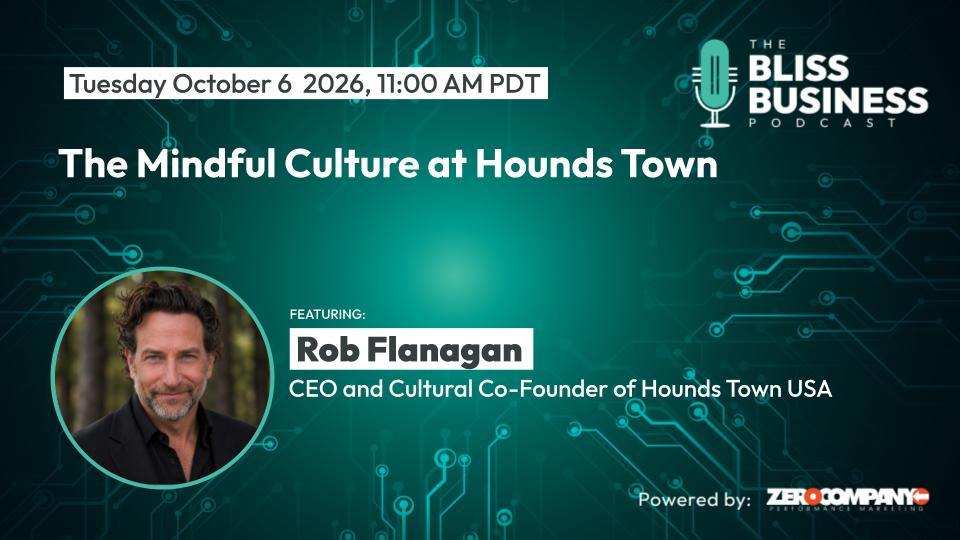
On The Bliss Business Podcast, we sat down with Rob Flanagan, CEO, President, and Culture Co-Founder of Hounds Town USA, to explore what happens when culture is treated as an intentional business system rather than a collection of aspirational values. Rob brings more than 20 years of franchising experience and a background in transpersonal counseling psychology, where he studied human behavior, self-awareness, mindfulness, empathy, and change. Today, he applies those ideas while helping lead a pet care franchise with more than 100 locations. The Mindful Culture at Hounds T…
His perspective challenges a familiar assumption in business: culture is not the soft side of performance. It is one of the systems that produces performance.
Culture Cannot Depend on One Person
Rob has spent much of his career helping emerging brands scale, and one pattern kept appearing. Small companies often begin with tremendous energy because the founder or a handful of passionate people are deeply involved in everything. The values are communicated naturally because the people who created them are present every day.
Then the company grows.
More people arrive. Systems become necessary. Departments form. Processes become more formal. The organization gains structure, but something about the original energy can begin to disappear.
Rob came to believe that the problem was often not growth itself. It was that culture had never been separated from the personalities carrying it.
If one leader is responsible for keeping the culture alive, culture becomes vulnerable every time that person is absent, promoted, leaves the organization, or simply becomes overwhelmed. That is why Rob began thinking about culture the same way he thinks about other business functions.
Operations need systems. Finance needs systems. Marketing needs systems. Culture does too.
The goal is not to remove the humanity from culture. It is to prevent humanity from depending on the availability of a single human being.
Values on a Wall Are Not Culture
Rob illustrated this distinction with a memorable story from his first traditional job at Long John Silver’s.
Like many employees, he watched a training video about the company’s mission and values. The words sounded appropriate. Cleanliness was presumably part of the expectation.
Then reality showed up.
During what his manager described as a “coleslaw emergency,” Rob watched as a trash can was emptied, filled with coleslaw ingredients, and used as an oversized mixing container.
The story is funny now, but the lesson is serious.
An organization can have all the right words and still have the wrong culture.
Enron famously had values. Countless companies have polished mission statements, culture decks, framed posters, and beautifully designed careers pages. None of those things prove how the company actually operates.
Culture is behavioral.
It is the distance between what the organization claims and what people experience.
That is why Rob tries to demystify culture. It does not have to mean ping-pong tables, elaborate perks, or inspirational slogans. It means defining the way people are expected to work together, building those expectations into the business, and measuring whether the experience matches the intention.
Culture Starts Slipping Before the Metrics Show It
One of the advantages of treating culture as a system is that leaders can begin looking for leading indicators rather than waiting for obvious problems.
Rob pays attention to energy and participation.
When people who normally contribute stop offering ideas, something may have changed. When employees begin protecting their department rather than communicating openly across the organization, there may be a trust problem developing. When people respond to important questions with some version of “I don’t care,” that can signal something deeper than a bad day.
Those shifts often happen before turnover increases or employee surveys deteriorate.
This is where attentive leadership matters.
A disengaged person in a meeting may simply be sick, tired, or distracted. Rob shared an example of noticing an ordinarily extroverted team member becoming unusually quiet. Instead of assuming there was a culture problem, he checked in and learned that she was simply feeling ill.
The point is not to diagnose every change in behavior.
It is to notice.
Culture becomes accidental when leaders stop paying attention to what people are showing them.
Apathy Is More Dangerous Than Disagreement
Rob drew an important distinction between empathy and apathy.
Disagreement is not necessarily a sign of unhealthy culture. In fact, healthy organizations often contain plenty of disagreement because people care enough to challenge ideas.
Apathy is different.
When people stop caring, they stop taking responsibility. They protect themselves. They stop raising concerns because they no longer believe anything will change. They may continue doing the job, but they are no longer emotionally invested in making the organization better.
Rob describes the alternative as tactical empathy: intentionally trying to understand the perspective of another person, whether that person is an employee, franchisee, or customer.
Empathy does not mean agreeing with everything someone says. It means caring enough to understand the experience before deciding how to respond.
That creates a very different organization from one where people simply protect their position.
Psychological Safety Requires More Than Saying “Speak Up”
Companies frequently tell employees that their opinions are welcome.
Then someone disagrees with a leader and discovers whether that promise is real.
Rob believes psychological safety has to begin before a conflict ever occurs. At Hounds Town, cultural conversations start during the hiring process. Candidates learn how the organization thinks about values, behavior, feedback, and what it means to participate in the culture.
Hounds Town even uses the term “culture co-founder” to describe the responsibility team members have in shaping the environment every day.
That framing matters because it gives culture agency.
Employees are not merely recipients of whatever culture leadership creates. They are participants in building it.
Rob also makes an important distinction between having a voice and having a vote. People may not have decision authority over every issue, but they should have the ability to speak honestly without being punished for doing so.
Leaders can destroy that safety without ever raising their voice. A dismissive expression, an impatient response, or quickly moving past an uncomfortable opinion can teach someone never to bring the subject up again.
The employee does not need a lecture about psychological safety after that.
They have already learned the real rule.
Listening Does Not Require Agreement
This is where mature leadership becomes important.
Making someone feel heard does not mean implementing every suggestion.
A team member might challenge an initiative, question an assumption, or propose something that ultimately does not fit the broader strategy. The leader can still respond with curiosity rather than defensiveness.
“What are you seeing that I might not be seeing?”
“Tell me more about why you think that.”
“I hadn’t considered it that way.”
Those responses preserve the relationship even when the final decision stays the same.
People can tolerate disagreement far better than dismissal.
When leaders consistently demonstrate that uncomfortable feedback will be heard and considered, people become more willing to share the information the organization actually needs.
That is not merely good culture.
It is better decision-making.
Systems Should Create Guardrails, Not Robots
One of the risks of systemizing culture is going too far.
Culture should not become another rigid SOP that dictates exactly how every human interaction must occur. That defeats the purpose.
Rob thinks about cultural systems as guardrails. They create enough clarity that people understand the expectations while preserving enough flexibility for judgment.
He gave the example of employee travel. Some organizations use strict per diem rules. Hounds Town chose a more flexible principle: spend the company’s money as though it were your own.
That requires judgment.
If someone early in their career makes an expensive choice, leadership can have a conversation about it. The purpose is development, not punishment.
This is where culture and trust become inseparable.
Rigid systems often exist because organizations do not trust people to make decisions. But if every possible choice has to be governed by a rule, people never develop judgment either.
Guardrails allow people to practice responsibility.
Care Can Be Systemized Without Becoming Mechanical
One of the strongest examples Rob shared involves pet loss.
Hounds Town is a pet care company, so the death of a pet can have profound emotional meaning for franchisees, customers, and employees. When someone connected to the organization loses a pet, the company works with an artist to create a portrait based on a photograph and sends it to the grieving person.
The important part is that the gesture does not live only inside Rob’s memory.
There is a process.
Team members know what to do. The picture is collected. The artist is contacted. The gift is sent.
That means the act of care can happen whether Rob is in the office, traveling, or unavailable.
This is exactly what building love into scalable systems looks like.
The system does not make the gesture less genuine. It makes it more dependable.
Hounds Town approaches birthdays, anniversaries, employee transitions, one-on-one conversations, and performance discussions with similar intentionality. The goal is to make sure care does not occur only when someone happens to remember.
Kindness becomes part of the operating model.
Autonomy Helps Culture Scale Across a Franchise
Franchising introduces an additional cultural challenge because each franchisee is an independent owner with a different personality, motivation, community, and vision.
Rob embraces that individuality rather than attempting to eliminate it.
Hounds Town has a brand culture, but franchisees are also encouraged to define their own mission and values for their local businesses. One owner might be motivated by creating a family legacy. Another may want to expand into multiple locations. Someone else may care deeply about giving back to the community.
The franchise system provides structure while allowing the owner’s individual purpose to come through.
That distinction matters because ownership should still feel like ownership.
Rob shared the example of a franchisee who cares deeply about community giving. That value may not be one of the brand’s primary stated values, but it became meaningful inside her local culture, including how she hires and how the business participates in its community.
Consistency does not have to mean uniformity.
A strong franchise system can protect the customer-facing promise while still giving local owners enough agency to build something that reflects what matters to them.
Recruiting Should Start With Why Someone Would Want to Belong
Rob is particularly passionate about job advertisements.
Many job ads begin with responsibilities, requirements, and qualifications. They tell candidates what they will do before giving them any reason to care about where they will be doing it.
Hounds Town reverses that order.
The organization leads with mission, values, and culture. Responsibilities still matter, but they come later.
The underlying message is simple: if this environment excites you, keep reading.
That approach treats recruiting as cultural alignment rather than simply filling a vacancy.
It also increases the likelihood that people joining the organization understand what they are choosing.
A company should not present one personality during the hiring process and reveal an entirely different reality once the employee arrives.
Transparency about culture gives both sides permission to decide whether the relationship fits.
Personalization Starts With Remembering the Person
Rob’s background in transpersonal counseling psychology also influences how he thinks about franchise support.
One principle stayed with him from his training: even when someone’s experience sounds familiar, it is still their experience.
A therapist may hear similar stories repeatedly, but to the person sitting across the room, the story is personal.
Franchising works the same way.
A franchise system may support hundreds of owners through similar challenges. But each owner has a different family, different goals, different motivations, different fears, and a different definition of success.
Hounds Town captures some of that context in its CRM. Team members may document a franchisee’s family information, personal goals, communication preferences, or meaningful life events. If someone’s daughter gets married, for example, that information can create an opportunity for another leader to call and acknowledge the moment.
That may sound like a small detail.
But details are what make scale feel personal.
Systems do not have to erase intimacy.
They can help us remember it.
Culture Needs Leading Indicators Too
One of the most practical lessons Rob shared is that culture should be measured before it becomes a crisis.
Hounds Town uses surveys, quarterly conversations, annual conversations, and recurring questions about how employees are experiencing the organization.
One of their long-term cultural aspirations is powerful: when someone eventually retires, the hope is that they will look back and say Hounds Town was the best place they ever worked and the place where they developed most, both professionally and personally.
That goal creates a useful measurement question long before retirement.
Do employees currently feel they are developing?
If someone says they are growing personally but not professionally, that becomes information leadership can act on. If the opposite is true, that matters too.
Culture problems should not have to become resignations before leadership notices them.
A strong system looks for yellow flags while they are still yellow.
Mindfulness Gives Leaders Space Between Emotion and Response
Rob’s psychology background and meditation practice also shaped the way he approaches difficult conversations.
His practical advice for leaders is remarkably simple: take a breath.
Mindfulness does not have to mean lengthy meditation sessions or spiritual practices. In the workplace, it can simply mean developing the ability to interrupt the automatic response.
When an employee is frustrated or angry, leaders naturally become defensive. The body reacts before the mind has fully processed what is happening. We prepare to argue, correct, explain, or protect ourselves.
A single breath can create just enough space to choose something else.
Rob also recommends simple grounding techniques, such as holding a small object and noticing its texture for a few seconds. The point is not the object itself. It is returning attention to the present moment before reacting.
That pause can transform the quality of the conversation.
Instead of two people exchanging defensive reactions, they have a chance to understand one another.
Mindfulness becomes a leadership capability when it creates space between stimulus and response.
Love Should Be the Leading Role
When we asked Rob what role love should play in business, his answer was immediate: the leading role.
For him, other elements of a meaningful business become byproducts of love. People need to love aspects of the work, the people they are doing it with, and the impact they are trying to create.
But Rob added another dimension that is often overlooked: self-love.
Leaders who are deeply disconnected from themselves may struggle to create environments where other people feel safe bringing their full humanity to work.
This does not mean the workplace becomes a therapy center.
Performance still matters. Accountability still matters. Profitability still matters.
The difference is recognizing that human beings create those outcomes.
Businesses cannot demand people leave their humanity at the door and then wonder why engagement, creativity, trust, and connection disappear with it.
Key Takeaways
- Culture becomes scalable when it is treated as an intentional business system rather than something dependent on one charismatic leader.
- Values and mission statements do not define culture unless everyday behavior consistently reflects them.
- Early cultural warning signs often appear as disengagement, guarded communication, departmental protection, or apathy before traditional metrics reveal a problem.
- Psychological safety requires leaders to demonstrate through their responses that honest disagreement and uncomfortable feedback are genuinely welcome.
- Employees can have a meaningful voice even when they do not have the final vote on every decision.
- Culture systems should function as guardrails that build judgment and accountability rather than rigid rules that turn people into robots.
- Acts of care, such as acknowledging the loss of a pet, can be systemized without becoming less sincere. Systems make compassion more dependable.
- Franchise systems can preserve consistency while giving owners enough autonomy to express personal purpose and local values.
- Recruiting should communicate mission and culture before focusing exclusively on tasks and qualifications.
- Personalization at scale becomes possible when organizations intentionally remember the goals, relationships, milestones, and stories behind the people they serve.
- Culture should be measured using leading indicators so leaders can respond before dissatisfaction turns into disengagement or turnover.
- Mindfulness can be practical. A breath or short grounding exercise can interrupt automatic defensiveness and create space for a more productive conversation.
- Love in business includes care for employees, franchisees, customers, the work itself, and the leader’s own humanity.
Final Thoughts
Rob Flanagan’s perspective challenges the idea that culture is too abstract to manage.
Culture may involve emotion, trust, belonging, empathy, and human behavior, but that does not make it less important than finance, marketing, operations, or growth. In many ways, those business systems depend on it.
The question is not whether an organization has a culture. It does.
The question is whether that culture is intentional or accidental.
Intentional culture does not mean scripting every interaction or manufacturing emotion. It means creating structures that make the desired behaviors easier to live consistently. It means teaching leaders how to listen, giving people agency to contribute, paying attention when engagement changes, and building care into processes so that it does not disappear when one individual is unavailable.
It also requires enough mindfulness to recognize that people are not machines moving through workflows. They bring emotion, identity, family, hopes, fears, and experiences into the workplace because those things cannot simply be switched off at the door.
When culture is treated as a living business system, something powerful happens. Profitability, retention, trust, engagement, and performance no longer have to compete with humanity.
They can become outcomes of it.
Check out our full conversation with Rob Flanagan of Hounds Town USA on The Bliss Business Podcast.

Executive Producer | Host | Blog Contributor
Tullio Siragusa is a strategic advisor, dynamic speaker, author, and EQ coach with 36 years of experience as a technology disruptor rooted in Design Thinking. Since 2018, he has been creating, producing and hosting live podcasts, interviewing over 1,000 C-suite executives across a wide range of industries. His work behind the mic reflects his larger mission: using conversation as a catalyst for human-centric innovation.
Tullio’s commitment to purpose-driven leadership and ethical transformation is reflected in his advisory roles at the University of California, Riverside’s Design Thinking Executive Program, and the University of San Francisco School of Management’s Digital Marketing Program. As a Board Advisor at AI2030.org, he helps guide the responsible advancement of AI toward ethical and sustainable outcomes. A founding member of RadicalPurpose.org, Tullio believes empathy isn’t just a trait, it’s a non-negotiable foundation for leadership.

Hospitality Begins With Making People Feel Seen