
Systems That Fit Real People with Graham Skidmore
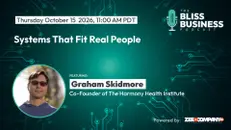
Too many systems ask people to fit into models that were never designed for the full range of human experience.
In health, wellness, and work, that can leave people feeling misunderstood, unsupported, or labeled as limited when what they really need is a more individualized path forward.
In this episode of The Bliss Business Podcast, we welcome Graham Skidmore, Co-Founder of Harmony Health Institute, for a conversation on Inclusive Innovation for the Future of Wellbeing.
Harmony Health Institute was created from lived experience and a belief that people are not broken — many of the systems meant to support them are simply incomplete. Graham has written about the need for systems that support individualized physiologies, especially for people who are neurodivergent or whose experiences do not fit neatly into traditional models.
Through Harmony Health Institute, Graham and his team are building a collaborative, whole-person care model designed to bring physical improvement, emotional healing, recovery support, and spiritual growth into one connected approach instead of leaving people to navigate scattered providers on their own.
In Systems That Fit Real People, we explore:
• Why inclusive systems begin by understanding individuality
• How neurodivergent and non-linear experiences can reshape health and work
• Why future-ready wellbeing models must move beyond one-size-fits-all care
• How leaders can design workplaces that support people as whole humans
• What it means to integrate healing, education, tools, and community
• Why innovation should restore power to people, not create more complexity
🎙️ Hosted by Stephen Sakach and Tullio Siragusa🎧 Produced by Martha Huerta
The future of wellbeing is not about forcing people into existing systems. It is about building systems flexible enough to honor how people actually live, work, heal, and grow.
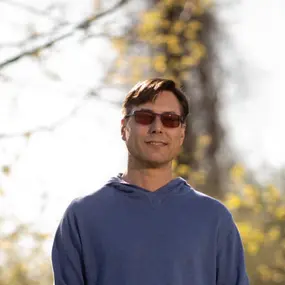
Co-Founder
Graham Skidmore is a former Rocket Mortgage executive turned entrepreneur, activist, and mystic. After reaching the traditional markers of success — six-figure income, the house, the car, the country club membership — he found himself burned out, miserable, and unfulfilled. That collapse became the catalyst for a deeper healing journey, one he now teaches as a cycle of personal growth: restoration of the genuine, authentic self and reclamation of the connection with the higher self — transforming life events from happening to us into happening for us.
Graham now works at the intersection of consciousness, healing, and human potential, building life-centric ecosystems — education, tools, community, and systems — that give people the infrastructure to understand themselves as beings of consciousness going through an experiential learning process that expands their consciousness, gifts, abilities, and wisdom. His work centers on providing power to the people, starting in the health and wellness space, and reflects his belief that technology, including AI, should be used to enrich human agency rather than replace it.
His broader mission is to build bridges that deepen our understanding of the human spectrum and experience — he sees this work as creating space for new ways of being to emerge during Earth's justice-through-restoration period, focused on living in alignment with the divine intelligent design. He believes that when individuals are truly supported, we can build a world of happy, healthy, productive, and empowered people.
