The Marketing Engine Only Scales When the Math and the Trust Both Work

A lot of businesses say they want marketing to drive growth, but what they often mean is that they want marketing to produce leads quickly, cheaply, and predictably. That sounds reasonable on the surface. But scalable growth is rarely that simple.
Because marketing does not become a revenue engine just because money is spent and leads appear.
It becomes a revenue engine when the economics are sound, the systems are aligned, and the people closest to the customer are equipped to convert trust into revenue. Without that full picture, a company can generate activity and still struggle to grow. It can buy visibility and still miss profitability. It can produce leads and still fail to create a model that works at scale.
That is why the conversation around revenue-driving marketing matters so much right now.
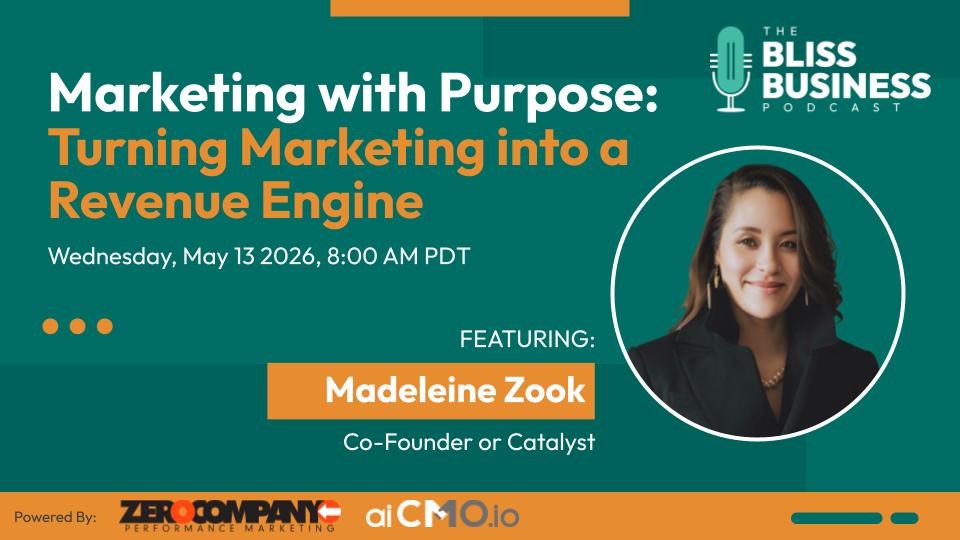
In a recent conversation with Madeleine Zook, Co-Founder of > CATALYST, on the Marketing with Purpose series of The Bliss Business Podcast, that reality came into sharp focus, and it kept coming back to math and trust. Madeleine brought a perspective shaped by deep franchise experience from multiple angles: franchisor, franchisee, operator, and advisor. Her message was practical and refreshingly direct: if marketing is going to function like a revenue engine, it cannot stay trapped in vague language. It has to be translated into a model. It has to be measurable. And it has to be built on more than top-of-funnel motion.
Because in the end, the brands that scale are not just the ones that market more.
They are the ones that understand how growth actually works.
Revenue Growth Starts by Asking a Better Question
One of the strongest ideas in this conversation is Madeleine’s insistence that “we need more marketing” is not a useful diagnosis.
That may be one of the most common and least helpful phrases in business.
When sales soften or growth stalls, many teams immediately assume the issue is simply lack of marketing. But marketing is not one thing. It is a system of decisions, channels, handoffs, messages, economics, behaviors, and conversions. Saying “we need more marketing” without understanding the underlying constraint is a little like saying “we need a car” without knowing whether you actually need a truck, a sedan, a bicycle, or a better map.
This is where smart growth work begins.
It starts by asking what is actually broken.
Is the cost per lead too high?
Is the conversion rate too low?
Are phone calls not being answered?
Are prices too low to sustain acquisition?
Are customers churning too quickly?
Is the brand too invisible locally to earn trust?
Is the traffic coming in, but the system failing after the click?
Those are very different problems.
And each one demands a different response.
Marketing becomes far more powerful when it stops being used as a catch-all label and starts being treated like a business system with specific pressure points.
Scalable Growth Is an Economic Model Before It Is a Campaign Plan
One of the most important insights Madeleine shares is that revenue-driving marketing has to start with the unit economics.
That is exactly right.
Before a company starts debating creative direction, brand refreshes, ad channels, or campaign volume, it needs to understand whether the current model can actually produce profitable growth. If the business has to spend more to acquire a customer than it can reasonably earn back, no amount of tactical sophistication will fix the underlying problem. The system is broken before the campaign even starts.
This is why her marketing revenue calculator mindset is so valuable.
It forces leaders to answer the uncomfortable but necessary questions:
What does a lead cost?
How many leads become qualified?
How many qualified leads become customers?
What is the average ticket size?
How long does the customer stay?
What level of investment actually produces the revenue target?
That kind of clarity changes the conversation.
It moves marketing away from opinion and toward operating truth.
It helps reveal whether the issue is really awareness, conversion, retention, pricing, or follow-through.
And it gives leaders a far better chance of investing in growth intelligently rather than emotionally.
Marketing Often Gets Blamed for Problems It Did Not Create
A particularly valuable theme in the conversation is that many apparent marketing problems are actually business model or operational problems in disguise.
This happens all the time.
A company sees weak growth and assumes the ad strategy is failing.
But maybe the sales team is not following up fast enough.
Maybe customer service is dropping the ball.
Maybe franchisees are not answering their phones.
Maybe the average order value is too low.
Maybe the retention model is weak.
Maybe the local trust signals are missing.
These are not abstract edge cases.
They are often the real reasons revenue stalls.
This is why the best marketing leaders have to think like business diagnosticians, not just campaign managers. They need enough visibility into the entire system to see where the real revenue leaks are. Otherwise, the business keeps trying to solve a downstream problem with upstream spend.
And that is one of the fastest ways to waste money while convincing yourself you are investing in growth.
The Local Trust Gap Is Becoming More Expensive
Another sharp point Madeleine makes is that one of the biggest friction points in franchising right now is trust at the local level.
That feels especially timely.
For a while, many brands were able to lean heavily on digital acquisition. Spend could be deployed, leads could be generated, and local relationships could sometimes be treated as secondary. But that environment is changing. Consumers are increasingly more skeptical, more selective, and more hesitant to trust faceless digital interactions at first glance. The appetite for local credibility, word-of-mouth, referrals, and recognizable community presence is growing again.
That is not just a branding observation.
It has major economic implications.
If digital leads are more expensive and trust is harder to earn online alone, then local market presence becomes more valuable. The franchisee or owner who knows how to be visible, referred, and embedded in the community has an advantage that paid spend by itself cannot fully replicate.
This is one reason scalable growth today requires more than strong media buying.
It requires stronger trust architecture.
And that architecture is often built through local relationships, reputation, responsiveness, and consistent visibility in the places where people already feel socially anchored.
The Market Has Changed Faster Than Some Operators Have
One of the most honest parts of Madeleine’s perspective is her observation that many business owners are still behaving as though the market works the way it did a few years ago.
That is understandable.
It is also dangerous.
Digital marketing during and just after COVID created certain habits. Many operators got used to the idea that they could sit behind a screen, spend into a few channels, and generate enough lead flow to keep things moving. But as the market has shifted, consumer behavior has shifted with it. Attention is more fragmented. Acquisition is more expensive. AI is changing discovery patterns. Trust has become more fragile. Local relevance matters more again.
Yet many owners still want the old machine to keep working the same way.
This is where advisors and CMOs earn their value.
Not by indulging outdated expectations, but by helping teams understand that the playbook itself may need to evolve. The world changed. The channel economics changed. The customer changed. The system now has to change too.
Expectation Setting Is One of the Most Underrated Revenue Skills
If there is one operational theme running throughout Madeleine’s perspective, it is that growth gets harder when expectations are loose, inflated, or misunderstood.
That is a major insight.
Many marketing failures are not truly failures of execution. They are failures of expectation management. Someone thought two percent of revenue spend would produce eight percent outcomes. Someone thought organic growth would keep rising despite structural changes in search behavior. Someone assumed the franchisee role, the agency role, and the leadership role were all operating from the same assumptions when they were not.
The result is confusion, blame, and slower growth.
Madeleine’s ACE structure—accountability, communication, and expectation—matters because it addresses this problem at the root. It forces the business to say clearly:
What are we actually doing?
What should happen next?
Who owns each handoff?
What benchmarks are reasonable?
What does success look like?
That level of clarity does not eliminate friction, but it does make friction much easier to resolve. And in scaling organizations, that matters enormously.
AI Is Not Just Changing Channels. It Is Changing Visibility Itself.
One of the most timely examples Madeleine shares is her recognition that AI-driven zero-click behavior is changing the role of websites, SEO, and organic expectations.
This is a major shift.
Consumers are increasingly getting summarized answers without needing to click through to the underlying site. That means some of the old assumptions around traffic growth, organic visibility, and the role of content are no longer as stable as they once were. Brands can still invest in authority, content, and discoverability, but they may not be rewarded in the same ways or on the same timeline as before.
This is exactly the kind of structural change that can quietly distort marketing expectations if leaders are not paying attention.
A brand may think the website team is underperforming.
The deeper reality may be that user behavior has changed at the platform level.
This is why scalable marketing leadership now requires more environmental awareness than ever. Teams have to know not only what they are doing, but what the market itself is becoming. That is the difference between optimizing an old system and actually preparing for the next one.
The Best Marketing Teams Make the Whole Business Smarter
Another strength in Madeleine’s approach is that she is not just trying to improve marketing outputs. She is trying to improve the business intelligence of the teams around her.
That is a crucial difference.
When she brings people into revenue models, teaches them how to see the funnel clearly, and helps them understand where the real operational levers are, she is doing much more than running campaigns. She is building strategic literacy. She is helping owners, leaders, and marketing teams think more clearly about how money actually moves through the business.
That is what strong CMOs and fractional leaders often do best.
They turn “marketing” from a foggy category into a set of understandable mechanics.
They create language leaders can use.
They create accountability teams can act on.
And they reduce the amount of guesswork that organizations mistake for decision-making.
Franchise Growth Is Ultimately About Protecting Someone’s Dream
The most human part of the conversation comes through when Madeleine reflects on what is really at stake in franchising.
Behind the revenue models, dashboards, and system-wide metrics are real people who have invested their lives into these businesses. They are not abstract units. They are owners, families, and operators who put capital, time, hope, and future plans into the system believing it can help them build something meaningful.
That perspective matters.
It changes how decisions are made.
It changes how crises are approached.
And it changes how marketing should be understood.
Because if marketing affects whether those owners get leads, whether they stay profitable, whether they expand, and whether they keep the doors open, then marketing is not a brand-support function. It is part of how those dreams are protected or lost.
That is one reason the work matters so much.
And it is one reason empathy belongs in the room right alongside the spreadsheets.
Key Takeaways
“We need more marketing” is not a diagnosis. Growth starts with identifying the actual barrier, not just increasing activity.
Scalable growth begins with unit economics. If the underlying model does not work, better campaigns will not fix it.
Many marketing problems are really operational problems. Weak conversion, poor follow-up, low pricing, or churn can all look like lead issues from a distance.
Local trust matters more again. As acquisition costs rise and digital skepticism grows, community presence and credibility are becoming more valuable.
Expectation setting is a revenue skill. Clear assumptions, benchmarks, and handoffs reduce friction and improve execution.
AI is changing discoverability. Teams need to revisit old assumptions about organic growth, websites, and visibility.
Franchise systems are built around real people’s stakes. Marketing decisions affect owners’ livelihoods, not just dashboard outcomes.
Final Thoughts
What this conversation with Madeleine Zook, Co-Founder of > CATALYST, makes clear is that turning marketing into a revenue engine is not about making marketing louder.
It is about making it clearer.
Clearer in what problem it is solving.
Clearer in what numbers actually matter.
Clearer in where the model is leaking.
Clearer in how local trust is built.
And clearer in how growth gets repeated without depending on guesswork.
That is what makes marketing scalable.
Not just creativity.
Not just spending.
But a system strong enough to turn attention into trust, trust into conversion, and conversion into durable revenue.
Where to Go Next
Listen to the full conversation: Marketing With Purpose Kit: Turning Marketing into a Revenue Engine.
Watch the video: Madeleine Zook on local marketing trust.
Meet Madeleine on her guest profile.

Guest Development | Producer | Blog Contributor
Martha is a connector who brings over two decades of experience in engineering, sustainability, education, and public relations. She is part of the integrated go-to-market team at Zero Company and serves as Guest Development Lead for The Bliss Business Podcast, where she connects with purpose-driven leaders to shape meaningful conversations. Martha also produces the Marketing With Purpose Kit segments with CMO guests.
Her career includes founding nonprofits, and speaking at global forums in Malaysia, Dubai, and Paris. A passionate community builder, Martha also mentors women entrepreneurs and supports environmental initiatives across Mexico and the U.S. Her work reflects a deep commitment to impact, inclusion, and authentic leadership.

Starting Over Deserves Community