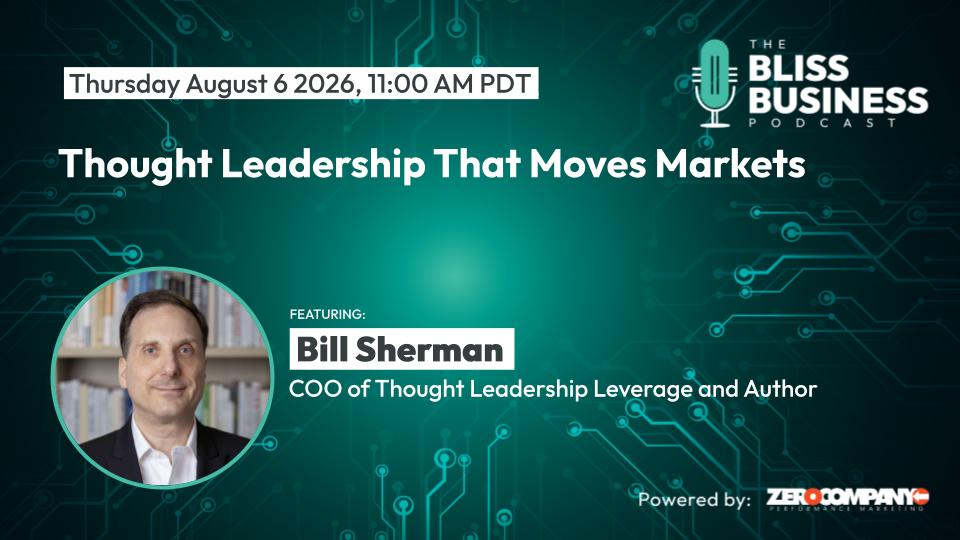
Thought Leadership That Moves Markets

Every business has ideas.
Some live in slide decks. Some live in strategy documents. Some live in the minds of founders, executives, consultants, and operators who have spent years learning what works. But not every idea creates impact.
For an idea to change how people think, it has to move. It has to be expressed clearly, carried by others, supported by systems, and offered generously enough that the right people can recognize its value.
On The Bliss Business Podcast, we sat down with Bill Sherman, COO of Thought Leadership Leverage, co-host of the Leveraging Thought Leadership podcast, and lead author of The Thought Leadership Handbook. Bill's guiding belief, that sharing expertise builds trust before it builds revenue, has shaped years of work helping executives, authors, consultants, and organizations turn that expertise into ideas that scale. His work focuses on helping leaders evaluate, systematize, and share ideas in ways that create impact and generate business value.
His message was clear: expertise alone is not enough. If leaders want their ideas to create change, they have to learn how to move those ideas through the world.
Ideas Need To Travel
One of Bill’s core beliefs is that leaders should give away their best ideas.
That can feel risky. Many companies, especially in professional services, worry that their expertise is the crown jewel. They fear that if they give too much away, clients will no longer need them.
Bill sees the bigger risk differently.
If leaders hold their ideas too tightly, the ideas do not travel. If ideas do not travel, they do not shape conversations, open doors, influence markets, or help the people who need them.
Thought leadership begins with generosity because generosity gives the idea a chance to move.
When people encounter a useful idea, they can evaluate it, remember it, share it, apply it, and eventually come back when the timing is right. That is how an idea creates impact beyond the person who originally expressed it.
Keeping Ideas Close Limits Their Power
Bill shared the example of Kara Goldin, founder of Hint Water.
Hint Water began as a fruit-infused water company without preservatives. At one point, Kara was so committed to the idea that she was nearly willing to give it away to Coca-Cola because she believed so strongly that the market needed a healthier alternative. The response she received was that it could not be done without preservatives.
But the story behind the product became part of what helped the brand travel.
People began telling the story themselves: the founder created it in her kitchen, built it around health and wellness, and refused to rely on artificial flavoring or preservatives. That story allowed others to carry the idea forward.
That is the power of making an idea simple enough and generous enough for others to repeat.
If people cannot explain your idea without you in the room, it has not yet become thought leadership.
Thought Leadership Is Not Just Content Marketing
Bill made an important distinction between thought leadership and content marketing.
Content marketing often supports the funnel. It helps educate prospects, generate leads, answer questions, and move people through a buying journey. That work matters, but thought leadership plays a different role.
Thought leadership is about taking an idea to scale to create impact for a specific audience. It starts from generosity and invites people to encounter, evaluate, and potentially use the idea. Over time, some of those people may self-select into a deeper business relationship because the idea earned their trust before a sales conversation ever began.
That is why thought leadership can open doors that traditional sales cannot.
A strong idea can get leaders into rooms, conversations, and relationships where a sales pitch would be ignored.
The Best Ideas Are Provocative and Generous
Bill described four elements of a core idea.
First, it has to be provocative. Not sensational, not gimmicky, not inflammatory for attention alone. But it must interrupt people enough to make them pause and say, “Tell me more.”
That matters because people make rapid decisions about what deserves their attention. A slow windup will not work in a noisy environment. A core idea has to signal quickly that it is relevant to the right audience.
Second, the idea has to be generous. It is not enough to say something is broken. Thought leadership has to offer people some sense of a better way. It does not need to reveal every detail or solve everything at once, but it must provide enough value to create hope and direction.
That combination is powerful.
Provocation gets attention. Generosity earns trust.
Distinctive Ideas Sound Like You
Bill’s third requirement for a core idea is distinctiveness.
An idea should sound like the person or organization behind it. It should not sound like everyone else in the category. It should not sound like generic AI-generated business language. It should carry a point of view, a voice, and a recognizable way of seeing the world.
That is especially important now.
AI can generate more content than ever, but more content does not mean more clarity. If everyone sounds the same, the market has no reason to care. Distinctive thought leadership helps people understand why this idea, this leader, and this organization deserve attention.
The goal is not to sound polished.
The goal is to sound true.
A Core Idea Has To Be Short
Bill’s fourth requirement is that a core idea should be 20 words or fewer.
That does not mean the idea is shallow. It means the entry point must be simple enough for people to remember, repeat, and share.
The purpose of a core idea is not to explain everything. It is to get someone interested enough to ask for more.
A long explanation can follow. A book can follow. A keynote can follow. A consulting engagement can follow. But the doorway into the idea has to be clear.
If people cannot repeat it, they cannot carry it.
Ideas Need Velocity
Thought leadership depends on velocity.
Bill described velocity as coming from two sources: you and not you. The first is what the originator does to share the idea. That might include writing, speaking, podcasting, publishing, teaching, or presenting.
But the more powerful form of velocity happens when others begin carrying the idea.
They recommend the book. They quote the concept. They share the episode. They bring it into a meeting. They tell a colleague, “You need to look at this.”
That is when thought leadership begins to scale.
No individual has enough time to personally reach everyone. The idea has to become portable enough for others to move it.
Impact Requires Simplicity, Relevance, and Audience Focus
Bill shared that impact comes from simple ideas that signal relevance to a specific audience.
That specificity matters. Many leaders want their ideas to be for everyone. But when an idea is for everyone, it often becomes too broad to be useful. It loses sharpness. It loses urgency. It loses emotional pull.
Strong thought leadership narrows the audience.
Who needs this idea most?
Who is facing the problem now?
Who is ready to hear it?
Who can use it?
Who will recognize its value?
The more clearly a leader defines the audience, the more precisely the idea can be expressed.
Thought leadership is not about reaching the most people. It is about reaching the right people.
You Do Not Need a Massive Platform
For small teams or leaders without a large platform, Bill’s advice was practical.
Do not start by chasing a massive audience. A large audience filled with the wrong people can waste energy. Instead, identify where the right audience already gathers.
That might be industry associations, podcasts, niche newsletters, conferences, communities, customer groups, or specialized media. The goal is to borrow attention from trusted spaces where the audience already exists.
That is a smarter strategy than trying to build an audience from scratch.
Start where the conversation is already happening, then add something valuable enough that people want to continue the conversation with you.
Test the Idea Before Going Big
Bill compared idea development to theater: off-off-Broadway, off-Broadway, and Broadway.
Do not start with the biggest stage. Start by testing the idea in smaller rooms where feedback can help shape it. Listen for what people repeat. Notice where they lean in. Watch what confuses them. Pay attention to the questions they ask.
That early testing helps refine the idea before it reaches a larger audience.
A thought leader does not simply declare an idea finished. They develop it in conversation with the market.
The best ideas become clearer as people interact with them.
AI Can Help, But It Cannot Own the Idea
AI can play a useful role in thought leadership, but Bill warned against outsourcing the work of originality.
AI can help test language, evaluate whether a message may resonate with a target audience, identify obvious gaps, and provide early feedback. But it should not be handed the responsibility for creating the thought leadership itself.
Why?
Because AI tends to generate from what has already been said. It can summarize the average of existing conversation, but thought leadership is supposed to move the conversation forward.
If leaders rely too heavily on AI, their work can lose distinctiveness. It may sound polished but generic. Useful, but not ownable. Relevant, but not original.
AI can support the process.
The leader still has to bring the insight, conviction, and point of view.
Introverts Can Be Powerful Thought Leaders
One audience question asked how introverted leaders can share ideas effectively.
Bill’s answer was encouraging: introverts can be powerful thought leaders when they find the idea that energizes them enough to speak.
They do not need to become extroverts. They do not need to love networking events, dinners, mixers, or constant visibility. But they do need to care deeply enough about the idea to advocate for it.
That spark matters.
People can hear whether a leader believes what they are saying. Employees can hear it. Customers can hear it. Audiences can hear it. If the leader is not energized by the idea, others will not be either.
For introverts, the path is not performance. It is conviction.
Content Insecurity Holds Ideas Back
Bill introduced an important phrase: content insecurity.
Imposter syndrome asks, “Do I belong in this room?”
Content insecurity asks, “Are my ideas good enough? Have they already been said? Are they worth someone’s time?”
This insecurity keeps many experts silent. They assume that because something feels obvious to them, it must already be obvious to everyone else. But that is often not true. Their insight may be exactly what someone else needs, expressed in the right way at the right time.
Ideas cannot speak for themselves.
Experts have to advocate for them.
Good Ideas Still Need Champions
Bill made a point that deserves to be remembered: there are many good ideas sitting unused in books, academic libraries, business archives, and private notebooks.
The issue is not always idea quality. The issue is whether anyone is actively advocating for the idea.
Ideas need champions. They need people willing to explain them, repeat them, refine them, defend them, and make them useful for others.
That is the work of thought leadership.
It is not only having the idea.
It is taking responsibility for its movement.
Love in Business Means Sharing What Helps
When asked what role love should play in business, Bill answered simply: everything.
He connected that answer to the work of Tim Sanders and the book Love Is the Killer App, which shaped his own thinking early in his career. The framework Bill referenced is powerful: share your knowledge, share your network, and show compassion.
That is a practical definition of love in business.
It is not vague sentiment. It is action.
Share what you know. Connect people who can help each other. Show care for the person in front of you. Build relationships without treating every interaction as an invoice waiting to happen.
That kind of generosity builds trust over time.
Relationships Are Like Muscles
Bill also shared the idea that relationships are like muscles. They get stronger when they are used.
That means relationships should not be treated as static assets to be protected or hoarded. They grow through generosity, introductions, support, follow-through, and mutual care.
In thought leadership, this matters because ideas often travel through relationships. Someone shares your work because they trust you. Someone invites you into a room because you helped them before. Someone recommends your book because they believe the idea matters and they believe in the person behind it.
Thought leadership is not only an intellectual practice.
It is relational.
The World Needs More and Better Thought Leaders
Bill closed with a strong reminder: the world needs more and better thought leaders.
The public square will not become quiet if experts stay silent. Social media will not pause. Bad ideas will not wait. Generic advice will not disappear.
That means people with real expertise have a responsibility to speak clearly and generously.
Thought leadership is not about ego when done well.
It is about service.
It is about helping an audience think better, prepare better, decide better, and see a better path forward.
Key Takeaways
-
Expertise alone is not enough. Ideas have to move if they are going to create impact.
-
Giving away strong ideas can build trust, attention, and business value.
-
Thought leadership is different from content marketing because it is about taking an idea to scale for a specific audience.
-
A strong core idea should be provocative, generous, distinctive, and short enough to repeat.
-
Ideas gain velocity when other people start sharing them without the originator in the room.
-
Small teams do not need a massive platform. They need to reach the right audience in the right places.
-
AI can support thought leadership, but it should not replace original insight, voice, or conviction.
-
Introverted leaders can be effective thought leaders when they find ideas that genuinely energize them.
-
Content insecurity often keeps good experts from sharing ideas that others need.
-
Love in business means sharing knowledge, sharing networks, and showing compassion.
Final Thoughts
Bill Sherman’s perspective is a reminder that thought leadership is not about sounding smart.
It is about moving ideas in a way that creates value for others.
The best thought leaders are not simply experts. They are advocates for ideas that deserve to travel. They know how to make those ideas clear, memorable, relevant, generous, and useful. They understand that impact depends not only on what they know, but on whether others can understand it, trust it, repeat it, and apply it.
In a noisy world, good ideas need champions.
And when leaders share their ideas with clarity and generosity, they do more than build visibility.
They move markets.
Where to Go Next
Watch the full conversation on video, or meet Bill Sherman on his guest profile. When leaders share what they know instead of guarding it, expertise turns into trust before a single pitch is made.
Check out our full conversation with Bill Sherman on The Bliss Business Podcast.

Executive Producer | Host | Blog Contributor
Tullio Siragusa is a strategic advisor, dynamic speaker, author, and EQ coach with 36 years of experience as a technology disruptor rooted in Design Thinking. Since 2018, he has been creating, producing and hosting live podcasts, interviewing over 1,000 C-suite executives across a wide range of industries. His work behind the mic reflects his larger mission: using conversation as a catalyst for human-centric innovation.
Tullio’s commitment to purpose-driven leadership and ethical transformation is reflected in his advisory roles at the University of California, Riverside’s Design Thinking Executive Program, and the University of San Francisco School of Management’s Digital Marketing Program. As a Board Advisor at AI2030.org, he helps guide the responsible advancement of AI toward ethical and sustainable outcomes. A founding member of RadicalPurpose.org, Tullio believes empathy isn’t just a trait, it’s a non-negotiable foundation for leadership.

Belonging Is a Business Strategy