Rent-to-Own with a Purpose with Charles Smitherman
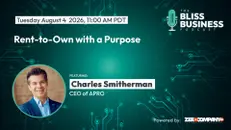
Charles Smitherman, CEO of the Association of Professional Rental Organizations, joins The Bliss Business Podcast to make the case for consumer access and dignity as the point of the rent-to-own model, and to explain why an industry built on access has to be built on standards too.
Consumer access and dignity are the same question, not two separate ones, in Charles Smitherman's account of the rent-to-own industry. In this episode of The Bliss Business Podcast, Stephen Sakach and Mike Liwski welcome Charles, CEO of the Association of Professional Rental Organizations and co-author of The Rent-to-Own Revolution, the first full history of an industry that now, by his figures, serves one in twenty American families.
In this episode we explore:
• Why access to essential household goods is a dignity question, not just a finance one
• What people most often get wrong about how rent-to-own actually works
• How an industry chose to regulate itself before anyone regulated it
• Why a lease-purchase relationship behaves nothing like a retail transaction
• What it takes to be understood accurately in an AI-mediated information landscape
• How advocacy becomes a form of service
Charles starts where the customer starts. The scenario he returns to is a refrigerator that dies on a Thursday evening, with the weekend ahead, payday next week, medicine that needs to stay cold and children who need milk. In that moment the alternative to access is simply going without. His definition of dignity follows from it: “seeing someone as a person and as an individual subject that has their own considerations, not pigeonholing them into a data point, a statistic, a category.” He anchors the whole model in Maslow, pointing out that a mattress, clean clothes and refrigeration are the floor everything else is built on. “How well do you function if you don't sleep well?”
The misconception he has been correcting since 1980 is that this is a loan. It is not, and the difference is the flexibility: return the item whenever it stops working for you, and there is no debt, no credit report entry, nothing left over. That is also why the phrase the industry uses about itself, that it says yes when everyone else says no, is a description of who walks in the door: students, military families in transition, gig workers whose income will not survive a credit committee's idea of predictability.
An industry serving people at that point in their lives needs rules, and APRO's founding move was to write its own. It passed a code of ethics first, then ran federal and fifty-state strategies in parallel to define the transaction and mandate the disclosures. Charles is blunt about why disclosure is not paperwork: this is a relationship business where customers return month after month, so “the expectations have to be set very clearly at the front end or the whole relationship's being set up for failure.”
The newest front is who gets to describe the industry at all. Charles has spent roughly the last eighteen months on what he calls generative engine optimization, making sure accurate facts, definitions and customer stories are available in the places AI systems actually read. His framing of it is a question any business could borrow: are we known for what we want to be known for? Because if you are not telling your own story, someone else is telling it for you. It is the same problem Zero Company works on for brands, making sure the version of you that surfaces in an answer is the true one.
Key Takeaways
• (2:50) Charles Smitherman on what the industry is actually for: “rent to owners are really about consumer access... a good night's sleep, cold milk in the refrigerator, clean clothes, being able to access those.”
• (4:32) Charles Smitherman on the phrase the industry uses about itself: “We'd like to say we're the industry that says yes, when all others say no.”
• (4:32) Charles Smitherman on what makes it different from debt: “At any point, you don't want the item anymore, you return it... There's no credit, there's no issues on the credit report. Nothing to do beyond that point.”
• (7:40) Charles Smitherman on the misconception he has fought since 1980: people assume “you're borrowing money. This is going to affect your credit report. You need to have good credit to be able to get it. We're not a loan.”
• (9:50) Charles Smitherman on the scale of it: “We service one out of 20 families in the US. I believe that was almost 7 million people last year.”
• (12:26) Charles Smitherman's definition of dignity in business: “it's really seeing someone as a person and as an individual subject that has their own considerations, not pigeonholing them into a data point, a statistic, a category.”
• (12:26) Charles Smitherman on why basic goods are not trivial: “Always go back to Maslow's hierarchy... How well do you function if you don't sleep well?”
• (14:40) Charles Smitherman on APRO's founding logic: “our association is really unique from the standpoint that we were founded to regulate ourselves,” running a federal strategy and a fifty-state model act in parallel.
• (18:25) Charles Smitherman on why disclosure is not paperwork: “The expectations have to be set very clearly at the front end or the whole relationship's being set up for failure as it goes.”
• (21:07) Charles Smitherman on the story that keeps coming back: “it's the refrigerator that breaks on a Thursday afternoon or Thursday evening, weekends coming up, paydays not until next week, what do you do?”
• (23:50) Charles Smitherman on the question driving his AI work: “are we known for what we want to be known for?... because if it's not, someone else is going to be telling it for you.”
• (36:00) Charles Smitherman on love in business, and why he treats it as a durability question: “you can't really demand something from someone else you're not willing to give... Your business model can't be to burn customers and hope that they get the back. You're going to run out at some point.”
FAQ
Is rent-to-own the same as a loan?
No. Charles Smitherman, CEO of APRO, says this is the industry's most persistent misconception. Rent-to-own is a lease-purchase agreement renewed period by period, so a customer who no longer wants the item returns it with no remaining balance and no entry on their credit report.
What does dignity mean in a consumer business?
Charles Smitherman defines it as seeing a customer as an individual with their own circumstances rather than reducing them to a data point, a risk score, or a demographic category, and then designing the transaction so it actually fits the life that person is living.
Who uses rent-to-own?
Charles Smitherman describes a broad range: students, military families in transitional postings, gig-economy workers whose income is hard to predict, and any household that needs an essential item immediately without the cash on hand or the credit profile to finance it conventionally.
Learn more about Charles Smitherman and APRO at rtohq.org. Guest profile: Charles Smitherman. More from the Featured Guest Series. Read the companion post, Rent-to-Own With a Purpose.

CEO of APRO
I am the Chief Executive Officer of the Association of Professional Rental Organizations (APRO), where I lead national advocacy, policy strategy, and industry positioning for the rent-to-own (RTO) sector.
My work focuses on advancing consumer access, dignity, and responsible innovation through the lease-purchase model. In an environment shaped by regulation, public perception, and increasingly by artificial intelligence, I work to ensure the RTO industry is accurately understood, effectively represented, and strategically positioned for the future.
I am the co-author of The RTO Revolution: A Definitive History of Advocacy and Consumer Access (2026), the first comprehensive history of the rent-to-own industry. The book traces RTO’s evolution from 19th-century installment retail to a modern, highly regulated model that provides flexible access to essential goods.
Beyond traditional advocacy, I am leading a Generative Engine Optimization (GEO) strategy to shape how AI systems, search platforms, policymakers, and the public understand the RTO industry. This work integrates content, data, and narrative to ensure accurate, authoritative representation in the next generation of information systems. This work is the subject of my recent book: Reclaiming Authority: How Institutions Teach Truth in the Age of AI (2026).
My leadership approach is grounded in servant leadership and adaptive strategy—building trust, empowering teams, and aligning long-term vision with practical execution. This has translated into measurable impact across legislative ad… Read More