The Growth Brands Win Is Usually Clarity

Growth is often treated like a speed problem.
How do we move faster?
How do we scale quicker?
How do we launch more?
How do we capture demand now?
But in many organizations, growth does not stall because the team is too slow. It stalls because the organization is not clear enough. Leaders are chasing different outcomes. Marketing is optimizing one thing while finance is guarding another. Sales, product, and customer teams are interpreting the customer through separate lenses. The result is not just friction. It is wasted motion.
That is why clarity matters so much, and why strategic clarity in marketing is what separates real progress from expensive motion.
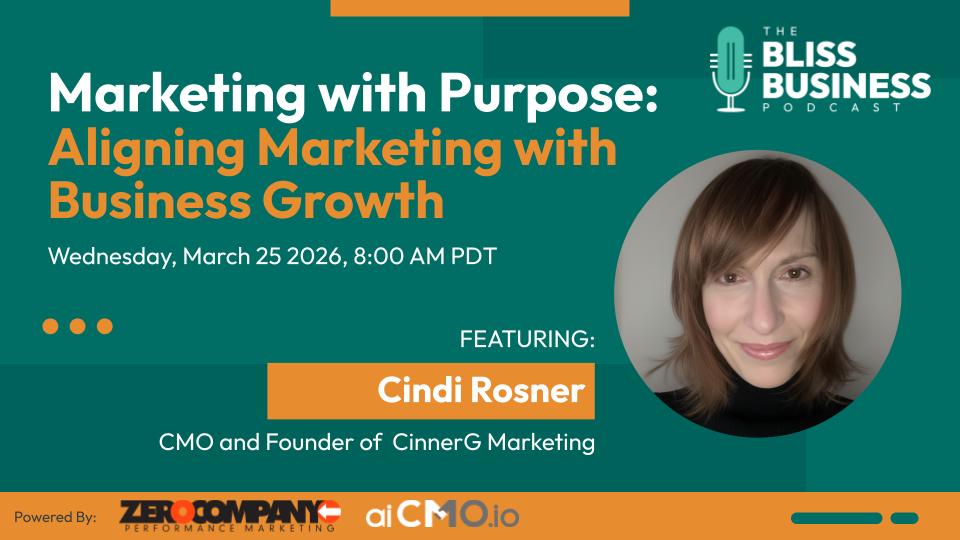
In a recent conversation with Cindi Rosner, Fractional CMO of CinnerG Marketing, on the Marketing with Purpose series of The Bliss Business Podcast, that idea came through with precision and depth. Cindi brought a perspective shaped by entrepreneurial work, private-equity-backed growth environments, and a strong belief that emotional intelligence is still one of the most overlooked drivers of business performance. Her message was both practical and timely: the companies that are winning right now are not necessarily the loudest or the fastest. They are the ones most aligned around what truly drives growth.
And that alignment starts with clarity.
Growth Gets Harder When Everyone Is Solving for Something Different
One of the strongest insights in this conversation is that friction rarely comes from effort alone. It often comes from misaligned incentives.
Cindi described a reality many marketing leaders know well: the CMO, CEO, and CFO may all care about growth, but they are often approaching it from different vantage points. One is thinking about long-term positioning. One is thinking about top-line ambition. One is thinking about cost, capital, and risk. If those perspectives are not actively aligned, marketing gets pulled into contradictory expectations almost immediately.
That creates drag.
Because then the question is no longer just, “What should marketing do?” It becomes, “Which definition of success are we being asked to serve right now?” And if that answer keeps changing quarter to quarter, what the company has is not a strategy. It has a reaction pattern.
That is one reason Cindi’s emphasis on clarity feels so essential. Alignment is not just about agreeing that growth matters. It is about agreeing on what kind of growth matters, how it will be recognized, and what tradeoffs the business is actually willing to make in pursuit of it.
Brand Without Outcomes Is Hard to Defend. Performance Without Brand Is Hard to Sustain.
Another valuable thread in the episode is Cindi’s framing of the tension between brand building and performance marketing.
This is one of the oldest tensions in the discipline, but it keeps returning because it still creates real pressure inside organizations. Leaders want pipeline now. Marketers know that brand compounds slowly. Finance wants evidence. Strategy wants patience. The whole thing can feel like a negotiation between urgency and endurance.
Cindi’s answer is both clear and important: these are not two unrelated jobs. They are two parts of the same system.
Performance marketing harvests demand.
Brand creates the conditions that make demand more durable, more efficient, and more likely to recur.
Without brand, a business can end up over-relying on tactical acceleration and promotion-driven growth. That may work in bursts, but it often becomes unstable over time. Cindi described this as a kind of “growth on crack,” which is a sharp and memorable way to put it. It may create quick spikes, but eventually the whole system weakens if the deeper brand equity is not being built alongside it.
That is why strong growth strategy requires both conviction and discipline. It needs enough patience to let brand work accumulate and enough rigor to connect that brand investment back to meaningful business outcomes executives can understand.
In a Crisis, the Best First Move Is Often to Slow the Room
When the conversation turned to pressure and crisis, Cindi offered one of the most useful leadership ideas in the episode: slow the room.
That is such a powerful phrase because it runs against the instinct many leaders feel under stress. When things go sideways, the reflex is often to speed up, react harder, do more, and answer faster. But panic rarely produces good strategy. It produces noise.
Cindi’s point is that pressure and panic are not the same thing.
Pressure can be handled.
Panic erodes judgment.
This is where emotional intelligence becomes a real business advantage. It allows a leader to notice when a room is moving too fast to think clearly, and then create just enough pause for better decisions to become possible. That might mean ten minutes. It might mean one deep breath. But the act of slowing down just enough to think clearly can change the quality of the entire response.
This is not passive leadership. It is disciplined leadership. It is what allows people to distinguish between what is actually happening, what is merely being feared, and what the customer or business truly needs next.
Empathy Is Not Soft. It Is a Faster Way to Find the Real Problem.
Another strong theme in the episode is Cindi’s description of empathy as signal detection.
That is a beautiful way to put it.
Too often, empathy in business is spoken about as tone, niceness, or emotional sensitivity in a general sense. But Cindi sharpens the concept by connecting it directly to decision quality. Empathy helps leaders notice what is really going on beneath the surface. It helps reveal the emotional truth, the customer tension, the human hesitation, or the internal disconnect that pure metrics may not explain.
In other words, empathy helps the business get to the real signal faster.
That makes it highly strategic.
Because if the company ignores those signals, it is not becoming more rational. It is becoming more likely to make bad decisions quickly. Empathy slows the rush to false certainty and improves the quality of what the organization notices in the first place.
In crisis, that matters.
In go-to-market strategy, it matters.
In messaging, talent, retention, and customer experience, it matters.
Alignment Breaks Down Most Easily in the Gaps Between Teams
When asked about launching products and entering markets, Cindi described something many growth organizations underestimate: teams do not fail because they lack a kickoff meeting. They fail because alignment was never built deeply enough to survive complexity.
This is especially true across sales, product, customer success, and marketing.
Product may be building in one frame.
Sales may be speaking in another.
Marketing may be positioning from yet another.
Customer success may inherit the gap once the customer arrives.
That is a dangerous pattern because every function may feel like it is doing its job while the customer experiences the inconsistency all at once.
Cindi’s answer is rooted in transparency, shared KPIs, constant questioning, and collaborative retrospectives. That is exactly right. Alignment is not a one-time event. It is a system of shared interpretation. Teams need to know not just what they are doing, but how their function connects to the rest of the customer journey and where they may be creating friction for someone else downstream.
This is where silos become expensive. They do not just weaken culture. They distort outcomes.
Data Tells You What Happened. Intuition Helps You Ask the Better Question.
One of the most memorable examples in the conversation came from Cindi’s work on a slipcover business.
On the surface, slipcovers might not sound like the most emotionally revealing category in the world. But the example proves something important: almost any category becomes more powerful when the marketer sees the emotional logic inside the purchase.
What the data initially revealed was that customers cared intensely about fit. That mattered. But intuition helped expose something deeper. This was not only about utility. It was about how people wanted their space to feel. It was about making furniture feel styled, refreshed, and more emotionally satisfying without having to replace it.
That insight changed the positioning.
Instead of treating the product like a practical cover, the brand began to speak more like “fashion for your furniture.” That is a meaningful shift. It turns a functional category into an identity category. It shows what happens when data points are translated through emotional insight rather than left as purely technical observations.
Cindi’s line here is especially useful: data tells you what is happening, intuition helps you understand why.
That is not an argument against analytics.
It is an argument for pairing analytics with human interpretation.
Revenue Engines Are Built Across the Whole Funnel, Not Just the Top
Another important section of the conversation focused on what it actually means to turn marketing into a revenue engine.
Cindi’s answer is refreshingly complete.
She points out that too many teams over-focus on acquisition as if growth begins and ends with the top of the funnel. But real revenue durability depends on much more than that. It depends on conversion, retention, reactivation, and how the brand behaves all the way across the customer lifecycle.
That is exactly right.
Acquisition gets the attention because it is often the most visible or exciting piece. But if the business is only acquiring and not retaining, or only converting and not understanding why people return, then the revenue system is incomplete. It may grow for a time, but it will be unnecessarily expensive, fragile, or inconsistent.
This is where empathy sharpens revenue strategy too. Because understanding why someone enters the category, what emotional or practical problem they are trying to solve, and what keeps them engaged after the first interaction creates much better marketing than a narrow acquisition mindset ever could.
Most CRM Systems Are Capable of More Than the Business Is Asking of Them
Cindi also offered a valuable perspective on CRM and customer understanding.
Her point is not that most businesses lack tools. It is that they often underuse the tools they already have or use them in overly simplistic ways. Systems get filled with segments, labels, and broad classifications, but they are not always organized around the real strategic question: how do we understand the customer well enough to create more meaningful, timely, one-to-one communication?
That is where the opportunity is.
Cindi started her career in database marketing, and that experience shows. She understands that the real value of CRM is not the software itself. It is what the business chooses to learn from it. When used well, CRM can reveal the key decision points, the behavioral patterns, the friction zones, and the opportunities to communicate in ways that feel relevant rather than generic.
But that requires intent.
It requires strategy.
And it requires enough clarity to know what the business is actually trying to understand, not just what fields the platform happens to offer.
People Perform Better When They Know Why Their Work Matters
When the conversation turned to leadership and team development, Cindi returned to a theme that is just as important internally as it is externally: context matters.
She made the point that people stay more engaged when they understand the bigger picture, when they know how their work fits into the company’s goals, and when they are trusted to use their judgment inside that framework. That is exactly right.
Too many leaders either micromanage or stay too distant. The result is the same: people feel disconnected from meaning.
Cindi’s approach is more developmental. Teach people to think strategically. Help them understand their strengths. Give them room to execute. Offer the “why,” not just the task. That is how you build better marketers and better decision-makers.
And it is one of the clearest ways to retain strong talent.
Because as she noted, people do not usually leave because the work is hard. They leave because the environment is chaotic, overcontrolled, or unclear. They leave when they cannot see how they are growing.
This is where emotional intelligence matters in management too.
Not as softness.
But as clarity, trust, and space.
Great Marketing Often Feels Personal Long Before It Feels Transactional
The personal story Cindi shared near the end of the episode is one of the strongest reminders of what purpose-driven marketing can actually do.
A friend, after finishing chemo and needing a fresh emotional environment without the budget for a full furniture replacement, had purchased a slipcover. It shifted how the room felt. It gave her a different atmosphere to live in at a moment when that mattered deeply. And it turned out the campaign that influenced that decision had been shaped by Cindi.
That is a powerful example because it shows what great marketing often does at its best.
It is not merely moving product.
It is altering an experience.
It is making life feel a little more livable, a little more beautiful, a little more possible.
That is why emotional intelligence matters so much in the work. Because behind almost every purchase is not just a transaction. There is a context, a mood, a need, a hope, or a moment of change that the brand may never fully see unless it takes the time to listen.
Key Takeaways
Growth alignment starts with clarity. Teams cannot scale effectively if leadership is solving for different definitions of success.
Brand and performance must reinforce each other. Short-term tactics without long-term brand investment create fragile growth.
In crisis, slowing down can improve speed later. Emotional intelligence helps leaders distinguish pressure from panic.
Empathy improves decision quality. It helps detect real signals faster and prevents the business from reacting blindly.
Cross-functional alignment has to be built continuously. Shared KPIs, shared narratives, and transparent collaboration matter more than kickoff meetings alone.
Data and intuition need each other. Analytics reveal what happened; human insight helps explain why it mattered.
Revenue engines are lifecycle systems. Acquisition alone is not enough without conversion, retention, and reactivation working together.
Final Thoughts
What this conversation with Cindi Rosner, Fractional CMO of CinnerG Marketing, makes clear is that aligning marketing with business growth is not mainly about better dashboards or louder tactics.
It is about building a company that knows what it is solving for.
That requires strategic clarity.
It requires emotional intelligence.
It requires the discipline to listen before reacting.
And it requires enough alignment across the business that marketing can stop performing in isolation and start working as part of a real growth system.
Because the brands that grow best are rarely the ones doing the most at once.
They are the ones clear enough to know what matters, empathetic enough to hear the right signals, and disciplined enough to build from there.
Where to Go Next
Hear the full conversation: Marketing With Purpose Kit: Aligning Marketing with Business Growth, with Cindi Rosner.
Watch the episode: Data and Intuition in Marketing, with Cindi Rosner.
More about the guest: Cindi Rosner.
More from the Marketing With Purpose Kit.
Strategic clarity in marketing is not knowing more than the competition. It is knowing what the whole company is solving for, so nobody has to guess which number to optimize.

Guest Development | Producer | Blog Contributor
Martha is a connector who brings over two decades of experience in engineering, sustainability, education, and public relations. She is part of the integrated go-to-market team at Zero Company and serves as Executive Producer and Guest Development Lead for The Bliss Business Podcast, where she connects with purpose-driven leaders to shape meaningful conversations. Martha also produces the Marketing With Purpose Kit segments with CMO guests and the ETF Marketing show.
Her career includes founding nonprofits, and speaking at global forums in Malaysia, Dubai, and Paris. A passionate community builder, Martha also mentors women entrepreneurs and supports environmental initiatives across Mexico and the U.S. Her work reflects a deep commitment to impact, inclusion, and authentic leadership.

Culture Becomes Real When It Becomes a System