Marketing With Purpose Kit: Aligning Marketing with Business Growth
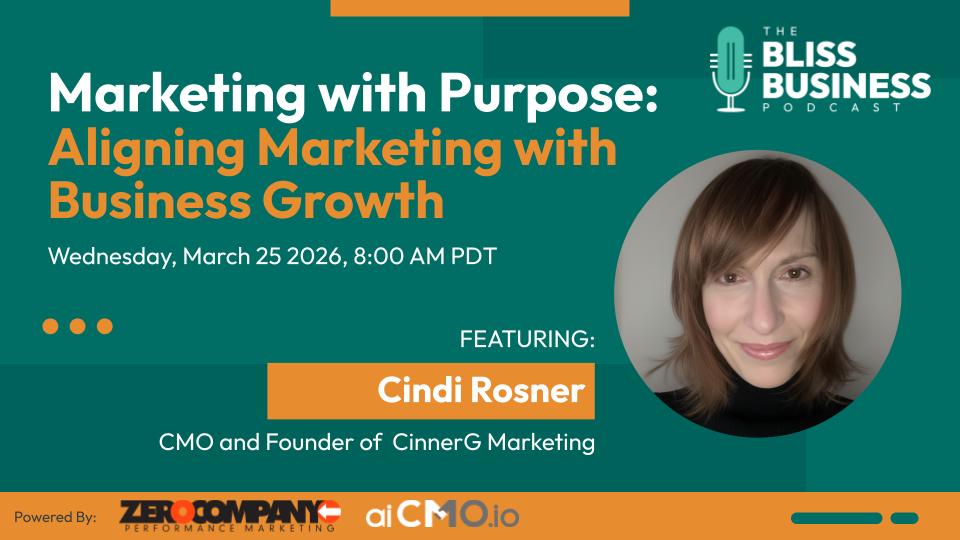
Cindi Rosner, CMO and Founder of CinnerG Marketing, joins the Marketing With Purpose Kit to argue that emotional intelligence in marketing is an underused growth lever, and to show how customer insight becomes revenue when the whole business is solving for the same thing.
Emotional intelligence in marketing is the growth lever Cindi Rosner thinks most companies leave untouched. In this Marketing With Purpose Kit episode of The Bliss Business Podcast, host Tullio Siragusa talks with Cindi Rosner, CMO and Founder of CinnerG Marketing, a fractional Chief Marketing Officer who builds marketing organizations that turn customer insight into durable revenue across entrepreneurial ventures and private-equity-backed consumer brands.
In this episode we explore:
• Why misaligned incentives between CEO, CFO, and CMO create most marketing friction
• The difference between harvesting demand and creating it
• Empathy as signal detection, and what ignoring the signal costs
• Where go-to-market alignment actually breaks between product, sales, and marketing
• The full funnel model: acquisition, conversion, retention, reactivation
• Why CRM systems stay underused even when the capability is already there
Alignment Is a Clarity Problem Before It Is a Marketing Problem
Cindi's case for the topic is about the conditions, not the tactics. “Capital isn't cheap, patience is gone, brand for brand sake doesn't really fly unless you can connect it to outcomes.” What the winning companies have is “clarity on the customer positioning and what actually drives growth,” and she is explicit that the benefit is human as well as commercial: alignment “will help alleviate at least some of the overwhelm given everything else that's going on.”
The friction she names first is structural. The CEO has a vision, the CFO has to fund it, the CMO has to deliver it, and “everybody is incentivized on different outcomes.” The second is impatience with a discipline that is “both a science and an art.” Her line on the classic performance-versus-brand trap is the sharpest in the episode: “if you're just doing performance, you're harvesting demand, you're not creating it.” Promotion-led growth she calls “growth on crack,” effective right up until the system falls apart. And changing strategic direction every quarter “is not a strategy... it's more of a reaction.”
Empathy Is Signal Detection
Asked how purpose and empathy survive a crisis, Cindi's answer is procedural rather than sentimental. Slow the room. “There's a difference between pressure and more so chaos and panic,” and the reaction people default to under panic is the one that produces bad decisions. Her framing of empathy is the line worth keeping: “Empathy is really about signal detection in a sense. And if you're ignoring that, you're making the bad decisions much faster.” On brand crisis specifically: “don't over-engineer the response. Be human. Be clear. Be accountable.”
The same instinct shows up in her most concrete story. Turning around a slipcover company for a private equity owner, she went into the Google Ads data expecting color and style to drive conversion. Fit came first. So the whole brand repositioned around fit, and the campaigns that followed ran on “fashion for your furniture.” Her summary of how the two inputs relate: “Data tells you what's happening. Intuition helps you understand why. So if you're using data only, you're reactive... If you're using intuition only, you're guessing.”
Revenue Lives Across the Whole Funnel
Where marketing becomes a revenue engine, in her model, is when it is “accountable to outcome, not just the activity,” and when it covers acquisition, conversion, retention, and reactivation rather than only the top. Her image for acquisition-only thinking is the one that sticks: keep pouring in and “the bathtub may drain.”
Empathy has a job inside that model too. The acne cream example she gives is not about clearer skin, it is about “how you feel going out, confidence,” and marketing that only addresses the surface problem misses what the customer is actually buying. On CRM she is unsentimental: the systems are capable of a customer file of one, but most companies run generic segments and never do the strategic work of deciding what signals matter, when to reach out, and how to score. “Don't overcomplicate it,” but do not leave it generic either.
That gap between what a stack can do and what a company asks of it is the one Zero Company spends most of its time closing on client accounts, and it is almost never a technology problem.
Key Takeaways
• (2:00) Cindi Rosner on why alignment is urgent now: “capital isn't cheap, patience is gone, brand for brand sake doesn't really fly unless you can connect it to outcomes.”
• (3:31) Cindi Rosner on the root of marketing friction: “everybody has, is incentivized on different outcomes,” between the CMO, the CFO, and the CEO.
• (3:31) Cindi Rosner on the performance-versus-brand trap: “if you're just doing performance, you're harvesting demand, you're not creating it where brand is creating that.”
• (3:31) Cindi Rosner on promotion-led growth, which she calls “growth on crack,” and on quarterly pivots: “if you're changing strategic initiatives every single quarter and just changing directions, it's not a strategy.”
• (6:11) Cindi Rosner on crisis response: “take a step back, breathe, slow the room... if you're just reacting, you will make poor decisions.”
• (6:11) Cindi Rosner on empathy as an instrument: “Empathy is really about signal detection in a sense. And if you're ignoring that, you're making the bad decisions much faster.”
• (8:44) Cindi Rosner on where go-to-market alignment breaks: “where it tends to break is really the silos,” with product building in a vacuum and sales not trusting marketing's leads.
• (12:36) Cindi Rosner on data and intuition: “Data tells you what's happening. Intuition helps you understand why... If you're using intuition only, you're guessing.”
• (12:36) Cindi Rosner on the slipcover turnaround, where the ad data showed fit mattered more than color or style, and the brand repositioned on “fashion for your furniture.”
• (15:52) Cindi Rosner on acquisition-only marketing: “if you're just focusing on one step, the bathtub may drain,” against a model of acquisition, conversion, retention, and reactivation.
• (18:18) Cindi Rosner on CRM: the capability for “a customer file of one” exists now, but the systems stay “messy, underutilized,” because the strategic decisions behind them were never made.
• (20:50) Cindi Rosner on retaining marketing talent: people leave because they are micromanaged or because there is “chaos and no room for growth,” not because the work is hard.
FAQ
What does emotional intelligence do for marketing performance?
Cindi Rosner of CinnerG Marketing treats it as signal detection: the ability to read what a customer or a colleague is actually communicating. Ignoring that signal, in her words, makes bad decisions arrive faster, which is why she calls emotional intelligence one of the most underused growth levers in business.
How do you balance data and intuition in marketing decisions?
Cindi Rosner's rule is that data tells you what is happening and intuition helps you understand why. Using data alone leaves you reactive, using intuition alone leaves you guessing, and her slipcover repositioning came from letting the ad data set the direction and intuition set the brand idea.
Why does marketing and sales alignment break down?
Cindi Rosner points to silos and mismatched incentives: product teams building in a vacuum, sales not trusting marketing's leads, and each function measured on a different outcome. Her fix is shared KPIs tied to revenue rather than siloed metrics per team.
Learn more about Cindi Rosner at her guest profile. Read the companion post, The Growth Brands Win Is Usually Clarity. More from the Marketing With Purpose Kit.

CMO and Founder
Cindi Rosner is a fractional Chief Marketing Officer and revenue growth architect who believes emotional intelligence is one of the most underutilized growth levers in business. She builds and leads marketing organizations that transform customer insight into measurable, durable revenue.
With experience spanning entrepreneurial ventures and private equity–backed consumer brands, Cindi has driven acquisition, retention, brand repositioning, and go-to-market strategy in complex growth environments. Known as a storyteller who can turn data into dollars, she pairs commercial discipline with strategic clarity to align brand, performance, and customer experience at scale.
Cindi believes that when leaders truly understand their teams and customers, strategy sharpens, decisions get smarter, and growth compounds rather than stalls.
She holds a BA in Psychology from New York University and an MBA in Marketing and Strategic Management from the University of Chicago.