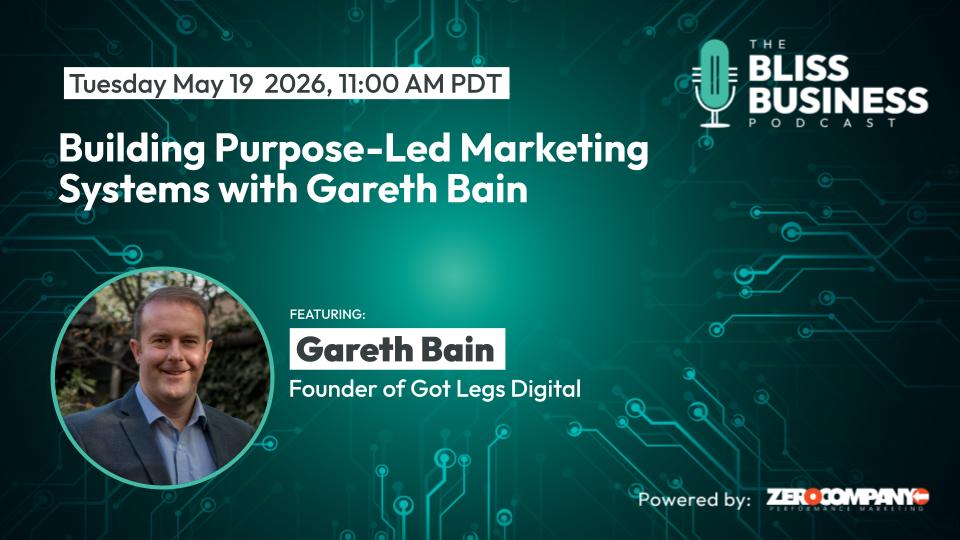
Purpose-Led Marketing Systems Beat Reactive Marketing Every Time

Marketing is often treated like a vending machine. Put money in, get leads out. When that fails, founders jump to the next tactic, the next platform, the next agency, the next “quick win.” The result is scattered activity that feels busy but never becomes predictable.
On The Bliss Business Podcast, we sat down with Gareth Bain, an award-winning fractional CMO and founder of Got Legs Digital, to talk about building purpose-led marketing systems that hold up past the founder stage. Gareth has spent 17+ years helping SaaS, fintech, proptech, and tech-driven businesses move from founder-led, reactive marketing to scalable growth systems. He has worked with brands like American Express, LEGO, Blackstone, and MoneyGram, and he has helped startups through fundraising and IPO readiness.
What stood out in the conversation is how simple his core belief is: growth becomes predictable when marketing stops being a set of disconnected tactics and becomes an operating system.
Founder-Led Marketing Breaks at Scale
Gareth described a pattern he sees constantly. Marketing starts in the founder’s head. The founder approves the copy, the creative, the messaging, the campaigns. That can work when the company is small. Then the business grows to 15, 20, 30 people and the founder becomes the bottleneck.
The downstream effects are predictable:
-
marketing becomes campaign-driven and short-term
-
urgency drives decisions instead of strategy
-
the team tries to be everywhere at once
-
budgets get spread thin across too many channels
-
nobody can clearly see what is working, or why
The fix is not more activity. The fix is getting what is in the founder’s head out of the founder’s head.
Clarity Is a Competitive Advantage
Stephen asked why clarity is often more valuable than complexity in marketing. Gareth’s answer was blunt: clarity gives you visibility, and you cannot measure what you cannot see.
Complexity shows up when founders do not know what channel is right, so they try everything:
-
a bit of social
-
a bit of Google
-
a bit of email
-
a bit of “we need to be everywhere”
Then nothing works because the system is not designed to learn. You end up burning money across platforms without a feedback loop that tells you what to double down on or what to stop.
Clarity is what makes learning possible. Learning is what makes growth repeatable.
The Fractional CMO Is the Architect, Not the Contractor
Gareth’s best analogy was the architect. An architect does not build the house. They design the blueprint so the build is coherent, and then skilled teams execute.
That is the value of the fractional CMO model in growth-stage businesses:
-
a strategic leader comes in to diagnose bottlenecks quickly
-
the roadmap gets built with sequencing and priorities
-
systems get documented so the business is not dependent on one person
-
execution can be handed to junior talent, internal teams, or specialized partners
-
the founder can shift from working in the business to working on the business
The point is leverage. You are buying the blueprint and the prioritization, not just labor.
Systems First, Then Channels
The most practical part of the episode was Gareth’s take on what “marketing systems” actually mean. Many founders assume systems mean tools. He framed it differently: systems are what prevent chaos and remove key-person risk.
He described the foundational sequence:
-
Extract the founder’s expectations into a documented system
What is right and wrong for the brand. What the company stands for. What “good” looks like. What “off-brand” looks like. -
Build SOPs so marketing is not trapped in one person’s head
If your first marketer leaves and everything collapses, you never had a system. You had a person. -
Then build the buyer journey, ICP clarity, channel strategy, and measurement loops
Once the foundation is stable, execution stops being emotional and starts being learnable.
This is where many companies go wrong. They run ads before they have a true message. They hire before they have clarity. They chase channels before they know who they are actually for.
The First 90 Days Should Prove the System Works
Gareth also shared how he decides what to fix first when he enters a business. He balances long-term strategy with the founder’s need for near-term revenue. His approach starts with an audit to see what is working, what is wasting money, and what is missing. Then he layers competitor analysis and gap analysis to determine where the most realistic wins are.
This matters because founders are not wrong to want quick wins. They are wrong when quick wins become the entire strategy.
Purpose That Is Operational, Not Decorative
One of the strongest parts of the conversation was Gareth’s purpose story. Got Legs Digital donates a portion of profits toward providing prosthetic legs to amputee survivors across Africa, and he tracks “KMIs,” key moments of impact, alongside KPIs. He shared how those stories create deeper client retention because clients feel connected to a real outcome, not just metrics.
He also gave a grounded warning: purpose needs alignment. If a business chooses a cause with no connection to what it actually does, it feels like a checkbox. The more purpose can connect to the work itself, the more employees and customers can believe it and carry it forward.
Ethical Marketing Is a Form of Care
Tullio brought up a question that deserves more attention: what does love have to do with marketing.
Gareth’s answer was honesty. Ethical marketing means telling the truth about what you can deliver, turning away clients when you are not the right fit, and refusing “tainted money” that comes from selling something you know will not work for the client.
That is care for the client and care for the market. It also happens to be good business. Short-term wins built on misfit clients create churn, conflict, and reputational drag.
Key Takeaways
-
Founder-led marketing breaks when the founder becomes the bottleneck, and systems are the way out.
-
Clarity beats complexity because clarity creates visibility, and visibility creates learning.
-
A fractional CMO acts like an architect: diagnose, design, prioritize, document, and then enable execution.
-
Systems come before channels: SOPs, ICP clarity, buyer journey, and measurement loops make growth repeatable.
-
Purpose works when it is operational and aligned to the business, not decorative.
-
Ethical marketing is care in action: honest fit assessment, truth-telling, and turning away work that cannot be delivered well.
Final Thoughts
Reactive marketing is not a marketing problem. It is a leadership and systems problem. The companies that win are not the ones with the most tactics. They are the ones with the cleanest priorities, the simplest message, the strongest feedback loops, and the discipline to execute consistently.
Where to Go Next
Listen to the full conversation: Building Purpose-Led Marketing Systems with Gareth Bain.
Watch the video: Gareth Bain on clarity over complexity.
Meet Gareth on his guest profile.
Hear another fractional CMO's take: Laura Rice of Rice Fractional CMO.

Executive Producer | Host | Blog Contributor
Tullio Siragusa is a strategic advisor, dynamic speaker, author, and EQ coach with 36 years of experience as a technology disruptor rooted in Design Thinking. Since 2018, he has been creating, producing and hosting live podcasts, interviewing over 1,000 C-suite executives across a wide range of industries. His work behind the mic reflects his larger mission: using conversation as a catalyst for human-centric innovation.
Tullio’s commitment to purpose-driven leadership and ethical transformation is reflected in his advisory roles at the University of California, Riverside’s Design Thinking Executive Program, and the University of San Francisco School of Management’s Digital Marketing Program. As a Board Advisor at AI2030.org, he helps guide the responsible advancement of AI toward ethical and sustainable outcomes. A founding member of RadicalPurpose.org, Tullio believes empathy isn’t just a trait, it’s a non-negotiable foundation for leadership.

Hospitality Begins With Making People Feel Seen