The Brands That Matter Most Stand for More Than Themselves

In a crowded market, competence is no longer enough.
Most brands today can run ads, optimize funnels, track clicks, and report on conversions. Many can create decent creative, build a clean website, and explain their offer with reasonable clarity. But the brands that truly stand out now are often doing something deeper. They are creating meaning. They are building emotional relevance. They are giving people a reason to care beyond the transaction.
That is where purpose and empathy begin to shift from nice ideas to serious business advantages, and where purpose as competitive advantage stops being a slogan.
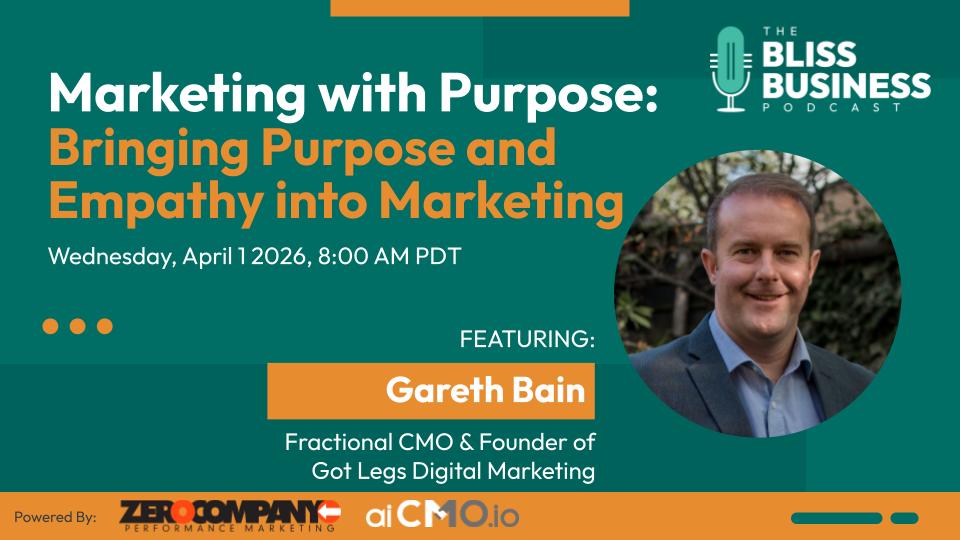
That truth came through clearly in a recent conversation with Gareth Bain, Fractional CMO & Founder of Got Legs Digital Marketing, on the Marketing with Purpose series of The Bliss Business Podcast. Gareth brought a rare blend of performance discipline and human-centered conviction to the conversation, shaped by years of growth strategy work and a business model intentionally built around impact. His message was not abstract. It was deeply practical: purpose is not something you layer on top of a brand after the fact. It can become the very thing that helps the brand stand apart, attract the right people, and build something much larger than a campaign.
In other words, purpose is not a distraction from growth.
It may be one of the clearest paths to it.
Purpose Creates a Different Kind of Competitive Advantage
One of the most powerful ideas in this conversation is that purpose can help a business do much more than feel good about itself. It can help it disrupt an industry.
That is a bold claim, but Gareth makes it concrete.
He built Got Legs Digital Marketing with a commercial mission and a philanthropic mission intertwined. On one level, the business helps companies “get legs” and grow. On another, it has contributed to helping fund prosthetic legs for amputee survivors across Africa. That is not a side note to the brand story. It is the brand story. And because of that, the business enters conversations differently from the beginning.
It is not just another agency talking about clicks, leads, and revenue.
It is a company making an argument that growth should move people and change lives.
That distinction matters.
Because in a noisy, undifferentiated market, one of the hardest things for any business to achieve is emotional memorability. A purpose-led brand has a chance to do that more naturally because it stands for something visible and human. It creates a deeper conversation before the sales conversation even starts.
Purpose Often Becomes a Filter Before It Becomes a Strategy
Another valuable insight Gareth shared is that purpose does more than attract attention. It also acts as a filter.
That is especially important in founder-led businesses, agencies, and service brands where fit matters deeply.
Gareth described how his purpose-first positioning has become a kind of pull strategy. The right clients are drawn in because they resonate with the mission. The right team members feel connected to the work because the values are visible and lived. And just as importantly, the wrong fits begin to screen themselves out earlier.
This is one of the most underrated benefits of purpose.
It helps the business identify alignment faster.
Instead of having every conversation on purely commercial terms, the business gets to see how people respond to the deeper mission. Are they interested in impact, community, and values? Or are they only asking what the ROI is on the philanthropic element? Those responses reveal something important about who the relationship will become over time.
Purpose, then, is not only a message to the outside world.
It is a decision-making tool for the inside.
The Real Opportunity Is Bigger Than One Brand
One of the most striking moments in the conversation came when Gareth zoomed out and talked about what would happen if more agencies built purpose into their model.
His math was simple but powerful. If a large enough portion of marketing agencies committed even a small percentage of earnings toward meaningful impact, the pooled result could become transformative at scale. In other words, the point is not only that one ethical business can do some good. The point is that a movement of ethical businesses could do much more than any one brand can alone.
That is a profound reframe.
It shifts purpose from being an isolated branding tactic to becoming an ecosystem-level possibility. It asks a bigger question: what if entire sectors saw themselves not just as generators of revenue, but as engines for broader human change?
That kind of thinking changes the role of business itself.
And it changes the role of marketing inside it.
Because marketing, at that point, is no longer only about demand generation. It becomes part of how a company defines its contribution to the world around it.
Short-Term Results and Long-Term Brand Building Do Not Need to Compete
Gareth also addressed one of the core tensions nearly every CMO knows well: the pull between immediate performance and long-term brand building.
This is where many leadership teams get into trouble. They feel the pressure for fast results and begin treating short-term revenue activity as if it exists apart from longer-term brand strategy. But Gareth’s framing is stronger than that. He sees these as connected layers of the same growth system, not competing priorities.
That is exactly right.
A brand still needs a roadmap.
It still needs measurable objectives.
It still needs short-term actions that support revenue.
But those actions should not feel random or disconnected from the larger strategic direction.
Gareth’s approach of building a multi-year strategy and then breaking it into quarterly actions is a strong answer to this tension. It gives the business something many teams lack: a sense of where they are going that is large enough to create stability and specific enough to create accountability.
This is one of the clearest ways to reduce friction.
When people understand how this quarter supports the larger picture, they stop seeing short-term tactics as isolated survival work and start seeing them as part of a coherent build.
In Difficult Times, Human Connection Often Matters More Than Immediate Selling
One of the strongest and most timely points Gareth made came when he reflected on operating in a region affected by instability and uncertainty.
His insight here is worth underlining: when fear rises, many businesses instinctively pull back, go quiet, or focus only on protecting themselves. But often the better move is not to disappear. It is to stay present more humanly.
That does not mean pretending conditions are normal.
It means showing up in a way that respects what people are going through.
Gareth’s example from Dubai, with businesses navigating the uncertainty of conflict, travel disruption, and economic hesitation, made this especially tangible. In that kind of environment, the role of the brand is not merely to push harder for immediate conversion. It is to connect, reassure, and contribute to the emotional steadiness of the community it serves.
This is where empathy becomes deeply strategic.
People remember who showed up with humanity when things felt unsettled.
They remember who understood that not every moment is a sales moment.
And that memory often becomes the basis for trust later.
Purpose Gives You Something Stronger Than Promotion
Gareth’s story about Joe Wicks during COVID is a perfect illustration of this idea.
At a time when people were locked down, uncertain, and physically disconnected, he did not lead with product or pressure. He led with usefulness. He created a daily ritual that helped people feel a little more in control of their lives and their bodies. It was not an aggressive monetization strategy. It was an act of service that built massive resonance.
That is what strong purpose does.
It gives a brand something deeper to communicate than “buy now.”
It makes the brand useful before it becomes transactional.
And often, that usefulness becomes the strongest marketing asset of all.
Because when people feel helped, they remember.
When they feel sold to in the wrong moment, they also remember.
Cross-Functional Alignment Is Easier When Everyone Owns the Same Outcome
Another important part of the conversation centered on launching products and entering markets, and Gareth’s answer was as much about people as process.
He described himself as the conductor of the orchestra, which is a strong metaphor for the work of a Fractional CMO. Sales, product, customer support, finance, and technology all hold different parts of the instrument set. If those parts are not moving from the same score, the launch becomes noisy rather than effective.
That is why alignment matters so much.
Gareth’s approach is not to disappear into strategy alone or dictate from above. It is to invite teams into the roadmap early, clarify what success looks like, and create a shared sense of ownership around the bigger goal. This is especially important in complex launches, where what seems obvious to one team may be invisible to another.
His example of entering Saudi Arabia and realizing early that the product experience needed to work right-to-left rather than left-to-right is a perfect case in point. Without cross-functional communication, that insight could have become an expensive late-stage problem. With the right collaboration, it became a solvable design and rollout consideration.
That is what alignment does.
It turns friction into foresight.
Data Validates. It Does Not Replace Listening.
When the discussion shifted to customer feedback and behavior, Gareth made one of the most useful distinctions in the entire episode: intuition helps you form the hypothesis, but data validates.
That is a very mature way to think about modern marketing.
Some teams over-index on instinct.
Others over-index on data in a way that strips the work of imagination.
The strongest teams know that both are necessary.
Gareth’s example from the health-tech launch illustrates this beautifully. Before spending heavily on advertising, his team used customer interviews, observed user behavior, and listened carefully to where the product experience confused or discouraged people. That feedback shaped the product before the market spend escalated.
This is one of the smartest and most empathetic moves a brand can make.
It recognizes that people do not exist to validate our assumptions.
We exist to build something more useful by understanding their experience.
That mindset changes the role of feedback. It stops being something defensive and starts becoming one of the most valuable tools for improving growth outcomes before expensive mistakes are scaled.
Marketing Becomes a Revenue Engine When It Understands the Whole System
Another strong theme in the episode is Gareth’s belief that marketing should not be judged only by top-of-funnel activity.
That is exactly right.
Revenue does not live in one campaign.
It lives in the full system.
Acquisition, activation, retention, referrals, and revenue are all linked. If marketing only feeds the front end while ignoring the mechanics of conversion, onboarding, customer experience, and loyalty, then the business may look busy without actually becoming healthier.
That is why Gareth’s idea of building a marketing automation engine is so important.
When businesses understand their numbers, their funnel stages, and the points of friction in the journey, they can stop guessing about why growth is uneven. They can see whether the problem is top-of-funnel traffic, mid-funnel conversion, onboarding experience, retention weakness, or message-market mismatch. And when they can see that clearly, marketing begins to feel much more like an engine and much less like an experiment.
This is where systems thinking becomes one of the most important leadership skills in growth.
People Stay Where They Feel Aligned to Meaning
Gareth also made a strong point about talent.
One of the reasons purpose matters is not only that it attracts the right clients. It also helps attract and retain the right team. People want to know that their work means something. They want to feel that what they are building contributes to something larger than a KPI dashboard, even if the dashboard still matters.
Gareth’s use of “key moments of impact” instead of traditional KPI language is a great example of this.
That shift in language does not remove performance expectations. It reframes them in a more human way. It reminds the team that the work is not only about metrics but about the lives, communities, and meaningful outcomes behind those metrics.
That kind of framing can be incredibly energizing for a team.
Because when people can see how their work matters in real terms, not just abstract numbers, they often bring more heart, commitment, and imagination into what they do.
Great Marketing Creates Stories People Want to Belong To
The final story Gareth shared about South Africa may be the clearest expression of what purpose-led marketing can really become.
What started as an idea for Mandela Day evolved into an unforgettable experience for students, a national story, and a campaign that resonated because it was not built around extraction. It was built around giving. Around memory. Around meaning.
That is what purpose can do when it is lived boldly enough.
It creates stories that matter because they are rooted in something real.
And when brands create those stories, they do not just capture attention.
They create emotional memory.
This aligns beautifully with the B.L.I.S.S. philosophy—Building Love Into Scalable Systems. Love in business is not vague. It is the deliberate choice to build systems, campaigns, and brands that leave people better than they found them. That can happen through customer care. Through ethical growth. Through community action. Through meaningful visibility. Through simply showing up differently than the market expects.
And when that happens, the brand does not just grow.
It starts to matter.
Key Takeaways
Purpose can be a real competitive differentiator. It gives a brand emotional memorability in a crowded market and changes the conversation from the very beginning.
A strong mission acts as a filter. It helps attract aligned clients and team members while screening out poor-fit relationships earlier.
Short-term performance and long-term brand strategy must work together. A clear roadmap helps keep immediate actions tied to a larger growth story.
In uncertain times, empathy builds trust. Brands that stay human and useful during disruption are often remembered long after conditions improve.
Cross-functional alignment prevents expensive mistakes. Product, sales, support, finance, and tech need shared ownership of the go-to-market strategy.
Customer listening improves growth before scaling. Data validates direction, but direct feedback often reveals friction the metrics alone cannot explain.
Marketing drives revenue best when it sees the whole funnel. Acquisition, activation, retention, referrals, and revenue all need to be connected, not treated as separate worlds.
Final Thoughts
What this conversation with Gareth Bain, Fractional CMO & Founder of Got Legs Digital Marketing, makes clear is that bringing purpose and empathy into marketing does not weaken commercial performance.
It strengthens it.
Because purpose gives the brand a reason to matter.
Empathy gives it a way to connect.
And together, they create something most performance-only strategies struggle to build: trust with emotional depth.
That is what attracts the right people.
That is what creates movements instead of campaigns.
And that is what turns marketing from a message into something people actually want to be part of.
Where to Go Next
Hear the full conversation: Marketing With Purpose Kit: Bringing Purpose and Empathy into Marketing with Gareth Bain.
Watch the episode: Cross Team Launch Alignment, with Gareth Bain.
More about the guest: Gareth Bain.
Purpose as competitive advantage is not what a brand says about itself. It is what the brand is still doing when nobody is buying.

Guest Development | Producer | Blog Contributor
Martha is a connector who brings over two decades of experience in engineering, sustainability, education, and public relations. She is part of the integrated go-to-market team at Zero Company and serves as Executive Producer and Guest Development Lead for The Bliss Business Podcast, where she connects with purpose-driven leaders to shape meaningful conversations. Martha also produces the Marketing With Purpose Kit segments with CMO guests and the ETF Marketing show.
Her career includes founding nonprofits, and speaking at global forums in Malaysia, Dubai, and Paris. A passionate community builder, Martha also mentors women entrepreneurs and supports environmental initiatives across Mexico and the U.S. Her work reflects a deep commitment to impact, inclusion, and authentic leadership.

Hospitality Begins With Making People Feel Seen