Belonging Is Becoming Marketing’s Most Powerful Advantage

For years, marketers have been told that the future belongs to precision.
Better targeting.
Better attribution.
Better segmentation.
Better automation.
Better optimization.
And to be fair, those things matter. They help brands spend smarter, move faster, and understand more of what is happening inside the funnel. But there is a growing limit to how much precision alone can do. A brand can know exactly who to target, when to reach them, and what message performs best, and still miss the deeper reason someone chooses to stay.
Because people do not remain loyal to brands only because they are well-targeted.
They stay when they feel something.
They stay when they belong.
They stay when the brand becomes part of how they see themselves.
That is why customer connection matters more than ever in a data-driven world. And it is why some of the most resilient growth brands are no longer just asking how to optimize performance. They are asking how to create emotional gravity.
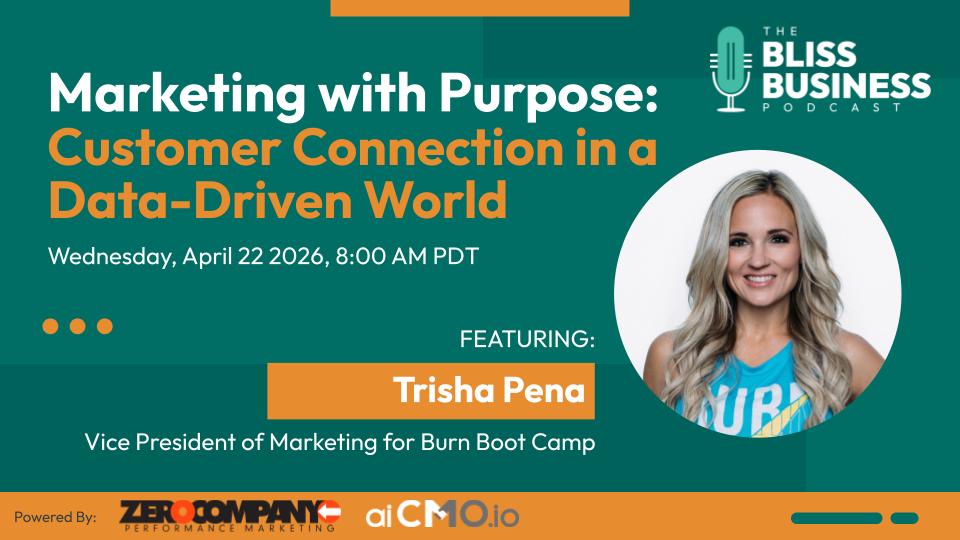
That perspective came through powerfully in a recent conversation with Trisha Pena, VP of Marketing of Burn Boot Camp, on the Marketing with Purpose series of The Bliss Business Podcast, where belonging as a growth advantage became the throughline. What makes her view especially relevant is that it lives at the intersection of measurable performance and human transformation. Burn Boot Camp is not simply a fitness brand. It is a brand built around community, confidence, accountability, and long-term health. That makes it a useful lens for a much bigger truth: in a market saturated with data, belonging may be one of the few advantages that still compounds.
Data Can Improve Marketing. It Cannot Replace Meaning.
The modern marketer has access to more information than any previous generation could have imagined.
We can track conversion events, lead sources, funnel velocity, retention patterns, referral behavior, click-through rates, audience characteristics, and content performance in extraordinary detail. But data still has a boundary. It can show us what happened. It can often suggest where something worked. It can help us infer intent. What it cannot fully capture is emotional significance.
That matters because emotional significance is often what determines whether a customer becomes loyal, not just converted.
The strongest brands understand that a purchase is rarely the full story. In many cases, the transaction is only the visible outcome of something more important happening beneath the surface. A person may join a fitness brand because they want to lose weight or improve strength. But what they may really be seeking is confidence, structure, identity, support, or proof that change is still possible.
Those deeper motivations do not always announce themselves cleanly in a dashboard.
But they are often the real drivers of behavior.
This is one reason the future of marketing will not belong only to the brands with the most data. It will belong to the brands that know how to combine insight with emotional intelligence.
Community Is Not a Brand Add-On. It Is a Growth System.
One of the biggest strategic misunderstandings in marketing is treating community as something ornamental.
It gets framed as culture.
As engagement.
As a nice byproduct of strong branding.
But for certain brands, community is not a side effect. It is the mechanism through which the brand grows.
That is especially true in emotionally charged categories like fitness, wellness, recovery, parenting, education, and personal transformation. In these spaces, customers are not only buying a product. They are entering an environment that either reinforces or weakens their sense of self.
This is where Burn Boot Camp offers such a useful example.
The brand’s language around “Burn Nation” is not just a naming strategy. It signals something much deeper: membership in a shared identity. That matters because identity-based brands tend to create stronger referral loops, longer retention, and more emotionally durable loyalty than purely transactional ones. People do not just consume the brand. They participate in it. They advocate for it. They invite others into it.
That is when marketing becomes more than messaging.
It becomes belonging architecture.
And once a brand creates belonging, growth becomes far more organic, because people do not keep something meaningful to themselves.
The Best Top-of-Funnel Strategy Often Begins with Emotion, Not Product
A common mistake in performance-driven organizations is leading too early with the product.
This happens because product language feels concrete. It feels measurable. It feels easier to defend internally. Features, offers, program details, functionality, and benefits all sound like rational selling tools. But rational tools are not always the best starting point for a new relationship.
At the top of the funnel, people are often deciding something more basic:
Does this feel like it’s for me?
Do I trust this?
Do I see myself here?
Will I feel judged, intimidated, welcomed, or supported?
These are emotional questions, even when the customer is not consciously phrasing them that way.
That is why brands that lead only with product too early can underperform, especially when the category itself carries emotional weight. Fitness is a perfect example. For many consumers, fitness is tied to vulnerability, insecurity, habit failure, body image, energy, mental health, and self-worth. If the brand leads only with the mechanics of the workout, it may never get close enough to the deeper hesitation to earn real consideration.
The better strategy is often this:
Lead first with emotional relevance.
Then validate with product truth.
Then reinforce with proof and experience.
That sequence does not make the brand less performance-driven.
It makes it more humanly accurate.
Referral Is Usually a Trust Metric Disguised as a Growth Channel
A lot of brands say they want more referrals.
Fewer really understand what referrals actually mean.
Referral is not just a lower-cost acquisition source. It is evidence of trust deep enough to be socially shared. People do not recommend brands lightly, especially in categories tied to health, confidence, identity, or personal routines. They recommend when they believe the experience is strong enough to risk their own credibility on it.
That is why referral culture is one of the clearest signs that a brand has moved beyond mere satisfaction and into emotional relevance.
When customers bring in friends, family members, or coworkers, they are not just saying, “This works.”
They are saying, “This mattered to me enough that I think it could matter to you too.”
That is a very different level of brand relationship.
And it is one of the strongest arguments for investing in belonging, not just conversion. Because a brand that creates emotional safety, consistency, and identity is much more likely to generate that kind of word-of-mouth than a brand that only performs technically well.
Referral, in that sense, is often the measurable output of something much less easily measured:
the customer’s feeling that this brand became part of their life in a meaningful way.
Internal Alignment Always Shows Up in the Customer Experience
Another truth that more leaders need to take seriously is this: customers can feel internal fragmentation, even if they cannot name it.
When performance marketing is pushing one message, brand marketing is shaping another, partnerships are operating in their own lane, and technology is disconnected from all of it, the customer journey starts to feel uneven. The pieces may all be individually competent, but the experience becomes disjointed.
That matters because emotional trust depends heavily on coherence.
A brand that wants customers to feel safe, seen, and supported has to make those signals feel consistent across touchpoints. If the top of the funnel promises inclusion but the next stage feels cold, generic, or confusing, the emotional promise weakens. If brand says one thing and the sales or onboarding experience says another, customers notice the contradiction even if the team does not.
This is why customer connection is never just a marketing issue.
It is an alignment issue.
Strong emotional brands are usually built by organizations that understand how to reduce internal silos and create one shared customer story across departments. The tighter that alignment becomes, the more naturally the brand can scale trust.
The Most Valuable Brands Often Change How People Feel About Themselves
The deepest customer connection usually happens when a brand helps people experience themselves differently.
That is the level most companies say they want, but relatively few earn.
It is one thing to help someone complete a task.
It is another to help someone feel more capable, more confident, more supported, or more alive.
That second category is where long-term value lives.
Because when a brand becomes part of a personal transformation, it stops being interchangeable. It becomes emotionally embedded. It gets associated not just with a service outcome, but with a shift in identity. That is where real loyalty begins to form.
Fitness brands understand this when they are at their best.
So do great coaches, educators, healthcare providers, and mission-led communities.
They realize that the real value they create is not only functional. It is often psychological and relational. They help customers reconnect with agency. They help them rebuild confidence. They help them believe something new about what is possible for them.
That kind of impact is difficult to commoditize.
And that is exactly why it is strategically powerful.
In the End, Belonging Is Harder to Copy Than Tactics
Most tactics can be copied.
A competitor can mimic a campaign style.
A pricing structure can be replicated.
A funnel can be reverse-engineered.
A targeting strategy can be approximated.
But belonging is much harder to duplicate.
It comes from a thousand small consistencies:
the way the brand speaks,
the way customers feel when they enter,
the way the team behaves,
the stories the brand elevates,
the emotional safety it creates,
the trust it earns over time.
These things are difficult to manufacture quickly because they are not surface-level differentiators. They are cultural ones.
This is why belonging may become one of the most defensible growth advantages in the years ahead. As AI and automation continue to lower the cost of execution, the brands that stand out will increasingly be the ones that can still create human depth at scale.
That is where the B.L.I.S.S. philosophy—Building Love Into Scalable Systems—becomes especially relevant. Because the point is not to reject systems, performance, or measurement. It is to build systems humane enough to scale trust, confidence, and connection without flattening them into cold efficiency.
That is what the best modern brands are learning:
people may enter through performance,
but they stay through meaning.
Key Takeaways
Data improves precision, but meaning drives loyalty. Brands need both measurable insight and emotional understanding to grow sustainably.
Community is a business asset, not just a culture benefit. It strengthens retention, referrals, and long-term customer value.
Top-of-funnel messaging often needs emotional relevance first. People connect to identity and belonging before they commit to product details.
Referrals signal emotional trust. They are often the clearest sign that a brand has become personally meaningful.
Internal silos weaken external connection. Customers feel inconsistency when teams are not aligned around one brand experience.
Transformation builds stronger brands than transactions do. The most resilient loyalty comes from helping people feel differently about themselves, not just delivering a service.
Final Thoughts
What this conversation with Trisha Pena, VP of Marketing of Burn Boot Camp, makes clear is that customer connection in a data-driven world is not about choosing heart over measurement.
It is about understanding that the best measurement in the world still needs something meaningful to measure.
A brand can optimize every stage of the funnel and still remain forgettable.
Or it can build something people feel proud to be part of.
And increasingly, that difference is what separates efficient brands from enduring ones.
Where to Go Next
Hear the full conversation: Marketing With Purpose Kit: Customer Connection in a Data-Driven World. Watch it: Trisha Pena on belonging as a growth advantage. Meet the guest: Trisha Pena.

Guest Development | Producer | Blog Contributor
Martha is a connector who brings over two decades of experience in engineering, sustainability, education, and public relations. She is part of the integrated go-to-market team at Zero Company and serves as Guest Development Lead for The Bliss Business Podcast, where she connects with purpose-driven leaders to shape meaningful conversations. Martha also produces the Marketing With Purpose Kit segments with CMO guests.
Her career includes founding nonprofits, and speaking at global forums in Malaysia, Dubai, and Paris. A passionate community builder, Martha also mentors women entrepreneurs and supports environmental initiatives across Mexico and the U.S. Her work reflects a deep commitment to impact, inclusion, and authentic leadership.

Empathy Is an Operating System