Storytelling That Builds Connection with Ben Green
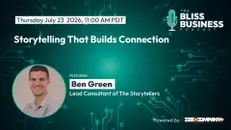
In this episode of The Bliss Business Podcast, Ben Green, Lead Consultant at The Storytellers (part of Accenture), shares how storytelling that builds connection helps leaders lead with empathy, activate strategy, and turn change into shared ownership.
Connection does not happen because a strategy is announced. It happens when people understand the story they are part of and feel invited to help shape what comes next.
In this episode of The Bliss Business Podcast, we welcome Ben Green, Lead Consultant at The Storytellers, part of Accenture. Ben has spent the last seven years working globally with C-suite leaders and organizations to transform workplaces through the power of storytelling. His background spans behavior change, psychology, leadership development, coaching, facilitation, and consulting.
The Storytellers uses story-driven activation to help organizations accelerate change, build culture, activate strategy, strengthen leadership, and unlock extraordinary performance. Their approach combines the art and science of storytelling to create clear, emotionally compelling narratives that help people understand the role they play in business transformation.
Ben opens with a distinction he leans on constantly: empathy isn’t sympathy. “Sympathy is looking down and saying, oh, that looks bad, I feel sorry for you,” he explains, pointing to Brenée Brown’s well-known work on the difference. “Empathy is really putting yourself in their shoes.” He makes it concrete with a story from an insurance client: a head of marketing stood in front of 100 leaders and shared that she’d lost her husband in a car accident — and that the life insurance policy he’d insisted on was the reason she could still send her kids to school. “We’re not doing insurance,” Ben recalls her saying, “we’re giving people that option to continue living.” There wasn’t a dry eye in the room — and for the first time, everyone understood what the company actually did.
“No one ever built a great relationship with someone because of slide 74 of a PowerPoint deck,” Ben says — which is the case for The Storytellers’ six-chapter framework, built loosely on Joseph Campbell’s hero’s journey: pride and purpose, the honest challenge, the opportunity, the strategy, the human behaviors it requires, and the destination. Get the story right, he argues, and the strategy becomes the coat hanger everything else in the business hangs on.
In Storytelling That Builds Connection, we explore:
• Why empathy is essential to leadership
• How storytelling helps people connect to strategy and change
• Why community cannot be built through messaging alone
• How leaders create emotional connection without losing clarity
• What makes a story powerful enough to shift behavior
• How businesses can build cultures where people feel part of something larger
Key Takeaways
• (2:26) Empathy is not sympathy: sympathy looks down and feels sorry for someone, while empathy means putting yourself in their shoes
• (12:11) An insurance company’s head of marketing told 100 leaders she’d lost her husband, and the life insurance he’d insisted on was why she could still send her kids to school: “We’re not doing insurance, we’re giving people that option to continue living”
• (20:42) The Storytellers’ six-chapter framework, built loosely on Joseph Campbell’s hero’s journey, moves organizations through pride and purpose, the honest challenge, the opportunity, the strategy, the human behaviors it requires, and the destination
• (30:47) “No one ever built a great relationship with someone because of slide 74 of a PowerPoint deck.” Stories, not slide decks, are what build trust and community inside a business
• (39:04) A practical habit any leader can start today: before sharing a message, ask “can I share this with a story?” instead of defaulting to business speak
FAQ
What is the difference between empathy and sympathy in leadership?
Ben Green explains that sympathy looks down at someone and feels sorry for them, while empathy means genuinely putting yourself in their shoes. Leaders often confuse the two, which is why empathy gets dismissed as a “soft skill” instead of a business lever.
What is the six-chapter storytelling framework?
Built loosely on Joseph Campbell’s hero’s journey, The Storytellers’ six-chapter framework moves organizations through pride and purpose, the honest challenge, the opportunity, the strategy, the human behaviors it requires, and the destination.
How can leaders tell if they are communicating without truly connecting?
Ben Green points to discretionary effort as the clearest signal. People who are genuinely connected to a strategy go above and beyond without being asked, while silence and disengagement, more than open complaints, are often the real warning signs.
🎙️ Hosted by Stephen Sakach and Tullio Siragusa🎧 Produced by Martha Huerta
When leaders tell stories with empathy and purpose, they do more than communicate. They help people belong, believe, and move forward together.
Learn more about Ben Green and The Storytellers at thestorytellers.com. Explore more conversations like this in our Featured Guest Series.

Lead Consultant | The Storytellers (Part of Accenture)
Ben Green is a lead consultant at The Storytellers, having spent the last 7 years as part of the team working globally with C-suite and organisations to transform the workplace through the power of storytelling. The Storytellers fundamental belief is the emotional connection and innate power of story that dictates much of our every day lives should not be taken for granted in our working world too. The Storytellers use a unique six-chapter story framework to help organisations transform and manage change through powerful human stories.
Ben's background is in behaviour change, psychology and leadership development and has spent over a decade thinking about the best ways to make organisations more human. Ben is a coach, facilitator and consultant to many senior leaders. Away from work, Ben is an avid field hockey player and despite being a Brit also has a passion for NFL!