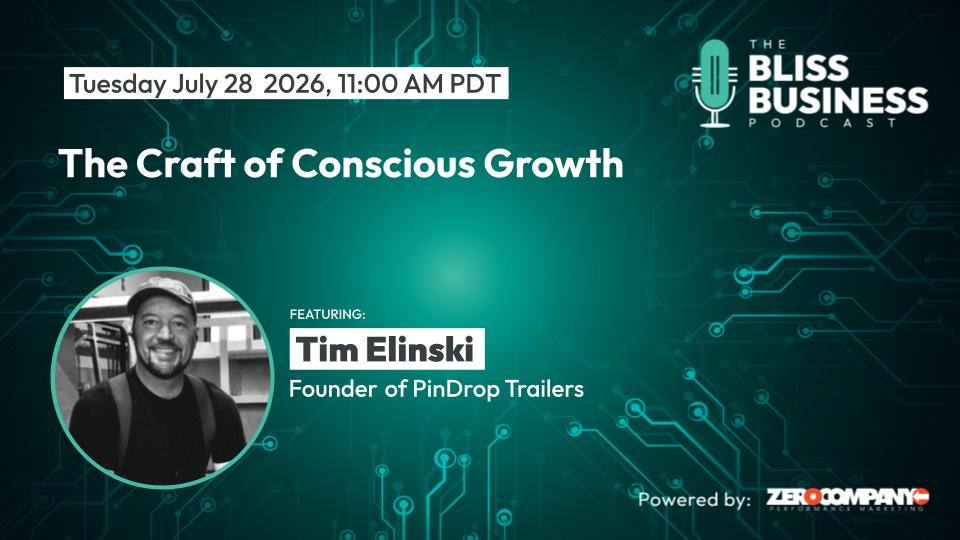
The Craft of Conscious Growth
Sustainability is often treated as a checklist.
Use better materials. Reduce waste. Add solar. Make the product more efficient. Tell the market you care about the environment.
But real sustainability goes deeper than that.
It shows up in what a company builds, how long that product lasts, where it is manufactured, what kind of community it supports, how employees think about quality, and what kind of relationship the customer is invited to have with the natural world.
On The Bliss Business Podcast, we sat down with Tim Elinski, Founder and Fabricator of Pin Drop Travel Trailers, to explore sustainable business practices through the story of a company building handcrafted, solar-powered travel trailers in rural Arizona. Tim leads design and manufacturing for Pin Drop, an award-winning micro camper company creating durable, solar-powered trailers designed for rugged terrain and comfortable outdoor experiences. With more than 25 years of experience as a licensed general and HVAC contractor, along with a background in historic restoration, energy-efficient design, and civic leadership, Tim brings a rare combination of craftsmanship, stewardship, and community-minded business design to the work.
His perspective is a reminder that conscious growth is not only about getting bigger. It is about building with intention.
Sustainability Begins With Longevity
Tim’s view of sustainability starts with durability.
In the RV industry, many products are built for relatively short lifespans. They serve their purpose for a number of years, then wear down, break apart, or become too expensive to maintain. For Tim, that was not good enough.
Pin Drop was designed to be a generational product. The goal is to build a travel trailer that can be used for years, maintained with care, and eventually passed down to the next generation.
That is an important reframing.
Sustainability is not only about what happens during production. It is also about what happens after purchase. A product that lasts longer creates less waste, requires fewer replacements, and forms a deeper bond with the people who use it.
Durability is sustainability in physical form.
Built by a Contractor With a Camping Addiction
Tim describes himself as a general contractor with a camping addiction.
That phrase captures the origin of Pin Drop perfectly. His background in the trades, historic restoration, HVAC, construction, and energy efficiency shaped the way he thinks about design. His love of the outdoors shaped the problem he wanted to solve.
For years, he restored vintage campers and tried to modify them to fit the way he and his wife liked to camp. But they never quite delivered what he wanted. Lack of power and lack of water often forced people back to civilization sooner than they wanted. So Tim started designing something better in his head long before he built it in real life.
Pin Drop began as a product he wanted for himself and his family.
That matters because some of the best companies start with a founder who understands the problem personally. Tim was not designing from a spreadsheet. He was designing from lived experience.
Beauty and Performance Can Belong Together
Pin Drop trailers balance vintage aesthetics, modern performance, rugged durability, and sustainable design.
The company still offers a vintage-style model inspired by the teardrop trailers of earlier decades, but its more rugged models have become especially popular. Larger wheels, a more robust stance, roof racks, and a stronger visual profile have helped expand the appeal while keeping the warmth and charm that make the product distinctive.
Inside, Tim still uses natural wood such as Baltic birch, maple, and cherry. The lighting is LED and modern, but designed to create a soft glow reminiscent of older camping experiences. The goal is not to make the trailer feel like a plastic shell. It is to create warmth, comfort, and a sense of craft.
That balance is important.
Sustainability should not feel like deprivation. It can feel beautiful, thoughtful, durable, and deeply human.
The Product Should Invite People Outside
Pin Drop trailers are not designed for people who want to sit inside all day watching television.
They are designed to help people get outdoors and stay outdoors longer.
That is an important part of the philosophy. The trailer provides comfort, safety, power, water, storage, and shelter, but it does not replace the outdoor experience. It supports it. Customers can bring mountain bikes, kayaks, fly rods, and other gear. They can reach quieter spaces, avoid crowded RV areas, and experience nature with more comfort than sleeping on the ground.
This is not about escaping nature.
It is about making nature more accessible.
For some customers, especially active empty nesters or boomers who no longer want to sleep in a tent, a micro camper creates a bridge between adventure and comfort. It allows them to keep exploring without needing a large RV.
The Customer Is Choosing More Than a Trailer
Tim understands that Pin Drop customers are not only buying a product. They are choosing a set of values.
They tend to care about the outdoors. They want to reduce their impact. They appreciate craftsmanship. They are willing to wait for something built by real people in a rural town. They understand that their purchase supports a local manufacturing ecosystem and other businesses in Arizona and the United States.
That is a very different relationship than a purely transactional purchase.
A customer who buys from Pin Drop is not simply asking, “What can I get right now?”
They are asking, “What kind of company do I want to support?”
That is where conscious brands create deeper alignment. The product, the process, the place, and the purpose all reinforce one another.
Modularity Creates Personalization Without Chaos
Tim came from a world of custom contracting, where one-off projects were common. While he valued that experience, he also knew that manufacturing required a different kind of discipline.
Pin Drop trailers are highly configurable, but they are not chaotic one-off builds. The company uses modular design, with pre-wired and pre-configured systems that allow customers to upgrade or adapt over time. A customer can begin with a base model and later add features or trim packages that move the trailer closer to another model.
That approach creates a smart balance.
Customers feel like the product is personal, but the business can still maintain production discipline, quality standards, and serviceability.
This is another example of conscious growth. It gives customers choice without creating operational chaos that would compromise the craft.
Material Choices Reflect Values
Tim described a careful process for deciding which materials and features belong in the product.
The first question is durability. Will the component last as long as the trailer is designed to last? If not, is it easily replaceable? The company also considers whether materials can be sourced domestically and whether they genuinely improve the design.
That kind of discipline matters because many products contain parts that become weak points over time.
One example was the rooftop ventilation fan common in many RVs. Tim saw it as a problem because it required a large hole in the roof, invited leaks, and did not match the long-term quality standard Pin Drop was trying to build. So the company paused, prototyped, and developed its own EcoCool ventilation system, a ducted design intended to remove that leak risk and improve durability.
That is innovation driven by values.
The company did not accept an industry standard simply because everyone else used it. It asked whether the standard served the customer, the product, and the long-term promise.
Craftsmanship Is a Form of Care
One of the most interesting parts of the conversation was the connection between love and artistry.
Tim spoke about the personal relationship the team develops with each trailer. Each unit is built from the chassis up. Each receives attention, problem-solving, and special touches. When a batch leaves the shop floor, there is excitement, but also a kind of emptiness. The team has poured something into those trailers.
That is what craftsmanship does.
It turns work into more than production.
There is artistry in shaping raw materials into something beautiful. There is artistry in solving design problems. There is artistry in sourcing materials, negotiating with suppliers, telling the company’s story, and building a product that carries people into the natural world.
Love in business often lives there, in the care given to the work itself.
Small Scale Can Preserve Connection
Pin Drop does plan to scale production, but Tim was clear that growth cannot come at the expense of customer connection.
The company wants to remain close enough to its customers to learn from them, celebrate with them, and continue building around their experience. Pin Drop held its first customer summit in the national forest near Flagstaff, Arizona, inviting customers to camp together, share the lifestyle, and build community around the product.
That is not just a marketing event.
It is a relationship system.
Customers become part of the brand’s living story. They are not only buyers. They are participants, users, explorers, and sources of feedback.
That kind of closeness helps a company improve without losing its soul.
Feedback Is Part of the Build
Early in the company’s development, Pin Drop created a fleet of rental units so people could experience the product before becoming customers.
That decision helped the team understand what people loved, what frustrated them, what broke, what lasted, and what needed improvement. Many early renters later became buyers. Their experience shaped the product.
This is an important lesson for founders.
The product may begin with the founder’s personal need, but it becomes stronger when real customers interact with it. Feedback turns the founder’s vision into something more durable, useful, and widely loved.
Listening is part of craftsmanship.
Place Matters
Pin Drop operates from a repurposed historic building in Miami, Arizona.
That choice was intentional.
Miami is a rural copper mining town with deep history and pride, but like many small towns, it has experienced decline and underinvestment. Tim and his wife chose to locate the manufacturing headquarters there because they wanted to support a community that needed opportunity.
Many business leaders would have chosen a more obvious location, such as a major metro area or industrial corridor with easier logistics, more visibility, and faster delivery. Tim chose the harder path.
That decision reflects a public service mindset. Before Pin Drop, Tim served for nearly 20 years in civic leadership, including as mayor of Cottonwood, Arizona. That background shaped the way he thinks about community, preservation, and economic identity.
A business can either extract from a place or contribute to it.
Pin Drop is trying to contribute.
The Greenest Building Is the One Already Built
The historic building Pin Drop occupies is more than 100 years old, with thick poured concrete walls and a long history of different uses. Rather than build something new, the company adapted what already existed.
That is sustainability too.
Preservation keeps embodied energy from being wasted. It honors the past. It creates continuity between old and new. It gives a small town another reason to feel pride in what is possible there.
Tim described the impact of people walking through the building and seeing something alive again. Manufacturing is happening. Craft is happening. A distinctive product is being built in a town many people have never heard of.
That kind of revitalization matters.
It reminds us that where a company builds can be part of what the company stands for.
Rural Talent Deserves Opportunity
Tim believes there is talent in rural Arizona that should not have to leave for metro areas just to find meaningful work.
Many people want to stay close to family, nature, and the communities that shaped them. But opportunity is often limited. By manufacturing in Miami, Pin Drop creates jobs and helps prove that rural places can support innovative, high-quality businesses.
That is a powerful business design choice.
It connects sustainability to economic development.
A company can reduce environmental impact and strengthen a community at the same time. Those are not separate goals. They can reinforce each other when leaders are willing to make intentional choices.
Community Attracts More Community
Since Pin Drop located in Miami, Tim noted that other makers and manufacturers have also come into the community, including a cabinet maker and a custom banjo maker. The town already had creative and manufacturing activity, but Pin Drop has become part of a broader story of renewal.
This is how small places begin to come alive again.
One business takes a chance. Then another. Then another. Over time, the story shifts from decline to possibility.
A restored building becomes a signal.
A handcrafted product becomes a source of pride.
A small town becomes a place where people can imagine something new.
Slow Growth Can Be Wise Growth
During COVID, the RV industry experienced a major surge as more people wanted to get outdoors. That created pressure for Pin Drop to scale quickly.
Tim resisted that pressure.
Rather than buying more property, rapidly expanding production, or chasing short-term demand, the company stayed measured. Looking back, he believes that was the right decision. Many travel trailer companies that started during the COVID surge are no longer around. Pin Drop is still here.
That is an important lesson.
Not every growth opportunity should be taken at full speed.
Sometimes sustainable growth requires patience. It requires knowing what the company is, what it is not, and what promises must not be broken.
Conscious growth is not slow because it lacks ambition. It is measured because it understands consequences.
Love Means Helping People Recharge Their Wonder
Pin Drop’s mission is captured in the phrase “recharge your wonder.”
That phrase reflects the deeper purpose behind the product. The trailer is not only a piece of equipment. It is a vehicle for helping people reconnect with nature, restore themselves, and fall in love with the outdoors again.
When asked what role love should play in business, Tim connected love to the product, the customer experience, the materials, the build process, the outdoors, and preservation for future generations.
That is love expressed through design.
The team loves the product. They love what it helps customers experience. They love nature enough to build in a way that protects it. They love the craft enough to care about details. They love the community enough to build in a place others might overlook.
Love becomes visible through choices.
Key Takeaways
-
Sustainability is not only about materials. It is about durability, design, place, community, and long-term impact.
-
A generational product creates less waste because it is built to last and potentially be passed down.
-
Craftsmanship is a form of care because it reflects attention, patience, and pride in the work.
-
Sustainability should enhance the customer experience, not make it feel like a compromise.
-
Conscious design questions industry standards instead of accepting weak points as inevitable.
-
Customer feedback helps turn a founder’s vision into a better, more durable product.
-
Place matters. Where a company builds can be part of its purpose and community impact.
-
Repurposing historic buildings can support both sustainability and local revitalization.
-
Slow, measured growth can protect quality, culture, and long-term viability.
-
Love in business can show up as artistry, patience, stewardship, and helping people reconnect with wonder.
Final Thoughts
Tim Elinski’s story is a reminder that sustainability is not one decision. It is a pattern of decisions made over time.
What you build matters.
How you build it matters.
Where you build it matters.
Who you build it with matters.
How long it lasts matters.
What it invites people to experience matters.
Pin Drop Travel Trailers is not trying to be the biggest manufacturer in the category. It is trying to be one of the most intentional.
That distinction matters.
In a business culture that often rewards speed, volume, and scale above all else, Tim’s approach reminds us that craft still matters. Place still matters. Patience still matters. Love for the work still matters.
Conscious growth is not about resisting growth.
It is about growing in a way that leaves the product, the customer, the team, the community, and the natural world better than before.
Check out our full conversation with Tim Elinski of Pin Drop Travel Trailers on The Bliss Business Podcast.

Executive Producer | Host | Blog Contributor
Tullio Siragusa is a strategic advisor, dynamic speaker, author, and EQ coach with 36 years of experience as a technology disruptor rooted in Design Thinking. Since 2018, he has been creating, producing and hosting live podcasts, interviewing over 1,000 C-suite executives across a wide range of industries. His work behind the mic reflects his larger mission: using conversation as a catalyst for human-centric innovation.
Tullio’s commitment to purpose-driven leadership and ethical transformation is reflected in his advisory roles at the University of California, Riverside’s Design Thinking Executive Program, and the University of San Francisco School of Management’s Digital Marketing Program. As a Board Advisor at AI2030.org, he helps guide the responsible advancement of AI toward ethical and sustainable outcomes. A founding member of RadicalPurpose.org, Tullio believes empathy isn’t just a trait, it’s a non-negotiable foundation for leadership.

Empathy Is an Operating System