
Emotional Intelligence for Durable Growth with Brad Poulos
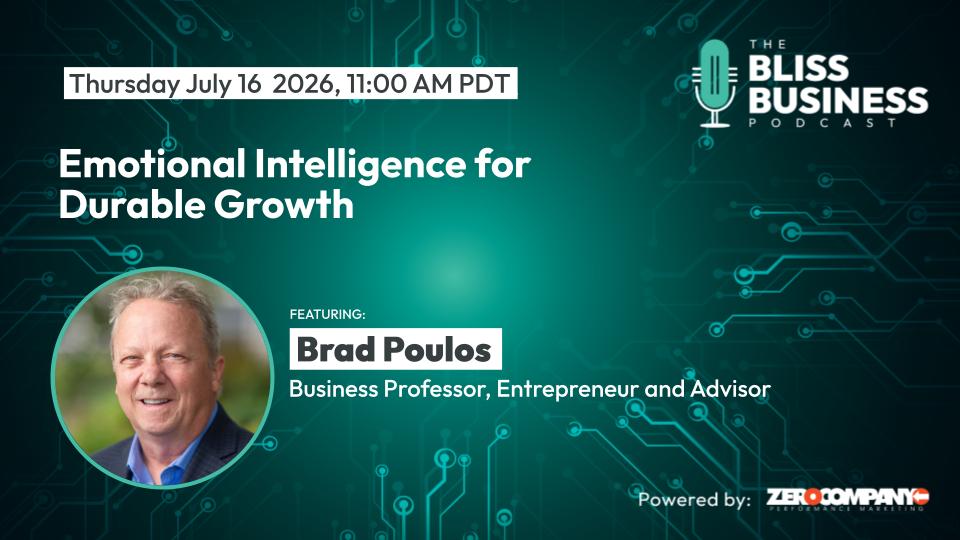
In this episode of The Bliss Business Podcast, Brad Poulos, small business professor and author of Most Problems Solve Themselves, unpacks emotional intelligence in business: how founders make hard calls with clarity, build durable systems, and grow companies that don't consume them.
Business growth is not only about strategy, capital, or ambition. Emotional intelligence in business is just as decisive: knowing when to push, when to pause, when to listen, and when to make hard decisions with clarity.
In this episode of The Bliss Business Podcast, we welcome Brad Poulos, small business professor, entrepreneur, advisor, and author of The Small Business Operator’s Manual and Most Problems Solve Themselves. Brad brings more than 30 years of experience building, scaling, fixing, and sometimes shutting down companies, including growing businesses from startup to more than $75 million in revenue.
Alongside his operating career, Brad has taught entrepreneurship and finance at Toronto Metropolitan University for more than 15 years, working with founders who are past the idea stage and facing the reality of running a business.
In this episode we explore:
• Why emotional intelligence in business matters in decision-making
• How founders can build companies that do not consume them
• Why community and connection support long-term resilience
• How leaders make difficult calls with discipline and empathy
• What business owners often miss between startup and exit
• Why clarity, systems, and fewer unforced errors create durability
Why Emotional Intelligence in Business Becomes a Survival Skill
Brad teaches two ideas at Toronto Metropolitan University that anchor this for him: adversity quotient, the ability to face a setback without it derailing your whole day, and an internal locus of control, believing “you are the pilot in the plane of your own life.” He lived out "radical candor" long before he read the book by that name. Early in his career, he asked a star employee to review him as a manager in return. The employee, Greg, finally told him: “Brad, you’re an effing tyrant.” Brad calls those four words life-changing, and says he’d corrected the behavior within a year, with help from his own boss.
Systems matter just as much as mindset. Brad recalls calling himself “quote boy” early in his first company, the bottleneck every quote had to pass through, before eventually delegating so far that even check-signing moved to his controller once the company passed 75 employees and $50 million in revenue. In Most Problems Solve Themselves, he describes training his team by pushing problems back to them instead of solving everything himself: “I believe in you. I give you the autonomy to make the decision. And I will back you up.”
That same instinct carries into how Brad thinks about honest communication under pressure: telling someone the truth, kindly, the way Greg once told him, builds far more trust than a message polished to avoid it, which is exactly the kind of grounded brand communication Zero Company helps growing companies get right.
Key Takeaways
• (2:49) Emotional intelligence rests on "adversity quotient" and an internal locus of control: the ability to face a setback without it derailing your whole day
• (5:43) A former employee once told Brad "you're an effing tyrant." Taking that feedback in, rather than dismissing it, reshaped how he led from then on
• (17:07) Getting out of the operational loop, from "quote boy" to delegating check-signing at $50 million in revenue, is what lets a company survive without its founder in every decision
• (24:08) Most day-to-day problems are the team's to solve; the real leadership skill is knowing which ones actually need you to step in
• (38:13) Golf, playing in a band, and training in martial arts with his grandson are, in Brad's words, part of what makes him "more valuable" when he steps back into the office, not less committed
FAQ
Why does emotional intelligence in business matter beyond the startup stage?
Brad Poulos points to "adversity quotient," the ability to face a setback without it derailing your day, and an internal locus of control, believing you're the pilot of your own life, as two traits that separate steady leaders from those who get knocked off course.
What's one story that changed how Brad Poulos leads?
Early in his career, Brad asked an employee to review him as a manager. The employee told him, "Brad, you're an effing tyrant." Brad calls those four words life-changing, and corrected the behavior within a year with his own boss's help.
What's one practical habit for building emotional intelligence?
Brad recommends humility: "I think humility goes a long way in terms of demonstrating emotional intelligence."
🎙️ Hosted by Stephen Sakach and Tullio Siragusa
🎧 Produced by Martha Huerta
The strongest businesses are not built by avoiding hard decisions. They are built by making those decisions with clarity, discipline, and care.
Learn more about Brad Poulos and his books at bradpoulos.com. For another close look at emotional intelligence in action, listen to The EQ Behind Clear Marketing with Josh Porter, or explore more conversations in our Featured Guest Series.

Business Professor, Entrepreneur and Advisor
Brad Poulos is a small business professor, entrepreneur, and advisor with more than 30 years of experience building, scaling, fixing, and occasionally shutting down companies. He’s grown businesses from startup to over $75 million in revenue, led publicly traded firms, negotiated major financings and contracts, and guided companies through restructurings, turnarounds, and acquisitions. Alongside his operating career, he has taught entrepreneurship and finance at Toronto Metropolitan University for over 15 years, working closely with founders who are past the idea stage and deep into the realities of running a business.
What makes Brad’s perspective different is the range of situations he’s lived through. He’s built fast-growing companies that landed on the Profit 100 list, launched new technologies and markets, integrated acquisitions, advised boards in regulated industries like telecom and cannabis, and helped owners make hard calls such as closing unprofitable divisions, renegotiating with creditors, or redesigning how their business actually works. His thinking is grounded in strategy, financial discipline, and systems, not slogans.
Brad is the author of The Small Business Operator’s Manual and Most Problems Solve Themselves, where he focuses on the overlooked phase of entrepreneurship: the long stretch between startup excitement and exit headlines. Listeners should tune in if they want calm, experience-based insight on growth, cash flow, decision-making, and how to build a business that doesn’t consume its owner. His work is about clarity, durability… Read More

