Marketing With Purpose Kit: The Truth Behind Purpose-Led Brands
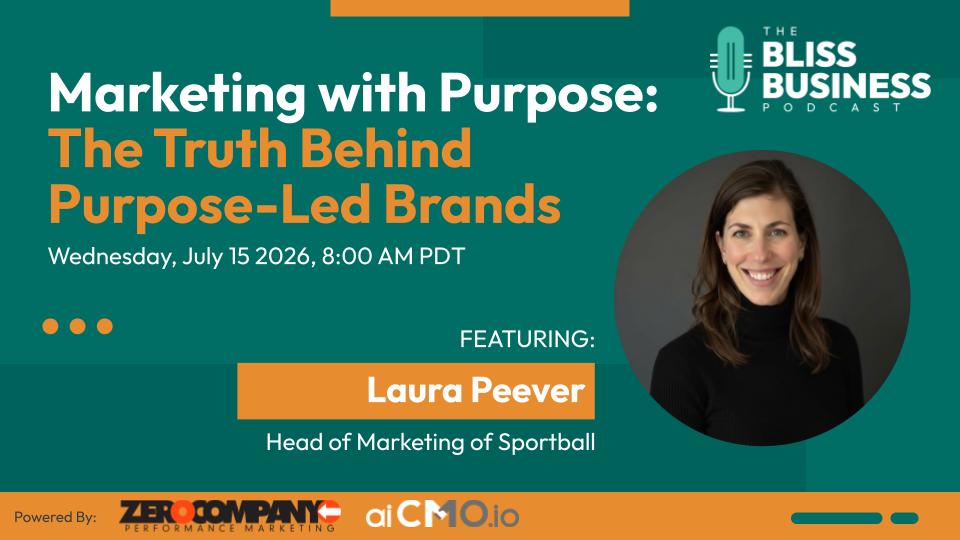
Sportball's Laura Peever explains why purpose can't be marketed into existence, and what it actually takes to build a purpose-led brand strategy that holds up under pressure.
If you lead marketing at a growing brand, you've likely felt the tension: leadership wants the company to stand for something, but you're not always sure whether that something is real or just good copywriting.
That tension sits at the center of a purpose-led brand strategy, and it's exactly where Laura Peever, Head of Marketing at Sportball, spends most of her days.
In this episode of The Bliss Business Podcast's Marketing With Purpose Kit, host Tullio Siragusa sits down with Laura to explore The Truth Behind Purpose-Led Brands. Laura leads brand strategy across Sportball's global franchise system, built around helping kids build confidence through sport. Her core belief drives the conversation: "Marketing doesn't create purpose. It can only expose whether it's actually there in the first place."
Purpose Has to Be Lived Before It's Marketed
Laura shared a story from earlier in her career, working at an ad agency for a large food brand that wanted a "give-back" campaign. Her team built a real program, a school lunch initiative tied directly to the product. The client's actual ask was simpler: donate $10,000 to charity and call it done. "That's a very short-term campaign without much thought to the long-term brand building," Laura said. The lesson stuck with her: purpose has to be the ethos of a company, not a seasonal marketing strategy that gets canceled the moment it doesn't perform.
What a Purpose-Led Brand Looks Like Under Pressure
The real test of a purpose-led brand strategy isn't the good times, it's the crisis. In January 2025, a new registration platform rollout sent Sportball's sales into a freefall. Laura described the team's reaction: "The reaction was, how can I help? No one was blaming anyone. We all just rolled up our sleeves and got to work." That instinct, she said, can't be manufactured overnight. "It has to be ingrained in the way that you operate, the habits that you have as a company, the way you treat people, so that you're ready when a crisis hits."
Alignment Beats Any Single Campaign
Laura brings a sports-team mentality to cross-functional alignment. Ops and customer service sit in Sportball's marketing planning sessions from day one, and every new project starts with a clear owner and an OKR exercise. "We're all singing from the same song sheet," she said, "and it's just so much clearer and everybody is bought in." It's a lesson echoed by other guests in this series, including Rebecca Throop's conversation on breaking down silos across teams.
Letting the Data Tell the Story
Laura also walked through how Sportball uses seasonal lifetime-value data to guide, not replace, intuition, running win-back campaigns for lapsed customers and rethinking retention program by program. On hiring, she was candid about a harder discipline: "You have to be willing to fire fast... it's critical to preserving this wonderful culture you've invested time, energy, and resources into building."
Key Takeaways
• (2:09) "Marketing doesn't create purpose. It can only expose whether it's actually there in the first place."
• (5:38) The $10,000 donation story: why short-term giving isn't brand building
• (7:45-10:22) The January 2025 platform crisis and the "how can I help" team response
• (10:59-13:53) Sports-team alignment: ops and customer service inside marketing planning
• (15:19-18:21) Seasonal LTV data driving win-back campaigns
• (22:50-24:57) Why Laura believes in firing fast to protect culture
• (25:32-28:32) The International Women's Day video shared by Billie Jean King, seen by over 500,000 people
FAQ
What does it mean for a brand to be purpose-led?
"Marketing doesn't create purpose, it can only expose whether it's actually there," says Laura Peever, Head of Marketing at Sportball. A brand becomes purpose-led when its values are lived operationally, at the highest levels of the company, before marketing ever tells that story.
How can a marketing team stay purposeful during a crisis?
According to Laura Peever, a purposeful culture can't be built overnight, it has to already exist before a crisis hits. When Sportball's registration platform failed in January 2025, the team's instinct was to ask "how can I help" instead of assigning blame, which let them fix the problem quickly and rebuild stronger.
Why should ops and customer service sit in on marketing planning?
Sportball includes operations and customer service in every marketing planning session so the whole company works from the same growth goals and OKRs, preventing the kind of misalignment that quietly breaks purpose-led brand strategies.
🎙️ Hosted by Tullio Siragusa
🎧 Produced by Martha Huerta
If you found this conversation valuable, explore more conversations with marketing leaders in the Marketing With Purpose Kit series, including The Strategic Value of a Fractional CMO, or meet more Bliss Business Podcast guests on our guest page.

Head of Marketing at Sportball
Laura Peever is a marketing leader and brand builder who believes the most powerful brands aren’t created through messaging—they’re built through action.
As Head of Marketing at Sportball, she leads brand strategy and growth across a global franchise system, helping scale a business rooted in developing confident, active kids through fun-first sport experiences. Sportball has spent decades designing programs that prioritize physical literacy, confidence, and joy in movement—proving that purpose, when embedded operationally, drives both impact and growth.
Laura’s career has been shaped by a non-linear path, a bias for action, and a deep belief that marketing’s role isn’t to manufacture purpose—it’s to reveal it. She’s especially passionate about helping organizations move beyond purpose as a positioning exercise and toward purpose as a discipline that shows up in how they operate, scale, and serve.