Emotional Intelligence Is a Survival Skill for Durable Growth

Entrepreneurship is often described through exciting milestones: the launch, the funding round, the growth curve, the acquisition, the exit.
But most of business happens in the long middle.
That is where owners wrestle with cash flow, hiring, pricing, debt, customer pressure, market shifts, difficult employees, and the emotional weight of being responsible for the company’s future.
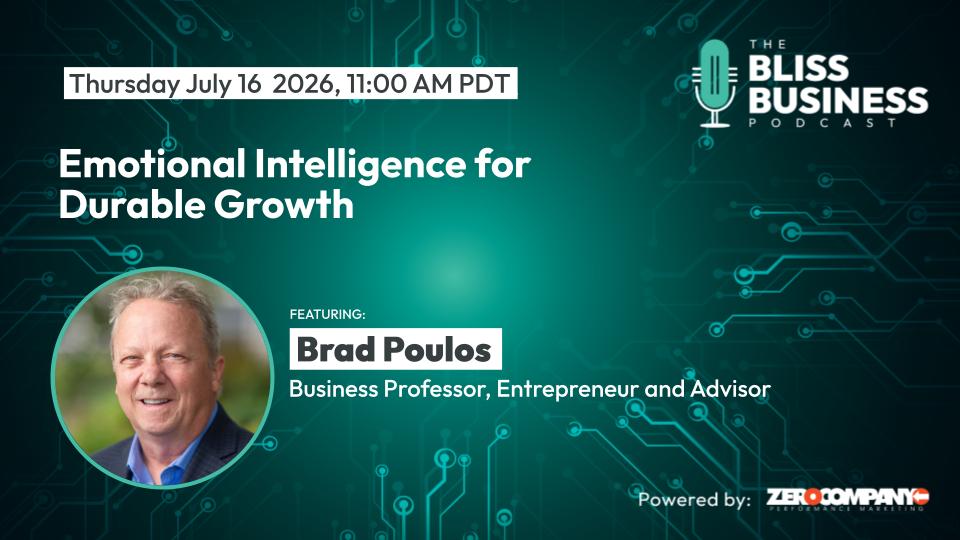
On The Bliss Business Podcast, we sat down with Brad Poulos, a business professor, entrepreneur, advisor, and author with more than 30 years of experience building, scaling, fixing, and sometimes shutting down companies, to talk about psychological safety in leadership and why durable growth depends on it. Brad has grown businesses from startup to more than $75 million in revenue, led publicly traded firms, negotiated major financing and contracts, guided companies through restructuring and turnarounds, and taught entrepreneurship and finance at Toronto Metropolitan University for more than 15 years.
His perspective is practical, direct, and deeply useful for business owners trying to build companies that grow without consuming them.
Emotional Intelligence Matters at Every Stage
Brad challenged the idea that emotional intelligence becomes important only after the startup stage. In his view, it matters from the beginning.
Entrepreneurship requires the ability to handle adversity without being derailed by it. Brad described this through the idea of adversity quotient, the ability to deal with things going wrong without becoming overwhelmed, reactive, or immobilized.
He also emphasized internal locus of control.
That means seeing yourself as the pilot of your own life, not merely a passenger. Business owners cannot control every challenge that comes their way, but they can control how they respond.
That is where emotional intelligence becomes a survival skill.
A leader who panics, avoids, lashes out, or freezes under pressure creates instability throughout the company. A leader who can stay present, assess reality, and act with clarity gives the business a better chance to endure.
Toughness and Compassion Must Work Together
Brad has built companies, scaled them, fixed them, and sometimes shut them down. That gives him a grounded view of what emotional intelligence looks like when leaders have to make difficult calls.
His answer was simple: toughness combined with compassion.
Hard decisions often affect other people. Closing a business may mean people lose jobs. Changing direction may affect suppliers, partners, customers, or employees. But avoiding a necessary decision rarely helps anyone. It often delays the inevitable and increases the damage.
The emotionally intelligent leader does not avoid hard decisions. They make them with as much honesty, care, and clarity as possible.
Compassion does not mean pretending the problem is smaller than it is. It means recognizing the human impact while still doing what the business requires.
Radical Candor Can Change a Leader
Brad shared a story from early in his management career that shaped him for decades.
After conducting a performance review with one of his strongest employees, he asked the employee to review him. The employee hesitated several times, then finally told him the truth: Brad was acting like a tyrant.
That moment changed him.
Instead of dismissing the feedback, Brad took it seriously. He worked on his leadership style, checked back later, and improved. Decades later, when he reconnected with that employee, the employee did not even remember saying it. But Brad never forgot.
That story illustrates a powerful truth: one sentence can change someone’s life, even if the person saying it does not remember it.
Leaders need to be careful with their words. They also need to be open enough to hear the words that may change them.
Feedback Requires Psychological Safety
Radical candor only works when there is enough trust for truth to be spoken.
The employee who gave Brad that feedback asked several times if he was sure he wanted to hear it. That hesitation is revealing. In many organizations, employees would never take that risk. They would assume honesty might hurt their career, relationship, or reputation.
That is why psychological safety matters.
Feedback should not only move top-down. The healthiest companies allow truth to move in all directions. Employees can challenge leaders. Peers can correct peers. Leaders can give direct feedback without humiliation.
Without psychological safety, companies do not get truth. They get silence, compliance, and hidden resentment.
Leaders Need Mirrors
Brad also spoke about the importance of peer groups, coaches, and trusted advisors.
Before selling his company to a public company and becoming CEO, he joined a CEO peer group. He described it as the closest thing he had to a boss. The group met regularly, challenged each other, and told each other the truth.
That kind of reflection is essential.
The more authority a leader gains, the easier it becomes to lose access to honest feedback. Employees may hesitate to speak directly. Partners may avoid conflict. Advisors may soften the truth.
Strong leaders intentionally build mirrors around themselves.
They seek people who will tell them what they need to hear, not only what they want to hear.
Watch for Anger, Fear, and Ego
When asked which emotions lead founders into poor decisions, Brad pointed to familiar traps: anger, fear, greed, pride, and ego.
Anger can cause a leader to act impulsively. Fear can cause indecision. Ego can prevent a leader from admitting they were wrong.
Brad also emphasized mindfulness as a practical tool. Through meditation and awareness, he has learned to notice anger before it fully takes over. That pause creates choice.
The goal is not to stop feeling emotion. Leaders are human. The goal is to avoid being controlled by emotion.
A mindful leader can say, “I am angry,” without letting anger make the decision.
Most Decisions Are Reversible
Fear often keeps leaders stuck because they assume every decision is permanent.
Brad challenged that assumption. Most decisions can be reversed. His example was Coca-Cola changing its formula, then changing it back. If a company that large can reverse a major decision, most smaller companies can reverse decisions too.
That does not mean leaders should be careless. It means they should avoid paralysis.
The stronger posture is: make the best decision with the information available, stay alert, and be willing to change course if new information proves the decision wrong.
That is not weakness. That is wisdom.
Get the Owner Out of the Loop
A major theme in Brad’s work is building businesses that do not consume their owners.
The first step is removing the owner from unnecessary operational loops.
Brad gave the example of becoming “quote boy” in one of his companies because every quote had to go through him. That created a bottleneck. Eventually, leaders have to build systems, delegate authority, and trust others to make decisions.
The same applies to approvals, checks, customer decisions, scheduling, operations, and problem-solving.
If every decision needs the owner, the company cannot scale. It can only exhaust the owner.
Most Problems Solve Themselves
Brad’s book Most Problems Solve Themselves is based on a leadership practice he developed while running a busy company and traveling frequently.
When employees brought him problems, he often responded with a question: “If I were not here, what would you do?”
When they answered, he would often say, “Let’s do that.”
That response did two things.
First, it communicated trust.
Second, it trained people to solve problems without always escalating them.
The point was not to avoid helping. The point was to show employees they were capable.
If leaders insist on optimizing every decision, they create dependency. The best people eventually leave because they want autonomy. The remaining team learns to wait for instructions.
A durable company needs people who can think, decide, and act.
Know Which Problems Require Intervention
Of course, not every problem should be left alone.
The art of leadership is knowing which issues truly require intervention. Some problems can be solved by the team. Some solve themselves with time. Others require immediate leadership action.
That discernment comes from experience, emotional regulation, and clarity about what truly matters.
Leaders who intervene in everything create bottlenecks. Leaders who intervene in nothing create chaos.
The emotionally intelligent leader learns the difference.
People Problems Grow Quietly
When asked which operational problems quietly grow until they become serious, Brad pointed first to people.
Owners often delay difficult people decisions because they want to be nice. But kindness is not the same as avoidance.
Keeping the wrong person in the wrong role can damage culture, performance, morale, and customer experience. It can also be unfair to the person if they are in a role where they cannot succeed.
Brad framed this through the idea of getting the right people in the right seats.
The right people are aligned with the company’s values.
The right seats match their skills, temperament, and capabilities.
Values are hard to teach, especially with senior people. Skills can often be trained. That is why values alignment matters so much.
Cash Flow Problems Also Creep In
Brad also identified cash flow as one of the most common silent threats, especially in B2B companies.
Businesses that extend credit may not be strong at collections. They may allow cash to leak out of the business through poor discipline, weak processes, or delayed follow-up.
Cash flow problems often look manageable until they suddenly are not.
Durable growth requires leaders to pay attention to the fundamentals, not only the exciting parts of the business. Revenue growth matters, but collection, margin, pricing, and cash discipline determine whether growth is sustainable.
Purpose Starts With the Owner
Brad believes company purpose matters, but he also believes it should begin with the owner’s personal purpose.
What are you here to do?
What kind of dent do you want to leave in the world?
What kind of community do you want to help build?
What kind of company do you want to steward?
That personal clarity matters because owners shape the business through their decisions, values, priorities, and sacrifices.
A company without purpose can still make money, but it may consume people along the way. A company with purpose has a better chance of creating value for owners, employees, customers, and the broader community.
Business Needs a Broader View of Value
Brad also challenged the overemphasis on shareholder value.
He pointed out that over recent decades, much of the benefit of productivity and profit growth has accrued to shareholders, while workers have not shared proportionately in the gains.
That imbalance creates broader social consequences.
A healthier version of capitalism would still respect capital and investors, but would also give greater consideration to employees, communities, and the people whose labor helps create the value.
Durable growth cannot be measured only by what shareholders receive. It also has to account for what the business makes possible for others.
Leaders Need Lives Outside the Business
Many owners tie their identity so deeply to the business that they become one-dimensional.
Brad warned against that.
Being multidimensional makes leaders healthier, more resilient, and often more effective. Outside pursuits can recharge the batteries, expand perspective, and reduce the emotional pressure of having everything depend on the company.
For Brad, that includes golf, playing in a band, practicing Taekwondo, and spending time with family.
He also shared that when he was most overwhelmed in a corporate role, a boss noticed he had become more tense. Brad realized he had stopped exercising and playing hockey. Once he returned to that outlet, it helped him manage stress more effectively.
Leaders do not become better by being consumed. They become better by staying whole.
Love Begins With Self-Care
When asked what role love should play in business, Brad began with love for oneself.
That means eating properly, exercising, sleeping well, meditating if helpful, and maintaining pursuits beyond work. It means caring for your own well-being so you have the capacity to care for others.
From there, love expands outward:
-
to family
-
to employees
-
to customers
-
to the company
-
to the community
Brad described leadership as a kind of chameleon ability: knowing what to be, how to be, and when to be it. That requires emotional intelligence because different people need different forms of support, direction, clarity, and care.
You cannot lead well if you are disconnected from yourself.
Humility Is a Leadership Practice
For leaders who want to develop emotional intelligence, Brad pointed to humility.
Humility allows leaders to receive feedback, reverse decisions, acknowledge blind spots, ask for help, and recognize that they do not need to control everything.
Humility does not make a leader weak.
It makes a leader teachable.
And teachable leaders build more durable companies because they are less likely to let pride become the operating system.
Key Takeaways
-
Emotional intelligence matters at every stage of entrepreneurship, not only after startup.
-
Leaders need both toughness and compassion when making hard decisions.
-
Radical candor can change a leader when feedback is received with humility.
-
Psychological safety allows truth to move in all directions, not only from the top down.
-
Anger, fear, and ego often lead founders into poor decisions.
-
Most decisions are reversible, so leaders should avoid paralysis.
-
Owners must remove themselves from unnecessary operational loops if the business is going to scale.
-
Most problems solve themselves when people are trusted and trained to think.
-
People problems and cash flow problems often become serious because leaders delay addressing them.
-
Love in business begins with self-care and expands through family, employees, customers, and community.
Final Thoughts
Brad Poulos’ perspective is a reminder that durable growth is not only a financial or operational challenge. It is an emotional one.
The business owner has to make hard decisions, hear difficult feedback, manage fear, avoid ego, delegate authority, protect cash, address people issues, and still remain human in the process.
That requires emotional intelligence.
The companies that last are not built by leaders who control everything. They are built by leaders who learn, listen, delegate, adapt, and stay grounded enough to make decisions without being consumed by the business they are trying to grow.
Where to Go Next
Hear the full conversation with Brad Poulos on Emotional Intelligence for Durable Growth, or watch the episode. Learn more about Brad and his books at bradpoulos.com.
Psychological safety in leadership is not a soft add-on. It is what makes radical candor, humility, and durable growth possible in the first place.

Executive Producer | Host | Blog Contributor
Tullio Siragusa is a strategic advisor, dynamic speaker, author, and EQ coach with 36 years of experience as a technology disruptor rooted in Design Thinking. Since 2018, he has been creating, producing and hosting live podcasts, interviewing over 1,000 C-suite executives across a wide range of industries. His work behind the mic reflects his larger mission: using conversation as a catalyst for human-centric innovation.
Tullio’s commitment to purpose-driven leadership and ethical transformation is reflected in his advisory roles at the University of California, Riverside’s Design Thinking Executive Program, and the University of San Francisco School of Management’s Digital Marketing Program. As a Board Advisor at AI2030.org, he helps guide the responsible advancement of AI toward ethical and sustainable outcomes. A founding member of RadicalPurpose.org, Tullio believes empathy isn’t just a trait, it’s a non-negotiable foundation for leadership.

Execution Improves When Leaders Remove What Gets in the Way