The Emotional Intelligence of High Performance with Scott Greenberg
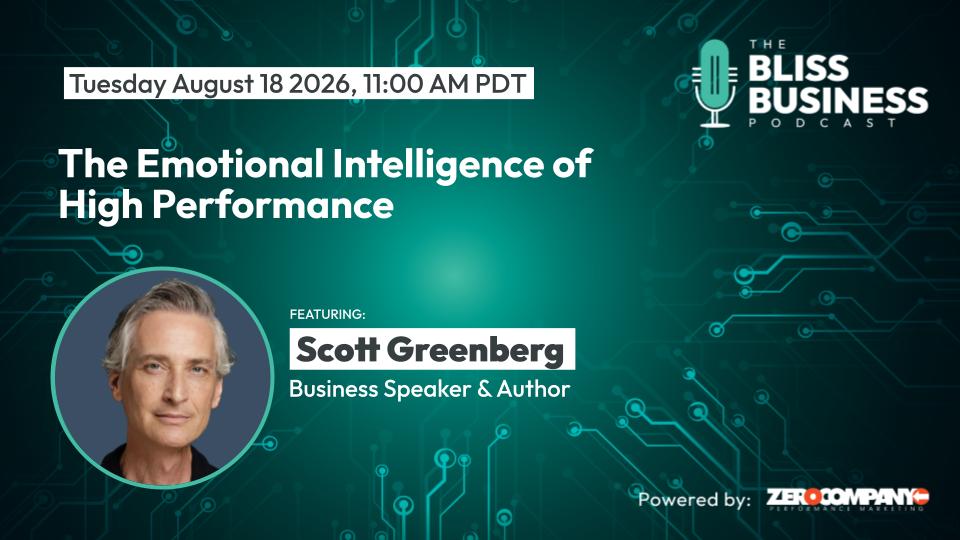
In this episode of The Bliss Business Podcast, business performance expert Scott Greenberg unpacks the emotional intelligence of high performance, showing how leaders shape team energy, transform customer experience, and build resilient, engaged teams from the frontline up, one hourly worker at a time.
Emotional intelligence of high performance is not a soft add-on to good leadership, it is the foundation Scott Greenberg has built his career on. In this episode of The Bliss Business Podcast, we welcome Scott Greenberg, business performance expert, workforce leadership speaker, author of The Wealthy Franchisee and Stop the Shift Show, and creator of the Hourly Employee Management System.
As a former multi-unit franchise owner and operator for Edible Arrangements, Scott earned strong sales rankings, customer service recognition, and management awards. Among the thousands of franchise owners he works with, the top performers share a pattern: they manage their own fear and greed, then use every product and service they deliver to lift how people feel.
In this episode we explore:
• Why emotional intelligence is a business performance advantage
• How leaders influence the mindset and energy of their teams
• Why hourly workers require a more human-centered management approach
• How great customer experiences begin with internal culture
• What separates transactional service from transformational service
• How leaders can build teams that are resilient, engaged, and accountable
Scott’s case for frontline teams starts on day one. When his daughter started her first fast-food job, the welcome was a shirt size and four hours of training videos. He asks what would change if coworkers applauded as a new hire walked in, if the uniform came wrapped as welcome swag, and if a buddy checked in through the first week.
Asked what moves service from transactional to transformational, Scott’s answer is love, which he defines as elevating others. He pairs it with accountability. As an employer he called out mistakes, and once a month his team spent five minutes praising each person by name. He tracks the employee side with an employee net promoter score: would you recommend this employer to a friend?
The same principle applies to how a brand shows up publicly: audiences respond to marketing that feels as human and consistent as the culture behind it, the kind of brand storytelling Zero Company helps growing companies build.
Key Takeaways
• (2:27) On why emotional intelligence drives results: “I look at emotional intelligence as everything that’s happening under the hood of a business.”
• (5:23) On what the top franchise owners he works with have in common: “They run their business in a way that elevates people emotionally and that elevates the business financially.”
• (10:19) On what he tells companies that book him to speak on service: “no discussion of customer service is complete without talking about the employee experience.”
• (14:14) On the “point of clarity” from The Wealthy Franchisee: “I think clarity is much more powerful than positivity, because positivity can lead to impulsive decisions.”
• (23:24) On why culture beats a raise for hourly teams: “As consumers, we will pay more for a better customer experience. Employees will accept less for a better work experience.”
• (38:34) On one practical habit for any manager, a question to ask at the end of each day: “what was it like to be led by me today?”
FAQ
What does emotional intelligence have to do with business performance?
Scott Greenberg compares emotional intelligence to what is happening under the hood of a car: it drives everything a business does. The top franchise owners he works with manage their own fear and greed and lift how customers and employees feel, which lifts the business financially.
How do you make new hourly employees feel valued on their first day?
Scott Greenberg recommends treating a new hire’s first day like hospitality: have the team greet them, hand over the uniform as welcome swag, and assign a buddy for the first week. He says onboarding should welcome people into the culture, not just train them for the job.
How can a leader become more emotionally intelligent?
Scott Greenberg suggests asking yourself several times a day how you are feeling and how much of what you are doing is driven by emotion versus data. At the end of the day, he says to ask one more question: what was it like to be led by me today?
🎙️ Hosted by Stephen Sakach and Tullio Siragusa
🎧 Produced by Martha Huerta
High performance is never only a systems problem. It is a people problem, and Scott Greenberg’s career is a case study in treating it that way.
Learn more about Scott Greenberg and his books at scottgreenberg.com. For another look at emotional intelligence in leadership, hear Brad Poulos on emotional intelligence in business, or explore more Featured Guest Series conversations.

Business Speaker & Author
Scott Greenberg is a business performance speaker, author, and former multi-unit franchise owner who helps leaders build stronger teams, healthier workplace cultures, and better customer experiences. After spending more than a decade owning and operating award-winning Edible Arrangements franchises, he shifted his focus to researching what separates top-performing businesses from the rest.
Scott is the author of The Wealthy Franchisee and Stop the Shift Show, and the creator of the Hourly Employee Management System (HEMS), a training program that helps managers hire, coach, motivate, and retain frontline employees. Clients of Scott include McDonald's, Choice Hotels, RE/MAX, Great Clips, Domino's, the Young Presidents' Organization (YPO), and the U.S Air Force among many others. His insights have appeared in Entrepreneur, Nation's Restaurant News, Global Franchise, QSR Magazine, and other business publications.
Drawing from both the stage and the realities of running a business, Scott explores the human side of performance, why people care, how culture shapes results, and what leaders can do to help ordinary teams achieve extraordinary outcomes.