Turning Customer Experience Into Revenue Growth

Marketing becomes a true revenue engine when it stops optimizing only for the next sale.
That may sound counterintuitive in a world where marketing leaders are under constant pressure to prove ROI, accelerate acquisition, and show measurable impact. But the strongest revenue engines are rarely built on transactions alone. They are built on the combination of acquisition, trust, retention, and a customer experience that makes people want to come back.
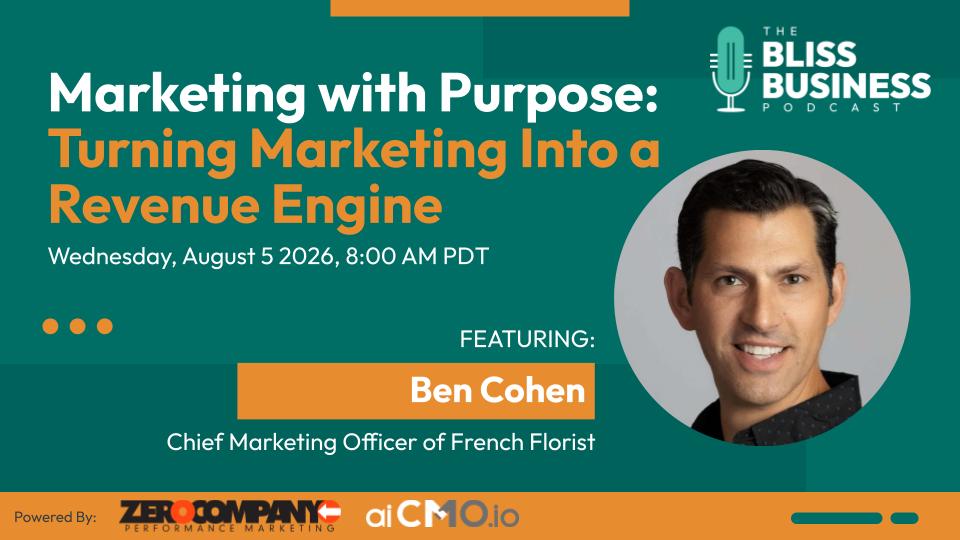
That perspective, that customer experience drives revenue as much as acquisition does, came through clearly in a recent conversation with Ben Cohen, Chief Marketing Officer of French Florist, on the Marketing with Purpose series of The Bliss Business Podcast. Ben brings more than two decades of marketing experience across major brands and franchise systems, and his view of marketing is both performance-driven and deeply practical: the work has to move the business forward, but it also has to build something durable.
For French Florist, that durability comes from creating stronger customer relationships around moments that already carry emotional meaning. Flowers are not just products. They are part of celebrations, apologies, grief, gratitude, romance, remembrance, and connection. That makes marketing’s role especially interesting, because the revenue opportunity is inseparable from the human experience surrounding the purchase.
The lesson reaches far beyond floral retail. Any company trying to turn marketing into a predictable growth engine has to understand that revenue becomes more sustainable when customers feel more than persuaded. They feel understood.
ROI Matters, but the Definition Has to Be Big Enough
Ben begins with a simple principle: marketing has to produce business impact.
That is the right starting point.
Creative quality matters. Brand expression matters. Campaigns should be compelling. But if marketing activity is not contributing to the growth of the business, something is eventually going to break down.
The challenge is that ROI can be interpreted too narrowly.
If leadership only asks what produced a sale today, it risks underinvesting in the work that makes future sales more efficient. Brand consistency, customer experience, and long-term familiarity may not always show up neatly in the same reporting window as a paid media campaign, but they still influence whether the next customer chooses the business.
This is especially important in franchise systems, where marketing spend often represents the hard-earned investment of local owners. Ben describes himself as a steward of that investment, which is a useful way to frame the responsibility. Marketing is not simply spending a budget. It is helping determine whether another person’s business has the best possible chance to grow profitably.
That raises the standard.
Near-Term Sales and Long-Term Brand Are Not Opposing Goals
Many marketing organizations still treat performance and brand as if they are fighting for the same dollar.
Ben’s approach rejects that idea.
The goal is to generate sales today in a way that also strengthens the brand customers will remember tomorrow. That requires consistency in strategy, message, and experience. A short-term promotion that produces transactions but weakens brand trust may look successful in isolation while damaging the longer-term engine.
This is why Ben repeatedly asks whether work is on strategy and on brand.
Those questions act as guardrails. They make sure immediate revenue pressure does not push the company into tactics that create inconsistency or train customers to value only price.
A predictable revenue engine needs both sides of the equation. Performance creates momentum, while brand strength lowers the friction around future acquisition and retention.
Customer Experience Is Part of the Revenue Model
One of the strongest themes in Ben’s perspective is that the customer cannot be separated from the financial model.
In moments of uncertainty, he comes back to a basic question: what is best for the client?
That is not simply a service principle. It is a strategic one.
In many consumer businesses, the long-term economics of growth improve dramatically when the customer relationship deepens. Retention lowers dependence on constant acquisition. Repeat behavior smooths volatility. Positive experiences increase referrals and strengthen the reputation that supports future conversion.
French Florist’s purpose, creating more love in life through flowers, gives that customer focus a clear expression. The brand is not simply trying to fulfill floral orders efficiently. It is participating in moments that matter to people.
When a company understands that, the revenue engine becomes less transactional by design.
Data Should Inform Decisions, Not Replace Judgment
Ben makes an important distinction about analytics: data is an input, not the decision-maker.
That is especially relevant now, when marketing teams have access to more dashboards, attribution systems, customer data, and behavioral signals than ever before.
The temptation is to assume that more data automatically creates better decisions.
It does not.
Quantitative data can show what is happening, but it cannot always explain why. That interpretation still requires context, experience, and judgment. This becomes particularly important in franchise systems where local markets can behave very differently.
A campaign strategy that works in one city may underperform in another because of competitive intensity, income levels, cultural differences, community dynamics, or established local habits. A single national playbook cannot capture all of that nuance.
Ben’s emphasis on partnering with franchise owners reflects a better model. Centralized data provides structure, while local operators contribute the context needed to understand how the market actually behaves.
That combination produces stronger decisions than either source alone.
Predictability Comes From Knowing Which Signals Matter
One of the hardest parts of building a revenue engine is separating signal from noise.
Marketing teams can track almost anything. The more sophisticated the stack becomes, the easier it is to confuse visibility with understanding.
Ben points to the importance of defining a single source of truth and identifying the metrics that actually matter to the business. That is particularly challenging when external forces such as seasonality, macroeconomic pressure, and local market changes can shift results from one quarter to the next.
Predictable revenue does not mean eliminating uncertainty. It means building enough understanding of the business that the organization can interpret variation intelligently.
That requires historical context, strong measurement, and a willingness to acknowledge that market conditions can change the meaning of the same number.
The goal is not perfect forecasting.
It is better judgment.
Retention Deserves More Attention Than It Gets
Acquisition tends to dominate marketing conversations because it is easy to see and easy to celebrate.
New customers create momentum.
Lead volume feels tangible.
Growth charts look exciting.
But Ben argues that retention deserves even more strategic focus.
That is especially true in categories where repeat purchase is possible and where customer habits can be nurtured over time. A retained customer often has a much different economic profile from a new one. They already know the brand, trust the experience, and require less persuasion.
For French Florist, that can mean becoming part of a customer’s regular rhythm rather than remaining a brand used only for special occasions.
The broader lesson is simple: if a company wants a more stable revenue engine, it should not rely exclusively on finding new people. It should become better at keeping the people it has already earned.
Internal Alignment Makes Growth More Repeatable
Ben is also clear about how quickly execution can fall apart without internal communication.
Even relatively small organizations can develop silos between functions. New initiatives become harder to execute when teams are not aligned on the objective, the success metrics, and ownership.
His solution is straightforward: a concise strategy brief.
That may sound basic, but its value is significant. A clear strategy on a page creates a common reference point for why the initiative exists, what success looks like, and who is responsible for what.
Without that structure, teams often fill in the gaps themselves. Different groups interpret the objective differently, deadlines become ambiguous, and execution drifts.
Marketing becomes more scalable when the organization can reduce that ambiguity before the work begins.
High-Performing Teams Need Meaningful Problems to Solve
Ben’s approach to talent development also reinforces the larger theme of purpose.
He believes strong performers want meaningful challenges and the autonomy to solve them.
That combination matters.
People rarely do their best work when they are micromanaged through every decision. Strong teams become stronger when leaders give them clear priorities, trust their expertise, and allow them to own meaningful outcomes.
At French Florist, quarterly priorities help create that focus. The expectations are visible, but the path to execution still leaves room for ownership.
Ben also emphasizes an important leadership principle: the goal of a leader is not to create more followers, but more leaders.
That is especially relevant for marketing organizations that want to scale. A CMO who remains the center of every decision eventually becomes the bottleneck. The more valuable approach is to develop people who can think commercially, take responsibility, and make good decisions without constant supervision.
Purpose Becomes Revenue-Relevant When It Shapes the Experience
The most memorable story from Ben’s conversation had nothing to do with flowers.
One of French Florist’s franchise owners had access to premium World Cup tickets that ultimately went unused. Instead of letting the opportunity pass, the business gave them to a loyal customer, allowing a grandmother to take her soccer-loving granddaughter to an experience they would never forget.
There was no immediate floral transaction attached to the gesture.
That is exactly why it mattered.
Ben connects this to the idea of unreasonable hospitality: creating experiences that go far beyond what customers expect. Those moments build emotional memory and deepen the relationship between customer and brand.
From a purely transactional perspective, the gesture may be difficult to attribute.
From a relationship perspective, its value is obvious.
This is where purpose becomes commercially meaningful. It gives the organization a reason to create experiences that customers remember, which strengthens trust, advocacy, and loyalty over time.
Key Takeaways
Marketing should be accountable to business growth, but ROI needs a long enough horizon. Short-term performance matters, but so does the brand equity that improves future acquisition and retention.
Customer experience belongs inside the revenue model. Relationships create repeat behavior, referrals, and stronger long-term economics.
Data is an input, not a substitute for judgment. Local context and human insight remain essential, especially in franchise systems.
Predictability starts with better measurement discipline. The goal is to identify the signals that actually help leadership understand the business.
Retention is one of the strongest ways to stabilize growth. A revenue engine becomes more durable when it relies less heavily on constant new-customer acquisition.
Internal clarity improves execution. Simple strategy briefs and explicit ownership help teams stay aligned as initiatives become more complex.
Purpose can strengthen commercial performance when it creates memorable experiences. The most meaningful customer relationships are often built through actions that go beyond the immediate transaction.
Final Thoughts
What this conversation with Ben Cohen, Chief Marketing Officer of French Florist, makes clear is that turning marketing into a revenue engine requires more than improving campaign performance.
It requires a broader understanding of how revenue actually grows.
Acquisition matters, but so does retention. Data matters, but so does judgment. Performance matters, but so does brand consistency. And customer experience matters because the strongest businesses are not built on an endless series of isolated transactions.
They are built on relationships people want to continue.
That is where marketing becomes more predictable, more defensible, and more valuable to the business over time.
Where to Go Next
Listen to the full episode or watch the video conversation with Ben Cohen on The Bliss Business Podcast. A revenue engine built on trust outlasts one built on transactions alone.

Guest Development | Producer | Blog Contributor
Martha is a connector who brings over two decades of experience in engineering, sustainability, education, and public relations. She is part of the integrated go-to-market team at Zero Company and serves as Guest Development Lead for The Bliss Business Podcast, where she connects with purpose-driven leaders to shape meaningful conversations. Martha also produces the Marketing With Purpose Kit segments with CMO guests.
Her career includes founding nonprofits, and speaking at global forums in Malaysia, Dubai, and Paris. A passionate community builder, Martha also mentors women entrepreneurs and supports environmental initiatives across Mexico and the U.S. Her work reflects a deep commitment to impact, inclusion, and authentic leadership.

Starting Over Deserves Community