Starting Over Deserves Community

Some of life’s biggest transitions are publicly celebrated. Weddings, graduations, new jobs, new homes, and babies come with rituals, gifts, gatherings, and clear social permission to ask for support.
Other transitions happen much more quietly.
Divorce, breakups, grief, moving, career changes, and other major life disruptions can require just as much emotional strength and practical rebuilding, yet people often move through them with far less structure around support. They may be expected to explain what happened, justify why they are starting over, and somehow manage the logistics of rebuilding while still processing the emotional reality of what changed.
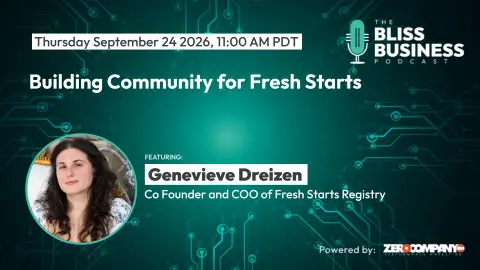
On The Bliss Business Podcast, we sat down with Genevieve “Jenny” Dreizen, Co-Founder and CEO of Fresh Start Registry, to explore what people really need when they are beginning again. Jenny and her sister, Olivia Dreizen-Howell, created Fresh Start Registry after both experienced major relationship transitions and recognized how difficult it can be to ask for help when life has suddenly changed. The platform now provides registry tools, curated product bundles, a vetted expert guide, educational resources, podcasts, and community support for people navigating divorce and other major transitions. Building Community for Fresh St…
Their work is built around a powerful idea: starting over should not be treated as something to hide. It should be supported with dignity, practical help, and human connection.
Starting Over Is Not the Same as Failing
One of the deepest barriers people face during major life transitions is shame.
Jenny talked openly about how language shapes that shame, especially when people describe a marriage that ended as a “failed marriage.” Her perspective is that the end of a relationship does not automatically invalidate everything that came before it. People learn, grow, build lives, raise families, change, and sometimes reach a point where the healthiest path forward is no longer together.
That does not make the relationship meaningless.
It also does not mean someone failed.
This reframing matters because people often hesitate to ask for support when they feel they should be apologizing for where they are. If someone believes the transition itself is evidence that they did something wrong, receiving help can feel uncomfortable or undeserved.
But rebuilding is not something to be ashamed of.
It can be an act of courage, clarity, and self-respect.
Practical Support Matters Because Emotional Capacity Is Limited
One of the most important insights behind Fresh Start Registry came from Jenny’s own experience of moving into a new place after ending an engagement.
She had left with very little and suddenly found herself managing a long list of decisions. Furniture had to be delivered. Utilities had to be set up. Passwords had to be changed. Accounts had to be separated. Basic household items had to be purchased. At the same time, she was processing the emotional reality of the relationship ending. Building Community for Fresh St…
That combination can be overwhelming.
When someone is in the middle of a major transition, even simple decisions can become exhausting. Choosing sheets, bowls, towels, or a couch may sound trivial from the outside, but those choices arrive on top of hundreds of other decisions involving finances, children, living arrangements, legal matters, identity, and the future.
This is where practical support becomes emotional support.
Helping someone replace basic household items is not just about the objects themselves. It reduces decision fatigue. It helps make a new home functional. It allows the person to feel less alone in rebuilding.
People Often Want to Help but Do Not Know How
One of the challenges Fresh Start Registry is designed to solve is the disconnect between people who need support and people who genuinely want to provide it.
Friends and family often ask, “What can I do?”
The person going through the transition often has no idea how to answer.
They may be too overwhelmed to create a list. They may feel uncomfortable asking for things. They may worry about appearing needy. They may not even realize what they need until they are standing in an empty kitchen wondering where the can opener is.
Jenny experienced this firsthand. People around her wanted to help, and some brought thoughtful gifts. But what she often needed were very practical household items, and there was no easy way to communicate that without feeling as though she was asking too much.
That is one reason the registry model is so useful.
It makes support visible.
The person starting over can identify what would actually help. The person who loves them can act without guessing. The awkwardness is reduced for both sides.
Support Does Not Have to Cost Money
Another important part of the Fresh Start model is the recognition that support should never be limited to purchasing things.
Some of the most meaningful help Jenny received involved people showing up physically and practically. Someone helped break down moving boxes. Someone helped assemble furniture. Friends offered time, attention, and labor.
That kind of support can matter enormously.
A friend can FaceTime with a child while a parent makes a difficult phone call. Someone can research a lawyer, organize a meal, help draft an email, make a grocery run, or simply sit in the room while the other person handles an overwhelming task.
The key is specificity.
“Let me know if you need anything” sounds kind, but it places the burden back on the person who is already overwhelmed. Saying, “I can bring dinner, help with the boxes, or research something for you, which would help most?” is much easier to respond to.
Support becomes more useful when it is concrete.
Rebuilding Can Be Especially Complex for Parents
Starting over becomes even more complicated when children are involved.
A family may suddenly need two sets of bedrooms, clothes, furniture, toys, school supplies, and household routines. Parents may be establishing new homes while also trying to create continuity and emotional safety for their children.
Jenny shared how thoughtfully her sister approached the children’s room bundle on Fresh Start Registry. One of the priorities was ensuring the furniture and items could be assembled by one adult because a newly single parent may not have another adult available to help. Building Community for Fresh St…
That detail reveals something important about empathy.
Good support does not simply ask, “What product should be included?”
It asks, “What situation is this person actually in when they receive it?”
That is the difference between designing around a category and designing around a human being.
The Objects in a New Home Can Carry Emotional Meaning
A towel is just a towel until someone who loves you gives it to you while you are rebuilding your life.
Then it becomes something more.
Jenny described how people can look around their homes and feel the presence of the community that supported them. The bowl, sheets, toothbrush holder, or piece of furniture may be practical, but it can also become a physical reminder that someone cared enough to show up.
That is what makes these registry items different from simple consumer purchases.
They become support made tangible.
When someone is starting over, creating a new physical environment is often connected to creating a new emotional one. Small objects can help someone feel that the new life they are building is not empty. It contains evidence of relationships that remain.
Curiosity Is More Helpful Than Judgment
One of Jenny’s strongest pieces of advice is to choose curiosity over judgment.
People going through a divorce or another major life change are often surrounded by assumptions. Friends assume they must be devastated. Family members assume they want reconciliation. Others assume they should be angry, relieved, embarrassed, or celebratory.
The truth may be far more complicated.
Someone may feel grief and relief at the same time. They may feel sadness about the relationship ending and confidence that ending it was the right decision. They may be escaping something harmful and feel deeply hopeful about what comes next.
That is why asking is better than assuming.
“How are you feeling today?” is more useful than deciding how someone should feel.
“How can I support you right now?” creates more space than telling them what they ought to do.
Empathy begins with curiosity because curiosity leaves room for the other person’s reality.
Modern Etiquette Should Help People Feel Welcome
Jenny also brings a modern etiquette perspective to this work.
Her definition is refreshingly simple: etiquette should help people feel warm and welcome. If it does not do that, it is missing the point.
That is especially useful during emotionally complicated moments.
People often freeze because they are terrified of saying the wrong thing. They default to phrases like “I’m sorry you’re going through this,” even when the transition may actually represent freedom, safety, or a healthier future.
The better approach is to pay attention to the individual.
Instead of leading with a script based on assumptions, ask where they are emotionally. Ask what kind of support feels right. Let them set the tone.
Good etiquette is not about perfect wording.
It is about making the other person feel respected.
Support Should Not Become Transactional
One of the most thoughtful aspects of Fresh Start Registry is the way the business model was designed.
Jenny and her sister were intentional about keeping the core resources free for people navigating divorce. They understood that divorce itself can create tremendous financial uncertainty, and they did not want the person going through the transition to become the primary source of revenue.
Instead, the business developed an expert membership model for divorce professionals who already have marketing budgets. Those professionals receive visibility, networking, coaching, podcast opportunities, magazine participation, educational programming, and referrals, while their membership fees help subsidize the resources available to people going through divorce. Building Community for Fresh St…
That model aligns revenue with purpose.
The business still has to make money. Professionals providing real services still deserve compensation. But the company has been thoughtful about where the economic burden belongs.
That is a meaningful example of balancing profit with social responsibility.
Community Can Be Built Into a Business Model
Fresh Start Registry is not only a registry platform. It has evolved into an ecosystem.
People going through divorce can access expert guidance, free educational materials, events, scripts, podcasts, and practical resources. Professionals working in divorce-related fields gain a community of peers and opportunities to develop their practices.
That two-sided structure allows one community to help sustain another.
It also addresses another challenge Jenny identified: divorce professionals can be isolated too. Many are solopreneurs working in emotionally demanding fields. They benefit from networking, shared learning, referrals, and spaces where they can ask questions of people who understand the specific challenges of the work.
The result is a business model built around connection on both sides.
That is what scalable care can look like.
Purposeful Businesses Still Need Patience
Jenny was candid about how long it took for the business to begin turning a meaningful corner.
Like many founders, she and her sister initially underestimated the time required. They kept building, experimenting, learning, and refining the model. Years later, they could finally see the financial progress becoming more visible.
This is an important part of purpose-driven entrepreneurship that does not get discussed enough.
A meaningful mission does not automatically create a sustainable company.
You still need product-market fit, revenue strategy, discipline, consistency, and patience. A socially meaningful business may be deeply needed and still take years to build.
Purpose can give founders a reason to persist.
But persistence still has to be paired with adaptation.
Starting Over Has No Expiration Date
One audience question asked about the biggest myth surrounding starting over later in life.
Jenny’s answer was powerful: the myth is that there is such a thing as “too late.”
People often ask whether it is too late to go back to school, change careers, move, leave a relationship, or begin again. But the time is going to pass regardless.
The real question is what life someone wants to be living when that time passes.
Starting over at 28, 52, or 72 can still be meaningful.
There is no age at which someone becomes disqualified from pursuing more peace, joy, fulfillment, or safety.
That belief is especially important because many people remain stuck not because there is truly no path forward, but because they have internalized the idea that they missed their chance.
Love in Business Means Building Around Human Reality
When we asked Jenny what role love should play in business, she described love broadly through respect, admiration, care, and fulfillment.
Her point was that people do not become completely different versions of themselves when they walk into work. The same person exists at home and in the business. Their emotional world, relationships, values, frustrations, and hopes travel with them.
That makes it unrealistic to expect people to completely separate their humanity from their work.
A business built with love recognizes this.
It does not mean eliminating professionalism or accountability. It means acknowledging that people are whole human beings and designing systems, cultures, and relationships accordingly.
In Fresh Start Registry’s case, that means designing around the emotional and practical reality of starting over rather than treating the person as simply another customer segment.
Key Takeaways
- Starting over should not automatically be framed as failure. Major life transitions can also represent courage, growth, freedom, and the pursuit of a healthier future.
- People going through divorce or other major transitions often need practical help because their emotional capacity is already being consumed by difficult decisions.
- Registries can reduce the awkwardness of asking for support by making real needs visible to friends and family who already want to help.
- Meaningful support does not have to cost money. Time, research, childcare help, meals, moving assistance, and specific offers of help can be just as valuable.
- Empathy means designing around the reality people are living, including details such as whether a newly single parent can assemble something without another adult.
- Practical items can become emotional symbols of community because they remind people that others supported them during a vulnerable time.
- Curiosity is more helpful than judgment because no two people experience divorce, grief, or major change in exactly the same way.
- Modern etiquette should make people feel welcome and respected rather than forcing them into predetermined emotional scripts.
- Purpose-driven business models can still be financially sustainable when revenue is aligned thoughtfully with who has the ability to pay.
- Community can be scaled when the business creates value for both the people receiving support and the professionals serving them.
- Starting over has no expiration date. People are never too old to pursue greater peace, fulfillment, or possibility.
Final Thoughts
Genevieve Dreizen’s perspective is a reminder that people do not only need community when life goes according to plan.
They may need it even more when the plan falls apart.
Starting over can involve grief, fear, confusion, financial pressure, logistics, identity, and hundreds of decisions that arrive at the same time. In those moments, support becomes more than an encouraging message. It becomes the practical evidence that someone does not have to rebuild alone.
That support can look like new sheets. It can look like assembling furniture. It can look like watching a child for an hour, helping research a professional, or simply asking the right question without judgment.
What matters is that the person feels seen.
Fresh Start Registry turns that idea into a system by helping people communicate what they need, helping loved ones know how to respond, and helping professionals connect with the people they are equipped to serve.
That is what it means to build community around a fresh start.
Not pretending the transition is easy. Not deciding how someone should feel about it. Not reducing it to a transaction.
Simply recognizing that when someone is beginning again, they deserve support too.
Check out our full conversation with Genevieve Dreizen of Fresh Start Registry on The Bliss Business Podcast.

Executive Producer | Host | Blog Contributor
Tullio Siragusa is a strategic advisor, dynamic speaker, author, and EQ coach with 36 years of experience as a technology disruptor rooted in Design Thinking. Since 2018, he has been creating, producing and hosting live podcasts, interviewing over 1,000 C-suite executives across a wide range of industries. His work behind the mic reflects his larger mission: using conversation as a catalyst for human-centric innovation.
Tullio’s commitment to purpose-driven leadership and ethical transformation is reflected in his advisory roles at the University of California, Riverside’s Design Thinking Executive Program, and the University of San Francisco School of Management’s Digital Marketing Program. As a Board Advisor at AI2030.org, he helps guide the responsible advancement of AI toward ethical and sustainable outcomes. A founding member of RadicalPurpose.org, Tullio believes empathy isn’t just a trait, it’s a non-negotiable foundation for leadership.

Growth Needs Both Discipline and Heart