The Fastest Way to Grow Is to Stop Treating Marketing Like a Department

A lot of businesses say they want marketing aligned with growth.
What they often mean is that they want more leads, lower costs, and faster results. That is understandable. But true alignment runs deeper than campaign performance. It asks a more serious question: is marketing actually connected to how the business grows, or is it still being treated like a separate function that reports on activity after the fact?
That distinction matters more than most leaders realize.
Because marketing does not become a growth engine simply by generating impressions, clicks, or downloads. It becomes a growth engine when it is tied directly to what the business is trying to achieve, when the right success metrics are being measured, and when the teams around it are aligned enough to turn attention into outcomes.
That is why aligning marketing with business growth is such an important conversation right now.
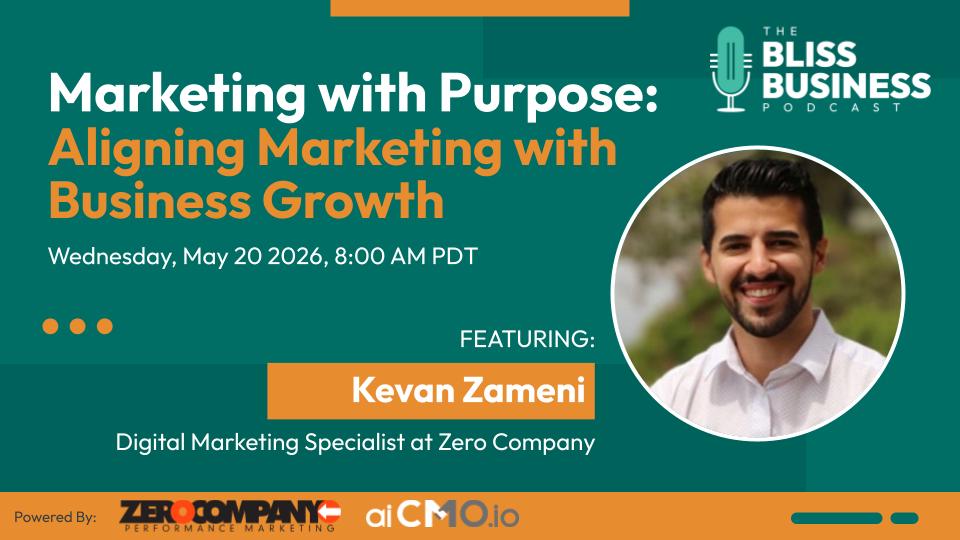
In a recent conversation with Kevan Zameni, Digital Marketing Specialist at Zero Company, on the Marketing with Purpose series of The Bliss Business Podcast, the case against treating marketing as a department came through clearly. Kevan brought a grounded perspective from paid media and search, shaped by the realities of helping businesses connect marketing performance to actual business goals. His message was refreshingly practical: marketing gets into trouble when it drifts too far from outcomes that matter. And the strongest growth happens when everyone is aligned around what success really means.
Because in the end, marketing only earns trust when it helps the business grow in ways the business can actually feel.
Marketing Gets Weak When It Optimizes for the Wrong Kind of Winning
One of the clearest ideas in this conversation is that many marketing teams still get rewarded for metrics that sit too far away from business reality.
Clicks can look good.
Engagement can look good.
Downloads can look good.
Traffic can look good.
But if none of those things connect meaningfully to leads, sales, retention, or revenue, then what exactly is being improved?
This is one of the quietest reasons companies lose faith in marketing. Not because marketing has no value, but because too much of its value is being described in terms that do not map clearly enough to business outcomes. The reporting looks active. The dashboard looks alive. But the leadership team is still asking the most basic question: is this helping us grow?
Kevan is right to point out that the strongest results come when marketers start from the business objective, not from the platform metric. That changes the whole discipline. It forces the team to ask better questions. What are we trying to drive? What behavior actually matters? Which metrics are meaningful signals, and which ones are just convenient proxies?
That is where alignment begins.
Not in the channel.
In the goal.
Short-Term Pressure Usually Becomes Destructive When Expectations Are Misaligned
One of the most common traps in modern marketing is expecting every campaign to do every job at once.
An awareness campaign gets judged like a sales campaign.
A brand initiative gets judged like a lead-gen sprint.
A long-term growth play gets abandoned because it did not produce yesterday’s result fast enough.
This is where friction shows up quickly.
Kevan’s point here is especially important: if the business is not clear on what a campaign is meant to do, then disappointment becomes almost inevitable. Marketing starts chasing approval rather than strategy. Leadership starts reacting to normal fluctuations as if they are failures. The whole system gets more emotional and less intelligent.
This is one reason the best marketers spend so much time setting expectations. It is not just about reporting the result. It is about making sure everyone understands the purpose of the work before the result arrives. Otherwise, teams end up evaluating success against assumptions no one ever properly defined.
That is not a campaign problem.
That is an alignment problem.
Pressure Reveals Whether the Relationship Is Built on Partnership or Blame
Another strong insight from the conversation is Kevan’s perspective on what happens when leads slow down or the market becomes unstable.
Those are the moments that expose the quality of the relationship between client and marketer.
If the relationship has been built on defensiveness, performance theater, or shallow trust, then pressure usually brings conflict quickly. The business owner feels fear. The marketer feels accused. Each side begins protecting itself. And instead of solving the problem, everyone gets pulled into proving they are not the problem.
That is a terrible place to try to make smart decisions from.
Kevan’s answer is a much healthier one. Stay calm. Do not react emotionally. Bring the conversation back to data. But just as importantly, lead with empathy. Understand that the business owner is not always reacting from logic alone. They are reacting from pressure, livelihood, uncertainty, and real fear. If the marketer can recognize that without taking it personally, the conversation can shift from confrontation to collaboration.
That kind of posture matters.
Because brands do not only need technical help when markets get hard.
They need steadiness.
They need perspective.
They need someone who can help translate fear into action without escalating the emotion in the room.
Alignment Breaks Down Most Often in the Space Between Departments
When the conversation turned to launching products and managing growth across functions, Kevan named something that nearly every growth organization struggles with: siloed interpretation.
Marketing may believe the campaign is working.
Sales may believe the leads are weak.
Product may believe the offer is clear.
Leadership may believe results should be happening faster.
All of them may be acting in good faith.
All of them may still be misaligned.
This is where the real work of growth leadership lives.
Because scalable growth is not created by one department doing its part in isolation. It happens when the handoffs between departments are clear enough, honest enough, and connected enough that the customer experiences one coherent path rather than a series of internal disconnects.
This is also why the role of a CMO or marketing leader is often misunderstood. The job is not only to generate messaging or demand. It is to help connect the business around the customer journey. That means asking what sales needs. What customer success is seeing. What the product is promising. What the market is actually responding to. If those conversations are not happening, then even very good marketing can end up feeding a broken system.
Data Is Powerful, but It Needs Context to Become Insight
One of the most useful parts of Kevan’s perspective is his balance between intuition and analytics.
He is not dismissing instinct.
He is not worshiping it either.
That is the right posture.
The best marketers often begin with an informed hypothesis. They think a certain audience may respond. A certain channel may fit. A certain angle may resonate. But then the data has to validate or challenge that instinct. And when the data says something different than expected, the job is not to force the narrative. The job is to listen and adjust.
This is where marketing becomes more scientific without becoming less human.
Because the point of data is not just to prove that we were right. It is to help us understand what is actually happening. Sometimes that means discovering that a campaign is attracting attention but not the right kind of attention. Sometimes it means seeing that the engagement looks healthy while the revenue contribution remains weak. Sometimes it means realizing that what feels intuitively strong is not what the market is choosing at all.
That kind of learning is not failure.
It is what makes the next move smarter.
Revenue Alignment Usually Requires Better Definitions, Not Just Better Ads
Another important point in the episode is that good marketing needs better business definitions around value.
A lead is not always a lead in the most useful sense.
A conversion is not always the same thing as meaningful progress.
A cost per acquisition only matters if the business knows what that acquisition is actually worth.
Kevan is right to stress the importance of assigning value to different conversion actions. Without that, marketing can end up optimizing toward movement that looks good mathematically but does not really serve the business economically. The platform may be performing, but the business may still feel stuck because the optimization target itself is too shallow.
This is why aligning marketing with growth often starts with better financial thinking. What is a qualified lead worth? What does a customer contribute over time? Which actions correlate most strongly with real revenue? What behaviors deserve more investment because they create long-term business value, not just short-term activity?
When those definitions become clearer, the campaigns become clearer too.
And when they do not, the whole function gets fuzzier than it needs to be.
A Great Marketing Partner Meets the Customer Where They Actually Are
One of the most practical lessons in Kevan’s conversation is his point that different businesses convert differently, and that reality should shape strategy.
This seems obvious.
It is still frequently ignored.
Some customers want forms.
Some want phone calls.
Some need speed.
Some need reassurance.
Some convert quickly.
Some require nurturing.
The job of marketing is not to force everyone into the funnel that is easiest to track. It is to build the path that best matches how the actual customer wants to move. That may sound simple, but it requires humility. It requires listening. And it requires resisting the urge to optimize around convenience rather than reality.
This is one of the reasons good marketing feels so aligned when it works well. It does not fight the customer. It does not insist on being right. It pays attention to behavior and adapts around what the customer is already showing.
That is not less strategic.
It is more strategic.
Great Marketing Talent Grows Through Context, Not Just Tasks
Kevan also offered an important insight on the internal side of marketing teams: people stay stronger when they understand how their work contributes to something bigger than their to-do list.
That matters because marketing can easily become repetitive and fragmented if all people are given are channel tasks and deadlines. A campaign here. A revision there. Another platform change. Another optimization cycle. Without context, the work can start to feel mechanical even when it is technically demanding.
But when a team understands the company’s purpose, the client’s business goals, and the reason behind the work, motivation changes. The person is no longer just “running ads.” They are helping a business grow. They are helping solve a real problem. They are part of a system with visible consequence.
That kind of context matters more than many leaders realize.
It helps people make better decisions.
It helps them stay engaged longer.
And it helps them grow into stronger strategic thinkers rather than just more efficient executors.
Empathy Is Often the Difference Between a Good Technician and a Trusted Advisor
The final story Kevan shared about a frustrated client illustrates something that many marketers only learn through experience: expertise alone is not enough.
When a client is upset, the easy move is to go defensive.
To explain.
To justify.
To prove.
But that often deepens the tension rather than resolving it.
Kevan’s better instinct was to step back and recognize what the client was actually feeling. Not just what they were saying, but what was underneath it. Fear. Stress. Urgency. Uncertainty. Once he responded from that understanding rather than from his own ego, the relationship shifted. The conversation became collaborative again.
That is a real leadership skill.
Because clients rarely need marketing partners who only know the platforms.
They need partners who can interpret the pressure without becoming consumed by it.
They need people who can help them think clearly when the numbers feel scary.
And they need to trust that the relationship is strong enough to handle difficult moments without collapsing into blame.
That is how marketing stops feeling like a vendor service and starts becoming part of the business.
Key Takeaways
Marketing gets stronger when it starts with business goals. Clicks and engagement only matter if they contribute to meaningful outcomes.
Expectation-setting reduces friction. Teams struggle most when campaigns are judged by goals they were never designed to achieve.
Pressure tests the relationship. Strong client partnerships are built when marketers lead with calm, data, and empathy under stress.
Cross-functional alignment matters as much as campaign quality. Marketing, sales, and product need shared understanding or growth gets fragmented.
Data should refine intuition, not replace it. The best marketers use instinct to form hypotheses and data to validate or challenge them.
Revenue alignment requires better definitions. Companies need to know what actions are actually worth before optimizing for them.
Context helps marketing talent grow. People perform better when they understand how their work contributes to larger business outcomes.
Final Thoughts
What this conversation with Kevan Zameni, Account Executive at Zero Company, makes clear is that aligning marketing with business growth is not mostly about better tools or louder campaigns.
It is about better connection.
Connection between metrics and meaning.
Connection between departments.
Connection between marketers and business owners.
Connection between what customers actually want and how the business shows up to serve them.
That is what turns marketing from a reporting function into a growth function.
And increasingly, the companies that win will be the ones that stop treating marketing like a separate department and start treating it like one of the clearest expressions of how the whole business grows.
Where to Go Next
Listen to the full conversation: Marketing With Purpose Kit: Aligning Marketing with Business Growth with Kevan Zameni.
Watch the video: Kevan Zameni on marketing metrics that matter.
Meet Kevan on his guest profile.

Guest Development | Producer | Blog Contributor
Martha is a connector who brings over two decades of experience in engineering, sustainability, education, and public relations. She is part of the integrated go-to-market team at Zero Company and serves as Guest Development Lead for The Bliss Business Podcast, where she connects with purpose-driven leaders to shape meaningful conversations. Martha also produces the Marketing With Purpose Kit segments with CMO guests.
Her career includes founding nonprofits, and speaking at global forums in Malaysia, Dubai, and Paris. A passionate community builder, Martha also mentors women entrepreneurs and supports environmental initiatives across Mexico and the U.S. Her work reflects a deep commitment to impact, inclusion, and authentic leadership.

Starting Over Deserves Community