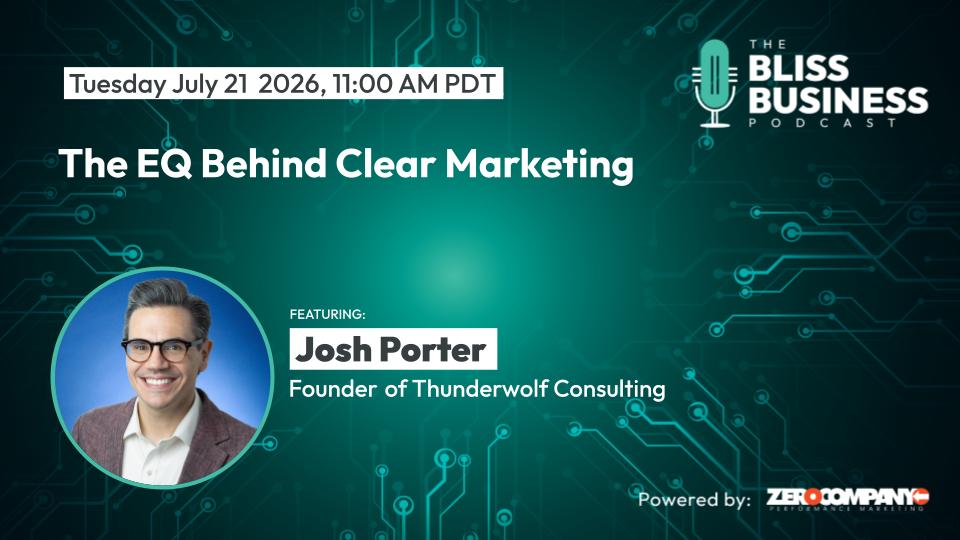
The EQ Behind Clear Marketing

A product may be brilliant, but if the message is confusing, buyers hesitate.
If the story is unclear, sales teams improvise.
If the team is misaligned, the market feels it.
This is especially true in technical markets, where companies can build powerful products that are difficult for customers to understand. In those environments, emotional intelligence is not just a leadership trait. It is a marketing advantage.
On The Bliss Business Podcast, we sat down with Josh Porter, Founder of Thunderwolf Consulting, to explore how EQ shapes product marketing, go-to-market strategy, sales alignment, narrative clarity, and customer trust. Josh brings 20 years of go-to-market experience across enterprise software and high-growth startups, with nearly a decade focused on AI and developer tools. He has led product marketing and growth at Google Cloud and multiple AI scale-ups, and through Thunderwolf Consulting he helps AI and developer-tool companies clarify positioning, sharpen narratives, and build go-to-market strategies that accelerate adoption.
His message was clear: technical excellence matters, but customers remember the story that connects to their pain.
Marketing Starts With the Customer’s Pain
Technical companies often struggle because they begin with what they built.
They talk about features, architecture, models, parameters, context windows, automation capabilities, integrations, and performance. Those details may matter, but they are not where the customer starts.
The customer starts with pain.
Josh put it directly: technically strong companies struggle when they do not begin with what the customer is experiencing. Buyers do not care about how sophisticated the product is until they understand how it solves a problem that matters to them.
That is where emotional intelligence enters marketing.
The emotionally intelligent marketer asks:
-
What is the customer frustrated by?
-
What pressure are they under?
-
What problem keeps returning?
-
What outcome would make their life easier?
-
What story helps them see themselves in the solution?
The product matters. But the customer’s world comes first.
Your Product May Have Teeth, But Your Story Needs Them Too
Thunderwolf’s positioning includes a memorable line: “Your product has teeth. Your story doesn’t.”
That speaks directly to a common problem in technical companies. The product may be powerful, but the story does not create traction.
Josh explained that customers need to see their own pain reflected in the message. For example, a company selling AI for customer experience should not start by saying it can automate millions of conversations. It should begin by showing how poor customer satisfaction, long wait times, or broken self-service journeys are hurting the business and frustrating customers.
The story becomes powerful when the buyer thinks, “That is exactly what we are dealing with.”
That is when attention turns into interest.
Confusing Messaging Creates Internal and External Friction
Messaging confusion is easy for customers to spot.
A website says one thing.
A salesperson says another.
A conference presentation tells a third version.
The CEO describes the company differently again.
From the outside, that inconsistency creates doubt. Customers wonder what the company really does, what it stands for, and whether it can deliver what it promises.
Josh shared that he often surveys customers and internal teams to assess narrative alignment. Many companies believe they are highly aligned, but the reality is often much lower. Sales, marketing, leadership, and product teams may all be telling different versions of the story.
That misalignment does more than confuse the market. It creates internal frustration.
Sales teams may feel marketing does not understand customers. Marketing may feel sales ignores the message. Leadership may feel the team is not repeating the company’s vision. Product may feel the technical value is being lost.
Clear marketing is not only about better copy. It is about organizational alignment.
Humility Keeps the Brand Honest
A strong CMO, product marketer, or fractional marketing leader cannot simply be a yes person.
Marketing has to challenge assumptions.
That requires humility from leadership and courage from marketing. Josh described the importance of bringing customer evidence, testing, industry observations, and experience into the conversation. When a founder or CEO believes one message will work but customer data suggests otherwise, the marketing leader has to be willing to respectfully disagree.
At the same time, marketing leaders need humility too.
Sometimes the sales team is closer to the customer and has better language. Sometimes leadership has a strategic insight marketing has not fully absorbed. Sometimes the market itself forces a change in narrative.
The goal is not for one function to win. The goal is for the company to tell the truth more clearly.
Emotional Intelligence Helps Teams Align
Josh emphasized that narrative alignment should not be developed in isolation.
A messaging framework is more likely to be used when sales, product, marketing, and leadership help shape it together. If marketing builds the framework alone and then hands it to sales as a finished product, sales may see it as another marketing exercise rather than a shared operating tool.
The better approach is collaborative.
Bring sales leadership into the process. Learn what customers are actually saying. Understand what objections come up repeatedly. Identify what language already works. Then create a framework that sales leaders can endorse and help train across the team.
That creates buy-in.
People are more likely to use a message they helped build.
The Customer Connect Code
Josh shared a practical framework from his book The Last Human Marketer called the Customer Connect Code.
The framework includes five Cs:
-
Customer
-
Channels
-
Category
-
Competition
-
Capability
The order matters.
Most companies want to start with capability. They want to describe what the product does. Josh argues that the process has to start with the customer. Who are they? What do they need? Where do they pay attention? What category do they believe they are buying from? Who else are they comparing you against? Only then should the company explain its capabilities.
That is emotional intelligence turned into a marketing system.
It forces the company to see the market from the buyer’s perspective instead of the builder’s perspective.
When You Market to Everyone, You Reach No One
Josh pointed out that many companies fail at the first C: customer.
They do not have a clear ideal customer profile. They do not understand the buyer personas. Their website tries to speak to everyone. Their message becomes broad, generic, and forgettable.
When marketing tries to speak to everyone, it speaks to no one.
This is especially dangerous in AI because so many companies are using similar language. Everyone claims to be intelligent, automated, scalable, efficient, and transformative. Without a precise customer pain and specific market point of view, the message disappears into noise.
Clarity comes from constraint.
The more specific the customer, the stronger the story.
Sales Enablement Is an Empathy Practice
Sales enablement is often treated as a set of documents, decks, and talk tracks. But Josh reframed it as a human process.
Leaders have to understand what their sales teams need, where they are struggling, what pressures they face, and how to coach them effectively. A team that is missing numbers does not only need another mandate. It needs clarity, support, coaching, and alignment.
Josh prefers a manager-coach style over a purely directive style.
That means telling the team, “Here is what we need to work on, and we are going to work on it together.”
That kind of leadership still holds people accountable, but it does so with partnership instead of fear.
The same empathy that helps a company understand customers should also shape how leaders support internal teams.
AI Makes Human Marketing More Important
AI has made it easier to write, launch, automate, and imitate.
But that also creates a problem.
If everyone uses the same models to generate content, much of the output starts to look and sound the same. The result is more messaging, but less differentiation. More content, but less connection.
Josh’s point was not that AI has no place in marketing. AI can produce a strong draft, accelerate research, and help teams move faster. But it cannot replace the human work of understanding emotion, trust, context, timing, pain, humor, and story.
AI can help create words.
Humans still have to create meaning.
Logic, Credibility, and Emotion
Josh brought up the classic persuasion structure of logic, credibility, and emotion.
In technical marketing, companies often over-index on logic. They explain how the product works, what the features do, and why the architecture is impressive.
Credibility matters too. Case studies, customer proof, outcomes, and expertise help buyers believe the company can deliver.
But emotion is what makes the message memorable.
Emotion appears when the customer sees a real problem, a recognizable struggle, and a meaningful transformation. A case study should not only say what improved. It should show what was painful before, what changed, and why that mattered to the people involved.
That is where story earns its place.
Every AI Company Needs To Explain Where It Fits
Every technology company seems to claim AI today.
Josh offered a useful way to separate the noise by looking at AI in four layers:
-
Application layer
-
Platform layer
-
Model layer
-
Infrastructure layer
The application layer is where business users interact with AI-enabled products. The platform layer helps developers build AI-enabled experiences. The model layer includes foundation model companies. The infrastructure layer includes the chips and systems that power AI.
Companies need to understand where they fit in that stack and explain it clearly.
But even that is not enough.
The buyer still wants to know: how does this solve my problem?
Being “AI-powered” is not a strategy. It is only meaningful when connected to a customer pain.
Trust Cannot Be Copied
AI can help competitors copy features, language, and campaigns more quickly than ever.
But trust is harder to copy.
Josh shared that trust is the foundation of doing business. In enterprise software, buyers need to believe the company understands their problem, can deliver the outcome, and will support them after the sale.
Storytelling helps build that trust when it reflects real customer experience.
A relevant case study from the same industry can show a prospect, “We understand your world because we have helped someone like you.” That kind of trust does not come from generic claims. It comes from proof, empathy, specificity, and consistency.
Trust is not a feature. It is earned through repeated alignment between what the company says and what it does.
Love Means Taking an Interest in the Customer
When asked what role love should play in business, Josh shared the story of a top car salesman who said the secret to his success was simple: he loved his customers.
That love showed up as attention.
He took an interest in them. He asked about their lives, careers, families, problems, and needs. He treated them as people, not transactions.
In marketing, the same principle applies.
Taking the time to understand the customer is an expression of care. Building a narrative that helps them feel seen is an expression of care. Communicating clearly instead of forcing them to decode technical language is an expression of care.
Love in business does not always sound sentimental.
Sometimes it sounds like clarity.
Key Takeaways
-
Technical products need emotionally intelligent marketing because buyers need to understand why the product matters.
-
Companies should start with customer pain, not product features.
-
Narrative misalignment creates confusion for customers and friction inside the company.
-
Marketing leaders need courage and humility to challenge assumptions with customer evidence.
-
Sales, product, marketing, and leadership should build messaging together so the company tells one clear story.
-
The Customer Connect Code starts with the customer before channels, category, competition, and capability.
-
AI makes human differentiation more important because generic content is easier to produce.
-
Strong messaging needs logic, credibility, and emotion.
-
Trust cannot be copied as easily as features or language.
-
Love in marketing means taking a genuine interest in the customer and communicating with clarity.
Final Thoughts
Josh Porter’s perspective is a reminder that clear marketing is not only a messaging discipline. It is an emotional intelligence discipline.
The best technical companies do more than explain what they built. They understand what customers feel, what buyers fear, what teams need, and what story makes the value clear.
In the age of AI, everyone can generate more content.
The companies that win will be the ones that generate more trust.
Check out our full conversation with Josh Porter on The Bliss Business Podcast.

Executive Producer | Host | Blog Contributor
Tullio Siragusa is a strategic advisor, dynamic speaker, author, and EQ coach with 36 years of experience as a technology disruptor rooted in Design Thinking. Since 2018, he has been creating, producing and hosting live podcasts, interviewing over 1,000 C-suite executives across a wide range of industries. His work behind the mic reflects his larger mission: using conversation as a catalyst for human-centric innovation.
Tullio’s commitment to purpose-driven leadership and ethical transformation is reflected in his advisory roles at the University of California, Riverside’s Design Thinking Executive Program, and the University of San Francisco School of Management’s Digital Marketing Program. As a Board Advisor at AI2030.org, he helps guide the responsible advancement of AI toward ethical and sustainable outcomes. A founding member of RadicalPurpose.org, Tullio believes empathy isn’t just a trait, it’s a non-negotiable foundation for leadership.

Compassion Scales When Care Becomes a System