Systems Should Fit People, Not the Other Way Around

Most organizations say they want people to perform at their best. Yet many of the systems we ask people to operate inside were designed around assumptions about how a “typical” person should think, communicate, learn, work, and contribute.
The problem is that real people are not typical.
Some process information quickly through conversation. Others need time to reflect. Some perform best early in the morning. Others do their best thinking later in the day. Some thrive in highly social environments. Others become overwhelmed by them. Neurodivergent employees may experience the workplace in ways that traditional structures were never designed to accommodate.
When someone struggles inside those systems, the default assumption is often that the person needs to adapt.
But what if the person is not the problem? What if the system is incomplete?
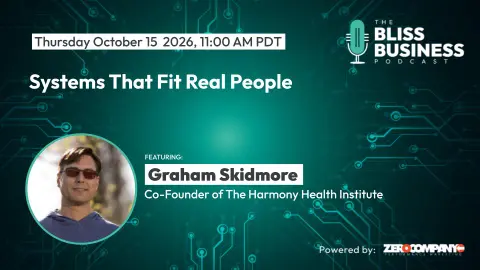
On The Bliss Business Podcast, we sat down with Graham Skidmore, Co-Founder of Harmony Health Institute, to explore what happens when organizations begin designing systems around real human variation instead of forcing everyone through the same model. Graham’s work is rooted in lived experience and in the belief that support should honor individuality across physical, emotional, spiritual, and practical dimensions of life. Systems That Fit Real People wi…
The conversation raised an important question for every leader: how much human potential are we losing because people are spending too much energy trying to fit the system instead of contributing their best work?
One-Size-Fits-All Models Leave Too Much Potential Behind
Traditional systems are often built around standardization.
That makes sense operationally. Organizations need structure, repeatable processes, measurable expectations, and consistency. But standardization becomes a problem when leaders confuse a common framework with a universal human experience.
Graham’s perspective is that many support systems focus too narrowly on what can be measured or categorized while missing the complexity of the individual living inside them. In his work, he advocates for a more integrated approach that considers what a person is actually trying to achieve in their life and what may be getting in the way. Systems That Fit Real People wi…
That same principle applies to work.
Instead of starting with, “How do we get this employee to operate more like everyone else?” leaders can ask, “What does this person need to perform at their best?”
Those questions produce very different systems.
The first encourages conformity.
The second encourages capability.
Accommodations Should Not Be Treated as Evidence of Deficiency
One of the most interesting points Graham made was about the language of accommodations.
In many workplaces, accommodations are associated with disability, limitation, or someone needing special treatment. But when executives receive individualized support, we rarely describe it that way.
Senior leaders have assistants. They have specialized technology. They delegate work outside their strengths. They may have flexible schedules, executive coaching, dedicated support teams, and significant autonomy over how they structure their time.
Those are accommodations too.
We simply call them resources.
That raises an important leadership question: why do we normalize individualized support at the top of the organization while treating it as exceptional elsewhere?
Every person has conditions that improve their ability to contribute. The goal should not be to make everyone work identically. It should be to understand what enables people to spend more of their energy doing the work that creates value.
Technology has made this increasingly possible. Different workflows, communication styles, learning formats, schedules, and work environments can often be supported far more easily than they could have been even a decade ago.
The barrier is increasingly less about capability and more about mindset.
Masking Comes With a Cost
Many people learn to adapt themselves to the workplace rather than expecting the workplace to adapt at all.
They learn how they are supposed to speak, behave, socialize, communicate, and organize their work. They observe which behaviors are rewarded and which attract criticism. Then they build an adapted version of themselves that fits the environment.
For some people, especially those who are neurodivergent, that process can require enormous cognitive and emotional energy.
Graham described how people can become focused on survival rather than contribution. When so much energy is being spent monitoring how to act, interpreting unwritten rules, managing sensory input, or worrying about whether an idea will be received well, there is less mental capacity available for creativity, problem solving, and innovation. Systems That Fit Real People wi…
That should concern leaders.
An employee may look functional while simultaneously using an extraordinary amount of energy simply to appear functional.
The organization sees the output.
It does not see the cost of producing it.
When people feel safer being themselves, some of that energy becomes available again.
Difference Is Information
Companies are extraordinarily sophisticated about using data externally.
They analyze customers, market segments, buying behavior, conversion rates, preferences, demographics, and thousands of other signals. Differences in customer behavior are treated as valuable information.
Internally, differences are not always treated with the same curiosity.
An employee prefers written communication instead of spontaneous meetings, and it is interpreted as rigidity. Another needs more processing time and is seen as slow. Someone works better later in the day and is labeled undisciplined. Another approaches a problem differently and is viewed as difficult.
What if leaders treated those differences as data?
The question would change from “Why can’t this person work the way everyone else does?” to “What information is this giving us about how this person produces their best work?”
That does not mean every preference can or should be accommodated.
Businesses still have customers, deadlines, collaboration requirements, and operational realities.
But curiosity should come before judgment.
Difference may be revealing an opportunity to improve the system for more than one person.
Purpose Gives People Room to Find Their Own Path
One way to create more flexibility without losing accountability is to become clearer about purpose and outcomes.
When organizations rely heavily on command-and-control structures, they often prescribe not only what needs to be accomplished but exactly how, when, and where it must be done.
That can create unnecessary constraints.
If the purpose and expected outcome are clear, there may be more flexibility in the path people use to get there.
This is particularly powerful in knowledge work.
One person may need data before making a decision. Another may think through conversation. Another might need time alone to develop an idea before bringing it to the team.
If everyone is working toward the same purpose and accountable for the same outcome, those differences can become strengths rather than problems.
This is one reason purpose-driven organizations can create more room for individuality. The North Star becomes the impact the organization is trying to create, not whether everyone takes identical steps to reach it.
Inclusion Has to Extend Beyond Identity
When organizations discuss inclusion, the conversation often centers appropriately on demographic representation and whether people from different backgrounds feel welcomed.
But inclusion also has an operational dimension.
Do different thinking styles belong?
Do different communication styles belong?
Can someone process information differently without being treated as difficult?
Can a person ask for what helps them work effectively without being viewed as demanding?
Can leaders distinguish between a legitimate need and an unwillingness to contribute without starting from suspicion?
These questions matter because inclusion is not only about who is allowed into the room.
It is also about how much of themselves people are allowed to bring once they arrive.
A workplace can be diverse on paper while still requiring everyone inside it to behave according to a narrow definition of professionalism.
Real inclusion expands the range of ways people can contribute successfully.
Support Should Be Designed Around Thriving, Not Merely Surviving
One of the strongest themes in Graham’s perspective is the difference between helping people cope and helping them thrive.
That distinction applies directly to organizational design.
Businesses sometimes ask, “What is the minimum adjustment required for this employee to get through the work?”
A better question may be, “What would allow this person to perform at their potential?”
Those are not the same standard.
Graham believes the workplace should become better at identifying what individuals need and testing whether providing that support improves performance. If someone says a different schedule, environment, communication process, or tool would help them work better, the request can be treated as a hypothesis rather than immediately as a problem. Systems That Fit Real People wi…
Try it.
Measure what happens.
If performance improves, the organization has learned something valuable.
If it does not, there is now better information for coaching and deciding what comes next.
That is a far more evidence-based approach than assuming everyone should succeed under identical conditions.
How You Treat Employees Eventually Reaches Customers
There is also a direct connection between internal systems and customer experience.
Organizations frequently expect employees to demonstrate empathy, patience, creativity, and personal attention with customers while giving employees very little of those things internally.
That contradiction eventually shows up.
If people spend their workday navigating rigid systems, feeling unheard, or being treated primarily as units of productivity, it is difficult to expect them to suddenly become deeply human and empathetic when they interact with customers.
The internal experience influences the external experience.
Graham connected this idea to customer service. Businesses increasingly use automation and AI to reduce costs, but the moments when something goes wrong can actually be some of the most important relationship-building opportunities a company has.
A customer who experiences a problem and then feels genuinely cared for may become a stronger advocate than a customer who never encountered a problem at all.
Efficiency matters.
But efficiency should not eliminate humanity from the very moments where humanity matters most.
Whole-Person Thinking Belongs in the Future of Work
Harmony Health Institute’s broader model looks at well-being through multiple dimensions rather than treating physical, emotional, and personal experiences as entirely separate.
Whether or not every organization approaches wellness in the same way, the underlying principle has relevance for leadership: people arrive at work as whole human beings.
Their physical condition affects concentration. Emotional stress affects decision-making. Sleep affects energy. A sense of purpose affects engagement. The environment affects nervous-system regulation. Personal circumstances influence capacity.
These factors do not disappear because someone logged into a business application.
For decades, many workplaces operated under the assumption that the professional self should be separated from the personal self.
That separation was always partly artificial.
The future of work will likely require leaders to become much better at understanding human capacity rather than simply measuring available hours.
Asking for Support Should Sound Like a Business Case
One audience question focused on how employees can advocate for what they need without feeling as though they are asking for special treatment.
Graham offered a useful approach: connect the request to performance.
Instead of framing the conversation only around personal preference, explain what the current obstacle is, what change would help, and how that change could improve the outcome.
For example: this is what I am responsible for producing. This is what is currently getting in the way. If I had this change or resource, I believe I could improve my performance in this specific way.
That gives the leader something concrete to evaluate.
It also allows the organization to test the support rather than debating it philosophically.
Employees cannot control how every leader will respond. But articulating the request in terms of capability and contribution creates a stronger conversation.
It can also reveal something important about the organization.
A company that refuses reasonable conversations about how people work best is communicating something about its culture too.
Neurodiversity Requires More Than Surface-Level Adjustments
When asked for one practical way to make work more inclusive for neurodivergent employees, Graham cautioned against reducing neurodiversity to simplistic advice.
Lowering lights or reducing noise may be helpful for some people, but those interventions do not capture the full range of individual experience.
The deeper question is why the adjustment helps that particular person.
What is happening cognitively, emotionally, or physically?
What kind of environment or workflow enables them to think more clearly?
How can the organization create a more systemic solution rather than only reducing one immediate source of discomfort?
That requires conversation.
Two people with the same diagnosis may need very different things.
Inclusion works best when leaders stop assuming they already know what someone needs and become curious enough to ask.
Trust Is a Prerequisite for Flexible Work
Many debates about workplace flexibility eventually come down to trust.
Can employees work remotely without being watched?
Can people manage different schedules?
Can someone be given autonomy over how they complete the work?
Graham raised a straightforward challenge: if leaders fundamentally do not trust employees to govern themselves or explain what they need to perform, why were those people hired in the first place?
Flexibility does not eliminate accountability.
It changes what is being measured.
Instead of measuring visibility, leaders can measure contribution.
Instead of measuring whether someone is sitting at a desk at 8:00 a.m., measure whether customers are served, commitments are met, collaboration works, and outcomes are achieved.
That shift can be difficult for organizations built around compliance.
But compliance and performance are not the same thing.
The Future of Work Has to Account for Human Capacity
Organizations are investing heavily in technology, AI, productivity tools, and automation.
Those investments matter.
But future-ready work models cannot focus only on technology.
They also have to understand human energy.
People have different sleep patterns, attention patterns, nervous systems, processing speeds, sensory needs, communication styles, and ways of generating ideas.
The industrial-era assumption that everyone should perform the same work during the same hours in the same environment made sense for certain kinds of production.
Knowledge work is different.
The question should increasingly become: what conditions help this person consistently create the outcome we need?
When the answer varies from person to person, that is not necessarily evidence that the system is failing.
It may be evidence that the system is finally becoming human.
Give Yourself Grace While You Learn How You Work
Toward the end of our conversation, we asked Graham what advice he would give a young neurodivergent person preparing to enter the workforce.
His answer centered on grace.
Early career experiences do not have to be viewed as permanent judgments about whether someone is good at work or fits into professional life. They can be treated as information.
One job may teach you that you need more autonomy. Another may reveal how important purpose is. Another may show that a particular environment drains you. You may discover that a schedule everyone else loves does not work for you at all.
That is learning.
Graham encouraged young people to use the period before major financial obligations accumulate to explore what works, what does not, and what kind of environment allows them to become their best. Systems That Fit Real People wi…
That advice applies far beyond neurodivergence.
Understanding how you work is part of learning who you are.
Key Takeaways
- One-size-fits-all systems can unintentionally suppress human potential when they assume everyone thinks, learns, communicates, and performs in the same way.
- Individualized support should not automatically be framed as deficiency. Organizations already normalize significant individualized support for executives.
- Masking differences can consume cognitive and emotional energy that employees could otherwise apply to creativity, problem solving, and contribution.
- Leaders can treat differences as information rather than evidence that someone has failed to adapt.
- Clear purpose and outcomes can create more flexibility around how individuals accomplish the work.
- Inclusion should extend beyond representation to include different thinking styles, communication styles, energy patterns, and ways of contributing.
- Support systems should aim to help people thrive rather than merely helping them cope with environments that do not fit.
- The way organizations treat employees eventually influences how those employees treat customers.
- Whole-person leadership recognizes that physical, emotional, environmental, and personal factors all influence performance.
- Employees advocating for support can strengthen their case by connecting the request to capability, contribution, and measurable outcomes.
- Neurodivergent inclusion should be individualized rather than reduced to a checklist of generic accommodations.
- Flexible work depends on trust and should increasingly be measured through contribution rather than visibility.
- Early-career experimentation can be valuable information about what environments, structures, and types of work allow someone to perform at their best.
Final Thoughts
Graham Skidmore’s perspective challenges a deeply embedded assumption in business: that the individual’s job is to adapt to the system.
Sometimes it is.
Every organization requires shared standards, expectations, responsibilities, and accountability.
But adaptation should work in both directions.
When talented people repeatedly struggle inside a system, leaders should at least be curious about whether the system itself is contributing to the problem. When someone asks for a different way to work, the first response does not have to be suspicion. It can be experimentation.
What happens if we try it?
Does the person perform better?
Does the team become stronger?
Does the customer benefit?
Those are business questions, not acts of charity.
The future of work will not be built by eliminating standards. It will be built by becoming more intelligent about which standards actually create value and which simply reflect inherited assumptions about how work is supposed to look.
Human beings are not interchangeable units.
They bring different nervous systems, histories, strengths, limitations, motivations, perspectives, and ways of solving problems.
The organizations that learn how to harness those differences rather than suppress them may discover that inclusion is not merely something they do for people.
It is a competitive advantage they build with them.
Check out our full conversation with Graham Skidmore of Harmony Health Institute on The Bliss Business Podcast.

Executive Producer | Host | Blog Contributor
Tullio Siragusa is a strategic advisor, dynamic speaker, author, and EQ coach with 36 years of experience as a technology disruptor rooted in Design Thinking. Since 2018, he has been creating, producing and hosting live podcasts, interviewing over 1,000 C-suite executives across a wide range of industries. His work behind the mic reflects his larger mission: using conversation as a catalyst for human-centric innovation.
Tullio’s commitment to purpose-driven leadership and ethical transformation is reflected in his advisory roles at the University of California, Riverside’s Design Thinking Executive Program, and the University of San Francisco School of Management’s Digital Marketing Program. As a Board Advisor at AI2030.org, he helps guide the responsible advancement of AI toward ethical and sustainable outcomes. A founding member of RadicalPurpose.org, Tullio believes empathy isn’t just a trait, it’s a non-negotiable foundation for leadership.

Execution Improves When Leaders Remove What Gets in the Way