The Brands That Will Win Next Are the Ones That Still Feel Human

For years, marketing has been racing toward greater precision.
More automation.
More targeting.
More attribution.
More AI.
More systems designed to predict what people want before they even say it out loud.
And there is real value in all of that. Better tools can make brands smarter, faster, and more efficient. But there is a limit to what efficiency alone can build. At a certain point, if every interaction becomes optimized but emotionally hollow, the brand may become easier to scale and harder to care about.
That is the tension modern marketers are now living inside.
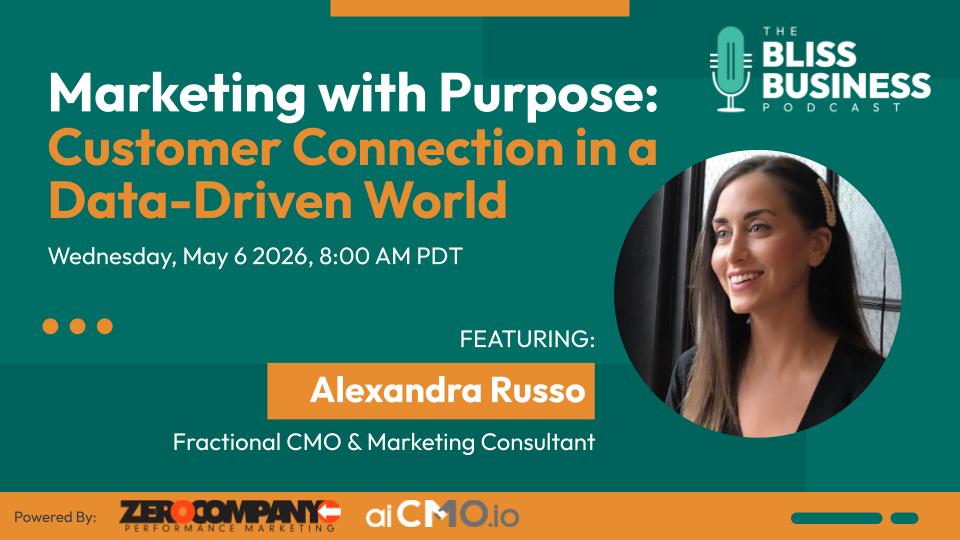
In a recent conversation with Alexandra Russo, Fractional CMO & Marketing Consultant, on the Marketing with Purpose series of The Bliss Business Podcast, that tension came into focus with real clarity. Alexandra brought the perspective of someone who has helped multi-location, franchise, and B2B organizations scale while still paying close attention to the human side of the work. Her message was simple but timely: in a world increasingly shaped by AI, automation, and data, customer connection may be becoming more valuable, not less.
Because the brands that stand out next may not be the ones with the most technology.
They may be the ones that still feel most human.
Data Can Improve Communication. It Cannot Replace Relationship.
One of the most important truths in this conversation is that technology can make marketing more efficient without making it more meaningful.
That distinction matters.
Modern tools can help brands target better, automate workflows, personalize sequences, and interpret behavior with more sophistication than ever before. But none of that guarantees that the message will feel real, relevant, or emotionally intelligent. A brand can know a great deal about someone and still fail to make them feel understood.
That is the risk many companies are running toward without fully noticing.
Alexandra’s point is that people are already craving something different. Even as the digital landscape expands, many consumers are becoming more selective about what they let in. They are growing tired of constant feeds, constant prompts, constant optimization, constant digital noise. What they are increasingly drawn to is connection that feels less manufactured and more sincere.
This is not an argument against data.
It is an argument against mistaking information for intimacy.
The Next Competitive Advantage May Be Emotional Relevance
A lot of companies still think of emotional relevance as a brand benefit.
It is more than that.
It is quickly becoming a strategic differentiator.
If a market becomes saturated with automated messaging and increasingly indistinguishable digital experiences, then the businesses that know how to create warmth, resonance, and credibility will naturally stand apart. Not because they reject technology, but because they use it without letting it erase the human signal.
This is where Alexandra’s framing is especially strong.
She points to a future where people will increasingly want experiences that feel more analog, more communal, more creative, more embodied. Whether that shows up through events, storytelling, community, design, brand voice, or real person-to-person interaction, the broader shift is the same: people want to feel less processed.
That is a meaningful insight for marketers.
It suggests that the future of performance may not come only from tighter optimization.
It may come from better emotional texture.
The Hardest Part of Growth Is Often Identifying the Real Problem
Another excellent theme in this conversation is Alexandra’s emphasis on diagnosis before execution.
This is one of the smartest things a growth leader can do, and it is surprisingly rare.
A company says it wants more revenue.
A leadership team says growth has slowed.
A board wants the next quarter to improve.
But “we want to make more money” is not a strategy. It is a symptom statement. Alexandra’s instinct is to ask the better question: what is actually getting in the way?
That is where real growth work begins.
Maybe the issue is awareness.
Maybe it is retention.
Maybe it is employment turnover.
Maybe it is product-market fit.
Maybe it is fulfillment capacity.
Maybe it is that the business is trying to push new demand into a broken experience.
Those are all very different problems.
And each one requires a very different marketing response.
This is why the best marketing leaders are often part strategist, part operator, and part translator. They do not just build campaigns. They identify the barrier that the campaign is actually supposed to solve.
Overcommunication Is Often the Real Scale Strategy
One of the most practical insights Alexandra shares is her belief in extreme planning and overcommunication.
That may sound basic, but it is actually one of the clearest markers of mature leadership.
Most marketing breakdowns do not happen because no one had a good idea.
They happen because people were working from slightly different assumptions, slightly different interpretations of the same goal, or slightly different levels of clarity about what mattered most. Add in new tools, shifting priorities, impatient stakeholders, and the temptation of shiny new tactics, and a team can drift off course quickly.
That is why overcommunication matters.
It helps teams stay oriented.
It helps them know what is changing and what is not.
It helps them challenge new distractions before those distractions become wasted time.
Most importantly, it creates room for consistency in environments where the pace of change is high and attention is fragmented.
Panic Is Contagious. So Is Calm.
Another powerful section of the conversation came when Alexandra talked about leadership under pressure.
Her phrase was memorable: if she panics, she panics in private.
That is not emotional suppression. It is emotional stewardship.
In high-pressure moments, teams naturally look upward to understand how serious the threat is, how to interpret the moment, and what kind of energy is safe to embody. If a leader floods the team with their own fear, the result is usually confusion, reactivity, and paralysis. If a leader becomes the calm translator of pressure, the team has a much better chance of staying useful.
This matters because difficult seasons are unavoidable.
Markets shift.
Costs change.
Channels fluctuate.
Clients get nervous.
Priorities move.
Performance dips.
The brands and teams that endure those moments best are often the ones led by people who know how to metabolize urgency without passing panic downward. That is a profoundly human skill, and it is deeply strategic.
Customer Feedback Often Reveals the Cost of Internal Blind Spots
One of the strongest examples Alexandra shared involved a campaign that was performing well on paper but creating frustration among existing customers.
New clients were being offered strong incentives and exclusive packages. The acquisition metrics looked good. But loyal members were noticing the imbalance and asking a fair question: why is the brand rewarding new people in ways that make existing customers feel overlooked?
That is such an important lesson.
Because performance data alone could have told the team to keep going. The metrics did not show catastrophic attrition. The campaign looked healthy enough. But the emotional feedback told a more important story. It revealed a tension that, if repeated long enough, could quietly erode trust and belonging.
This is one of the clearest examples of why qualitative feedback matters so much.
Data might tell you what succeeded.
Feedback often tells you what it cost.
And if a brand wants long-term health, it has to pay attention to both.
Most Revenue Leaks Happen After Acquisition
A particularly useful part of the conversation was Alexandra’s focus on re-engagement.
This is such an important point because many businesses still over-focus on top-of-funnel acquisition while underinvesting in what happens afterward. New leads get celebrated. First purchases get counted. Campaigns get judged. But the deeper business value often lives in whether someone comes back, buys again, upgrades, refers, or becomes attached to the brand in an ongoing way.
That is where revenue gets more durable.
Alexandra is right that many organizations have far too many disconnected systems, partial dashboards, broken integrations, and Frankenstein-style software stacks to see this clearly. When data lives in too many places, the team loses the ability to understand the full customer journey. They see fragments. They see platform outputs. But they do not always see the whole revenue story.
That makes real optimization difficult.
The answer is not more tools.
It is cleaner systems and clearer visibility.
Great Marketing Teams Need More Than Talent. They Need Belonging.
When the conversation shifted to people leadership, one of the clearest insights Alexandra offered was that internal connection and external connection are deeply linked.
That is exactly right.
If a team feels like a collection of stressed-out executors, disconnected from purpose, unseen as individuals, and overly managed under constant pressure, it becomes much harder for them to create work that makes customers feel understood. Internal culture always bleeds into external expression.
This is why her emphasis on individuality matters so much.
Knowing what people want professionally.
Understanding what energizes them personally.
Recognizing their side talents, strengths, and aspirations.
Having honest conversations about fit.
Helping people grow where they are or move on when the fit no longer serves either side.
That is not extra leadership.
That is real leadership.
And it matters because people do not usually leave just because the work is hard.
They often leave because they stop feeling connected to the work, to the leader, or to a meaningful future inside the company.
Customer Connection Usually Starts Inside the Company First
This may be the deepest idea in the whole conversation, and it is worth underlining clearly:
customer connection starts with internal connection.
That is not just a nice leadership principle.
It is a business reality.
Brands do not magically produce warmth, relevance, and human understanding out in the marketplace if the people building those campaigns feel none of those things inside the business. Teams that are trusted tend to communicate trust better. Teams that feel supported tend to create more supportive customer journeys. Teams that are energized and clear tend to make clearer, more resonant work.
This is one reason empathy should not be thought of only as a customer-facing value.
It is also an operational one.
It influences how people collaborate.
How they handle stress.
How they recover from failure.
How they build campaigns.
How they write.
How they respond.
How much care they are able to scale into the work.
The Most Human Brands Are Usually the Ones That Understand Conversation Best
Toward the end of the conversation, Alexandra said something simple but powerful: she sees messaging as conversation.
That is one of the best ways to think about modern marketing.
Not as broadcasting.
Not as persuasion theatre.
Not as endless promotional noise.
But as conversation.
That framing changes everything.
It asks:
Who are we talking to?
What do they care about?
What would feel natural here?
What would feel pushy?
What is the emotional context they are already in?
How do we respond to that rather than ignore it?
The brands that get this right are the ones that feel less like machines and more like people with judgment. They know when to speak. They know when to listen. They know when to simplify. They know when to step back. And increasingly, that may be exactly what consumers are looking for.
This aligns beautifully with the B.L.I.S.S. philosophy—Building Love Into Scalable Systems. Love in business does not mean sentimentality. It means designing systems and communication practices that preserve dignity, attention, and relational intelligence even as the business grows.
That is not anti-performance.
It is performance with depth.
Key Takeaways
Technology can improve marketing without making it more meaningful. Data is powerful, but it does not replace emotional intelligence or human relevance.
Growth gets easier when the real barrier is identified. “We need more revenue” is rarely the actual strategic problem.
Overcommunication creates alignment. Teams scale better when goals, priorities, and changes are repeated clearly and often.
Calm is a leadership skill. In pressure-filled moments, leaders shape outcomes by how they metabolize urgency for the team.
Qualitative feedback matters. A campaign can perform well in the numbers while quietly damaging trust if customers feel overlooked.
Re-engagement is often the biggest revenue opportunity. Long-term growth gets stronger when businesses look beyond acquisition and into return behavior.
Customer connection starts internally. Teams that feel seen, supported, and clear create better customer experiences more naturally.
Final Thoughts
What this conversation with Alexandra Russo, Fractional CMO & Marketing Consultant, makes clear is that customer connection in a data-driven world is not a nostalgic idea.
It is the next strategic frontier.
Because as more brands gain access to the same tools, the same targeting systems, the same AI enhancements, and the same optimization frameworks, what will distinguish them most may not be efficiency alone.
It may be whether they still know how to feel human.
Whether they know how to talk like people.
Whether they know how to build teams that care.
Whether they know how to listen when the numbers look good but the customers feel otherwise.
And whether they know that the strongest growth systems are often the ones that make more room for connection, not less.

Guest Development | Producer | Blog Contributor
Martha is a connector who brings over two decades of experience in engineering, sustainability, education, and public relations. She is part of the integrated go-to-market team at Zero Company and serves as Guest Development Lead for The Bliss Business Podcast, where she connects with purpose-driven leaders to shape meaningful conversations. Martha also produces the Marketing With Purpose Kit segments with CMO guests.
Her career includes founding nonprofits, and speaking at global forums in Malaysia, Dubai, and Paris. A passionate community builder, Martha also mentors women entrepreneurs and supports environmental initiatives across Mexico and the U.S. Her work reflects a deep commitment to impact, inclusion, and authentic leadership.

Starting Over Deserves Community