Scalable Growth Starts Long Before the Campaign Launches
A lot of companies talk about growth as if it begins when the campaign goes live.
The ads launch.
The emails deploy.
The landing pages go up.
The dashboards start moving.
But that is almost never where scalable growth actually begins.
It begins much earlier, in the systems a company builds before it ever goes to market. It begins in the discipline of knowing where the business is headed, how each brand fits into that direction, what success looks like across functions, and how data, process, and communication will support repeatable execution. Without those things, marketing can still produce activity. What it struggles to produce is compounding growth.
That is why scalable growth through marketing is such an important conversation right now.
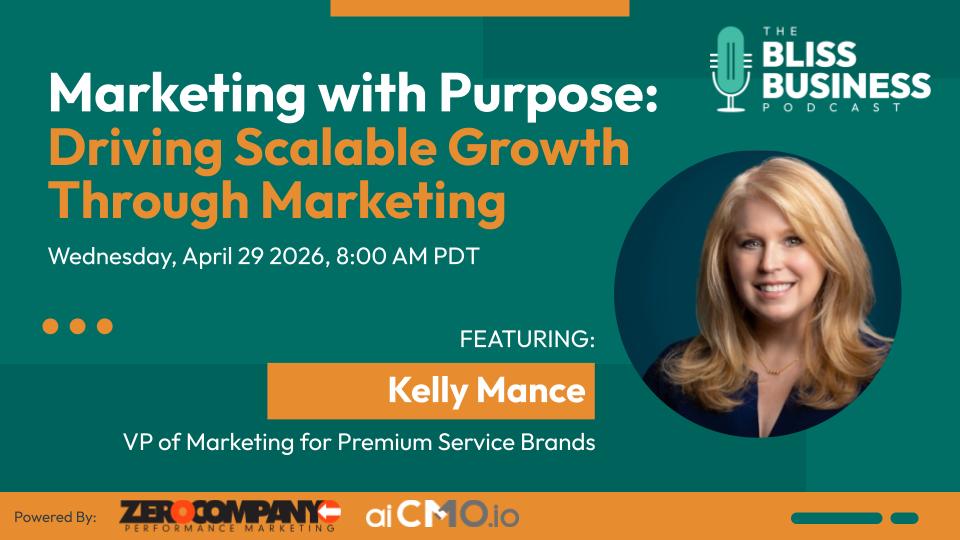
In a recent conversation with Kelly Mance, CMO of Premium Service Brands, on the Marketing with Purpose series of The Bliss Business Podcast, that truth came through clearly. Kelly brought a franchise operator’s understanding of what growth actually demands: not just creativity, not just campaigns, and certainly not reactive bursts of effort, but integrated systems that allow multiple brands, owners, and channels to move in the same direction. Her perspective points to a broader lesson for modern leaders: if growth is going to scale, marketing has to stop functioning like a sequence of one-off activities and start functioning like infrastructure. Her point is direct: growth before the campaign, in the systems behind it, is what actually determines whether marketing scales.
Most Marketing Breakdowns Are Not Creative Problems. They Are Systems Problems.
One of the most useful insights in this conversation is the distinction Kelly makes between building campaigns and building systems.
That distinction matters because many organizations still think of growth as a campaign challenge. They assume that if results are lagging, the answer is another offer, another channel, another round of creative, another push. Sometimes that helps in the short term. But if the underlying system is weak, the business eventually ends up right back where it started—busy, fragmented, and dependent on constant reinvention.
Scalable growth requires something sturdier.
It requires foundational systems that can support repeated execution across changing conditions. That means CRM discipline. It means lead handling. It means review generation. It means diversified channels. It means knowing what the numbers actually say and having processes in place to act on them. Those may not be the most glamorous parts of marketing, but they are often the parts that determine whether marketing can scale without becoming chaotic.
This is especially true in franchise organizations, where the complexity multiplies quickly. A campaign is never just a campaign. It has to work across markets, across operators, across brand nuances, and across local realities. That is why systems matter so much. They are what allow a brand to grow beyond isolated wins.
Growth Becomes Easier When Everyone Knows the North Star
Another strong theme in Kelly’s perspective is the role of shared clarity.
She makes a simple but extremely important point: before marketing can support growth, the company has to know where it is actually going. That sounds obvious, but many organizations underestimate how often this breaks down. Senior leaders may hold a clear picture of the future, but if that vision is not translated consistently across teams, functions, and workflows, the people doing the daily work often end up optimizing for disconnected priorities.
That is where friction begins.
Marketing may be pushing one initiative.
Operations may be supporting another.
Brand leads may be interpreting the objective one way.
Performance teams may be measuring success another way.
Everyone may be working hard, but effort without alignment rarely scales well.
Kelly’s approach of revisiting the North Star goal weekly is a smart answer to this. It reflects a truth many organizations resist: communication about strategy cannot be one-and-done. People need repetition. They need reminders. They need context. Alignment is not created because someone once said the right thing in a kickoff meeting. It is created because the organization keeps re-establishing what matters and why.
That kind of repetition is not redundancy.
It is operational clarity.
Scalable Marketing Needs Both Stability and Adaptation
One of the most interesting tensions in the episode is Kelly’s description of building stable campaign foundations that can also be customized brand by brand.
That is exactly the kind of challenge many multi-brand and franchise organizations face. Too much centralization creates blandness, rigidity, and poor local fit. Too much customization creates fragmentation, inefficiency, and brand drift. The real skill is in designing frameworks that are consistent enough to scale and flexible enough to remain relevant.
This is one of the places where scalable growth is often won or lost.
A company needs stable systems for lead flow, tracking, review generation, and customer acquisition. But it also needs enough room to honor the unique voice, seasonal needs, customer behavior, and service realities of each brand. That is not a contradiction. It is the actual work.
The strongest marketing leaders understand that scale does not mean sameness.
It means repeatable structure with intentional variation.
That is what allows the organization to grow without flattening the very distinctions that make each part of the portfolio valuable in the first place.
Marketing Gets Misunderstood When the Lag Effect Is Ignored
One of the most important truths Kelly touches on is that marketing is often judged too quickly and too simplistically.
This is especially dangerous when organizations cut marketing spend or treat it as a variable cost they can turn on and off without consequence. The reason that instinct is so misleading is because marketing does not always reveal its full value on the same timeline that finance or leadership wants to measure it. There is often a lag effect. A company can cut back and feel little pain at first. Then months later, the weakened pipeline, reduced awareness, or lower conversion quality starts to show up.
By that point, the cause and effect can feel disconnected.
But they are not.
This is one reason marketing leaders have to become stronger translators of time horizons. They have to help the business understand that not every result is immediate and not every cut is harmless just because the downside is delayed. Scalable growth depends on continuity, not only bursts of intensity.
The strongest organizations do not ask, “Can we pause marketing for a while?”
They ask, “What happens to our future demand if we interrupt the system now?”
That is a much better question.
In Franchising, the Hand-Off Is Often the Real Growth Lever
Kelly also offers a valuable reminder that in franchise systems, corporate marketing only carries the brand partway.
From the brand level, marketing can build awareness, drive demand, shape perception, and provide tools. But the actual transaction, customer interaction, and local trust-building often happen with the franchise owner. That means growth depends heavily on the quality of the hand-off between brand strategy and local execution.
This is where many franchise systems quietly struggle.
Marketing may be doing its job well.
The franchisee may be good at the service itself.
But if the local operator does not know how to convert trust, handle leads effectively, build relationships, or leverage the tools provided, then growth slows anyway.
That is why Kelly’s perspective is so strong. She understands that scalable growth does not end with national awareness. It has to translate all the way down to owner behavior in the field. Training, expectations, scripts, programs, dashboards, and support systems all matter because they help close the gap between brand promise and local action.
The hand-off is not secondary.
It is where much of the real business gets won.
Empathy Is Often the Fastest Way to Better Strategy
One of the clearest examples of this came when Kelly described the relationship between inspectors and realtors.
At first glance, it would be easy for inspectors to interpret realtor hesitation as personal distrust or unfair resistance. But Kelly reframes the situation in a much more strategic way. She asks inspectors to step into the realtor’s position and understand what is emotionally at stake. A realtor has often spent months guiding a client toward a deal, and then must entrust a crucial late-stage experience to someone else. That is not a small ask.
This is a great example of empathy driving better business strategy.
Once you understand the emotional pressure the other party is carrying, the right response becomes clearer. You stop selling from your own certainty and start building from the other person’s need for confidence. That is what makes programs like “try, trust, believe” so effective. They reduce perceived risk, create exposure, and build belief gradually instead of demanding it immediately.
This is what strong marketing often does.
It identifies the emotional barrier inside the business process and creates a structured way to move through it.
Data Without Adjustment Is Just Documentation
Kelly’s story about referral assumptions is another important lesson in scalable growth.
It is easy for experienced operators to assume that because they do good work, referrals will naturally follow. But good service does not automatically create repeat behavior or recommendation unless the business is actually designed to support and prompt those outcomes. When the data showed that referrals were not happening at the expected level, the answer was not to defend the assumption. It was to build systems and scripts that made the ask intentional.
That is the right use of data.
Data should not just document what happened.
It should change what happens next.
This is one of the clearest differences between reactive marketing and scalable marketing. Reactive marketing notices a drop and scrambles. Scalable marketing notices a pattern and builds a repeatable response. It creates training, systems, and processes so that the lesson becomes institutional rather than anecdotal.
That is how organizations get smarter over time.
The Best Marketing Leaders Build Businesspeople, Not Just Campaigns
Another strength in Kelly’s approach is that she is not only trying to improve campaigns. She is trying to strengthen the business judgment of the franchisees themselves.
That is a critical distinction.
Many operators are very good at the service they provide. They know the craft. They know the customer in their local market. They know the operational side. But that does not automatically mean they know how to think strategically about sales, marketing cadence, channel mix, review strategy, or data-informed decision-making.
So scalable growth requires more than handing them assets.
It requires helping them think more like disciplined business owners.
Kelly’s planning tools, dashboards, and marketing director groups all point in this direction. They are designed to make operators more capable, more informed, and more consistent in how they approach growth. That is where real leverage comes from in a franchise model. The more the system can elevate the strategic capability of the owners inside it, the more scalable the marketing becomes overall.
Teams Stay Stronger When the Work Feels Seen
The internal leadership side of Kelly’s perspective is just as important.
Her emphasis on recognition, cross-training, and clear communication reflects something many growing organizations forget: people can only sustain high output for so long if the work begins to feel invisible. In environments where teams are producing hundreds of assets, juggling multiple brands, and operating under constant deadlines, appreciation is not fluff. It is fuel.
The way she describes calling out strong work publicly, creating team rituals, and cross-training people across functions reveals a deeper truth about scalable growth: it is not only built on systems and dashboards. It is built on people who feel connected enough to keep doing great work over time.
That matters because churn is expensive.
Lost tribal knowledge is expensive.
Burnout is expensive.
If a company wants scalable growth, it cannot just think about scalable campaigns.
It also has to think about scalable culture.
Marketing Becomes More Powerful When It Is Rooted in Contribution
The personal story Kelly shares near the end adds something important to the whole conversation.
When she reflects on her father’s work ethic and the bookstore moment where she chose to serve a customer’s real need rather than chase the bigger immediate sale, it reinforces a deeper principle: marketing is strongest when it is grounded in service, not only conversion.
That does not mean results do not matter.
It means results last longer when they are built on genuine contribution.
Customers feel the difference between being pushed and being helped.
Employees feel the difference between being managed and being valued.
Franchise owners feel the difference between being directed and being equipped.
And those differences add up.
They shape the health of the system over time.
Key Takeaways
Scalable growth begins with systems, not just campaigns. Marketing becomes more repeatable and effective when foundational processes are built before reactive activity takes over.
A clear North Star reduces fragmentation. Teams perform better when they understand the larger goal and hear it reinforced consistently.
Scale requires both consistency and customization. Strong frameworks should be stable enough to repeat and flexible enough to fit different brands and markets.
Marketing must be understood across time horizons. The lag effect matters, and delayed consequences can make bad decisions look harmless in the short term.
In franchising, local execution is a major growth lever. Corporate strategy only works if the hand-off to owners is supported well.
Empathy improves business strategy. Understanding what customers, partners, or referral sources are feeling often reveals the right commercial move faster.
Data should lead to adjustment. Scalable organizations use data to build better systems, not just to explain underperformance after the fact.
Final Thoughts
What this conversation with Kelly Mance, CMO of Premium Service Brands, makes clear is that driving scalable growth through marketing is not really about finding more things to do.
It is about building a business that knows how to repeat what works, adjust what does not, and align people around a strategy strong enough to carry through complexity.
That means vision.
That means systems.
That means communication.
That means empathy.
And that means enough discipline to turn marketing from a reactive function into a compounding one.
Because in the end, growth becomes scalable only when the business itself becomes more coherent.
Where to Go Next
Listen to the full conversation: Marketing With Purpose Kit: Driving Scalable Growth Through Marketing.
Watch the video: Kelly Mance: Get the Right People in the Room First.
Meet the guest: Kelly Mance, VP of Marketing at Premium Service Brands.

Guest Development | Producer | Blog Contributor
Martha is a connector who brings over two decades of experience in engineering, sustainability, education, and public relations. She is part of the integrated go-to-market team at Zero Company and serves as Guest Development Lead for The Bliss Business Podcast, where she connects with purpose-driven leaders to shape meaningful conversations. Martha also produces the Marketing With Purpose Kit segments with CMO guests.
Her career includes founding nonprofits, and speaking at global forums in Malaysia, Dubai, and Paris. A passionate community builder, Martha also mentors women entrepreneurs and supports environmental initiatives across Mexico and the U.S. Her work reflects a deep commitment to impact, inclusion, and authentic leadership.

Empathy Is an Operating System