Growth Is a Responsibility, Not a Race

Growth is exciting in any business. Every new location can represent an entrepreneur pursuing ownership, a family taking a financial risk, a local team being built, customers being served, and a community gaining another business.
But that is exactly why growth carries responsibility.
In franchising, development cannot simply be about selling more units or filling more territories. Every person who enters the system affects the health of the network, the reputation of the brand, the experience of existing franchisees, and the opportunities available to everyone who comes after them.
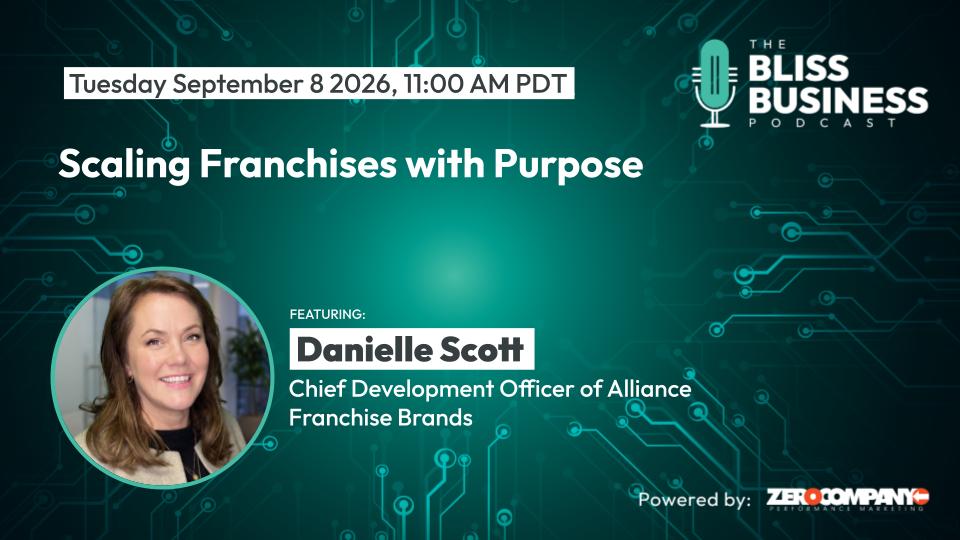
On The Bliss Business Podcast, we sat down with Danielle Scott, Chief Development Officer at Alliance Franchise Brands, to explore responsible scaling, ethical franchise development, entrepreneur support, brand trust, and what it means to grow without losing sight of the people behind every location. Danielle brings more than 32 years of experience in franchise development and operations, along with the perspective of someone who has been an entrepreneur, consultant, operator, and development leader.
Her perspective is grounded in a simple idea: franchise growth should never be measured only by how many people you can bring into the system. It should also be measured by whether those people belong there in the first place.
Healthy Growth Begins With Fit
Danielle was candid about how her own view of franchise development evolved over the course of her career.
Early on, the focus was much more transactional. If someone had the money, was interested, and was ready to move forward, the instinct was to close the deal. But experience taught her that a franchise agreement is not the end of the relationship. It is the beginning of one.
When the wrong people enter a franchise system, the consequences show up later. Franchisees become dissatisfied. Compliance becomes more difficult. Validation suffers. Existing owners begin questioning the system. Support teams spend more time solving problems that might have been prevented with better selection at the beginning.
That changes the role of franchise development.
A development leader is not simply choosing a new franchisee. They are choosing a future business partner for everyone already inside the network.
That means fit matters more than urgency.
A candidate can love the brand and still be wrong for the business. They may have the financial capacity but not the temperament. They may be excited about ownership but resistant to following systems. They may want the benefits of franchising while still wanting to reinvent the model.
None of those things make someone a bad entrepreneur. They may simply mean franchising is not the right vehicle for them.
Franchising Requires Knowing Who You Are
Franchising offers something powerful: a system that has already gone through much of the experimentation, reinvention, and costly learning that independent entrepreneurs face on their own.
The playbook exists. The brand exists. The support infrastructure exists. Training, technology, marketing, processes, and vendor relationships have already been developed.
But there is a tradeoff.
Franchisees are expected to use the system.
That is why self-awareness matters so much before someone invests. A person who wants to create the recipe may be happier building an independent company. A person who appreciates having the recipe and wants to become exceptional at executing it may thrive inside a franchise system.
There is no superiority in either path. They simply require different mindsets.
The trouble begins when someone buys a franchise because they want the system and then spends the next several years fighting the system.
Danielle sees the discovery process as an opportunity to uncover that tension before the investment is made.
Discovery Should Be Mutual
At Alliance Franchise Brands, discovery is not designed as a one-way sales process.
Candidates meet the people who may eventually touch their business. They learn about marketing, technology, training, operations, and support. At the same time, the company observes how they move through the process.
Do they follow through? Do they provide information when requested? Do they respect the sequence? Are they constantly trying to skip steps? Are they willing to learn?
Those behaviors provide useful clues about what the relationship might look like after the agreement is signed.
If someone cannot follow a relatively straightforward discovery process, there may be reason to question how comfortable they will be following an operating model once they own the business.
That is not about being rigid for the sake of control.
It is about understanding whether there is alignment.
The best discovery process gives both sides permission to say no.
Education Is More Responsible Than Persuasion
Danielle believes franchise development should become less about selling and more about educating.
Most serious franchise candidates have already made a major psychological decision before they enter discovery. They are considering business ownership. They may be leaving a corporate career, investing decades of savings, borrowing money, or using assets they worked years to accumulate.
The franchisor does not need to manufacture desire.
It needs to help the candidate make an intelligent decision.
That means being transparent about what support exists, what responsibilities remain with the owner, what the business actually requires, what successful operators tend to do well, and where candidates commonly struggle.
A responsible development process should leave someone more educated even if they decide not to buy.
If candidates reach the end knowing little more than they could have discovered on the website, the process has missed an opportunity.
Education builds trust because it tells the candidate, “We care whether this works for you, not simply whether you sign.”
Sometimes the Most Ethical Answer Is No
One of the hardest responsibilities in franchise development is telling someone they are not the right fit.
That becomes especially difficult when the person has the money and is enthusiastic about the opportunity.
Danielle gave the example of a business model that depends heavily on sales. If a candidate clearly does not enjoy selling and does not possess that skill set, pretending it does not matter serves no one.
The honest conversation might be that the candidate needs to hire someone strong in sales. Or it may be that this particular business is simply not right for them.
Those conversations require courage because short-term incentives can encourage the opposite behavior.
The franchise fee may be earned today. The commission may be paid today. But a poor-fit owner can create years of financial and emotional consequences for themselves and the system.
That is why ethical development requires thinking beyond the close.
Growth Should Stop When the Network Is Unhealthy
Leaders often assume that growth problems are solved with more growth.
Danielle argues that sometimes the opposite is true.
If a meaningful portion of the franchise community is unhappy, noncompliant, disconnected from leadership, or refusing to follow the system, that is a signal to stop and understand what is happening.
Adding more owners into an unhealthy network does not solve the underlying problem. It amplifies it.
The better questions are internal.
Why are franchisees unhappy? Is support failing somewhere? Are expectations unclear? Has trust broken down? Are the operations working the way they were designed to work? Is the organization expanding faster than it can support?
Responsible growth requires the discipline to strengthen the foundation before adding more weight to it.
That can be difficult because slowing growth may look like failure from the outside.
In reality, it may be one of the healthiest decisions leadership can make.
Culture Can Disappear Quietly
One of the risks of scaling is losing the very culture that made people want to join in the first place.
Danielle has seen franchise systems grow from small, tightly connected communities into much larger networks and lose some of the qualities that originally made them special.
That does not necessarily happen because anyone stopped caring.
Scale simply changes the dynamics.
A small network may have 20 cultural qualities that everyone experiences naturally because people know one another, leaders are accessible, and communication happens informally. As the system grows into hundreds of locations, those informal mechanisms disappear.
At that point, leadership has to decide what truly matters.
What are the three, four, or five characteristics that cannot be lost?
Those need to become part of the values, training, communication, and leadership practices of the company.
Culture cannot remain dependent on memory.
Eventually, it has to become intentional.
Failure Can Make Leadership More Human
One of the most powerful parts of our conversation was Danielle’s openness about a major business failure earlier in her career.
She had acquired multiple learning centers and undeveloped territories shortly before the financial crisis. When household budgets tightened, services like tutoring were among the expenses many families cut.
The business deteriorated. Danielle lost much of what she had invested. Employees who had been with the centers for years were affected. Some blamed her directly. The experience forced her to confront failure on a level she had never experienced before.
She described how different she had been before that experience. Success had given her confidence, but also a degree of arrogance. She had never really failed.
Then she did.
And the failure changed her.
It gave her greater empathy for business owners who put their savings, homes, retirement accounts, reputations, and families on the line to pursue entrepreneurship.
That context matters when you work in franchise development.
A candidate is not merely buying a unit.
They may be placing a meaningful part of their life into your hands.
Adaptability Is More Valuable Than Being Right
Failure also teaches something that success often cannot: reality does not care how convinced we are.
Markets change. Economies shift. Consumer behavior moves. A business that performs beautifully under one set of conditions can struggle under another.
Leadership maturity often requires replacing certainty with adaptability.
That does not mean becoming indecisive. It means remaining willing to see what is actually happening rather than defending what we hoped would happen.
This becomes especially important in franchising because leaders are advising people whose livelihoods may depend on those decisions.
The goal should not be to prove the original plan was right.
The goal should be to respond intelligently to the environment that exists now.
Strategic Scaling Requires More Than Demand
Responsible franchise growth also requires discipline around where and how to expand.
Territories matter. Population matters. Business density matters. Local market dynamics matter. The number of leads required to support growth matters. The operating team’s ability to support new locations matters.
Scaling is not simply a matter of selling wherever interest appears.
A development team needs to understand how the system should grow geographically, where concentrations of owners make sense, how territories interact, and what level of expansion the organization can realistically support.
Otherwise sales can outrun operations.
That creates pressure everywhere else in the system.
Strategic scaling means aligning demand with capability.
Courage Is a Leadership Requirement
When asked what an ethical franchise development process needs most, Danielle’s first answer was courage.
That is an important word.
It takes courage to tell a strong candidate they are not the right fit. It takes courage to push back on an executive who wants more growth than the system can responsibly support. It takes courage to tell a development team that a deal should not move forward even when revenue is attached to it.
Danielle paired courage with resilience and honesty.
Resilience matters because franchise development contains a lot of rejection. Deals disappear. Financing changes. Candidates walk away. Timing changes.
Honesty matters because the temptation to soften reality can become strong when the financial incentive is sitting directly in front of you.
Ethics rarely fail because people do not know the right thing.
They fail when people lack the courage to do it.
Great Leaders Build Their Replacements
Danielle also believes strongly that every leader should be developing someone who could eventually replace them.
That idea can make insecure leaders uncomfortable.
They may fear that making someone else capable diminishes their own value.
The opposite is usually true.
If no one can do your current job, it becomes difficult for the organization to move you into another one.
Leadership growth depends on creating capacity behind you.
Danielle encourages people to identify talent, teach what they know, expose others to decision-making, and prepare successors before the need becomes urgent.
You create room for your own growth by creating room for someone else’s.
Mentorship Transfers What Manuals Cannot
This connects to another gap Danielle sees in franchising: mentorship.
Training can explain processes. Manuals can document procedures. Classes can teach frameworks.
But judgment is harder to transfer.
How do you navigate an unhappy franchisee? How do you handle conflict between the system and the individual? When should you push? When should you listen? How do you recognize that the stated problem is not actually the underlying problem?
Those things are often learned by being close to someone who has done them before.
Mentorship allows emerging leaders to see how experienced leaders think.
That is especially important because leadership is rarely about knowing the answer in advance.
It is about learning how to work toward the right answer when the situation is complicated.
Love in Business Looks Like Respect and Follow-Through
When we asked Danielle what role love should play in franchise development, she connected it to something very practical: respect and follow-through.
Do what you say you are going to do.
Say what you mean.
Do not hide behind vague language.
Do not create false expectations simply because you want a candidate to keep moving through the process.
People making serious investments deserve clarity.
That is what care looks like in a business relationship.
It does not require telling everyone yes.
Sometimes love is telling someone no before they make an expensive mistake.
Sometimes it is challenging a franchisee because you believe they can perform better.
Sometimes it is slowing expansion because the existing community needs attention.
Care without honesty is not really care.
Ask Whether People Will Be Better Because of You
Toward the end of our conversation, Danielle offered one question that deserves to sit at the center of every growth strategy:
How is this person going to be better by doing business with me?
That question reaches well beyond franchising.
Most growth conversations begin with what the customer, employee, partner, or franchisee can contribute to the company.
Revenue. Productivity. Fees. Market share. Territory expansion.
Danielle’s question reverses the direction.
What will the relationship create for them?
Will they become more capable? Will they build something valuable? Will they create greater financial security? Will they develop as leaders? Will they have access to opportunities they could not have created alone?
That is the difference between extraction and contribution.
The best growth strategies create value in both directions.
Key Takeaways
-
Responsible franchise growth begins with choosing the right people, not simply closing more deals.
-
Discovery should be a mutual process where the candidate learns about the system and the franchisor evaluates long-term fit.
-
Education creates more trust than persuasion because candidates need clarity about what ownership will actually require.
-
Ethical development sometimes means telling a financially qualified candidate that the business is not right for them.
-
When the existing franchise network is unhealthy, leaders should strengthen the system before accelerating expansion.
-
Culture has to become intentional as organizations scale or the qualities that made the company special can quietly disappear.
-
Failure can create deeper empathy, humility, and respect for the risk entrepreneurs take when they invest in a business.
-
Strategic scaling requires aligning sales, market expansion, territory design, and operational support.
-
Courage, resilience, and honesty are essential leadership qualities when short-term growth conflicts with long-term health.
-
Great leaders develop successors and use mentorship to transfer judgment, not just information.
-
Growth becomes more conscious when leaders ask whether the people entering the relationship will actually be better because of it.
Final Thoughts
Danielle Scott’s perspective is a reminder that growth is not simply a business objective.
It is a responsibility.
Every franchise agreement represents a person making a consequential decision about their future. They may be leaving a career, investing their savings, taking on debt, hiring employees, and placing their confidence in a system they believe will help them succeed.
That deserves stewardship.
Responsible growth requires leaders who are willing to say no when the fit is wrong, slow down when the system is unhealthy, educate rather than pressure, develop people rather than protect territory, and tell the truth even when the truth could cost a deal.
That is not anti-growth.
It is what makes growth sustainable.
Because the best franchise systems are not built by asking how many people they can bring in.
They are built by asking whether the people they bring in will be better because they joined.
Check out our full conversation with Danielle Scott of Alliance Franchise Brands on The Bliss Business Podcast.

Executive Producer | Host | Blog Contributor
Tullio Siragusa is a strategic advisor, dynamic speaker, author, and EQ coach with 36 years of experience as a technology disruptor rooted in Design Thinking. Since 2018, he has been creating, producing and hosting live podcasts, interviewing over 1,000 C-suite executives across a wide range of industries. His work behind the mic reflects his larger mission: using conversation as a catalyst for human-centric innovation.
Tullio’s commitment to purpose-driven leadership and ethical transformation is reflected in his advisory roles at the University of California, Riverside’s Design Thinking Executive Program, and the University of San Francisco School of Management’s Digital Marketing Program. As a Board Advisor at AI2030.org, he helps guide the responsible advancement of AI toward ethical and sustainable outcomes. A founding member of RadicalPurpose.org, Tullio believes empathy isn’t just a trait, it’s a non-negotiable foundation for leadership.

Gratitude Is a System, Not a Sentiment