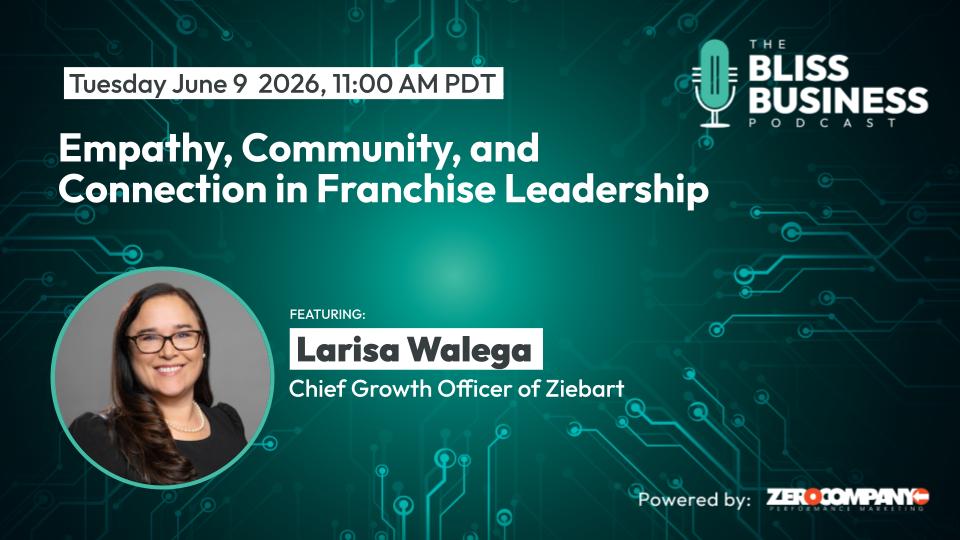
Empathy Is the Growth Strategy Franchising Cannot Fake

Franchise growth is often measured in units, markets, revenue, and brand recognition. Those numbers matter. But the franchise systems that endure are built on something harder to measure and impossible to fake: empathy, trust, connection, and community.
On The Bliss Business Podcast, we sat down with Larisa Walega, Chief Growth Officer of Ziebart International Corporation, one of the world’s leading automotive appearance and protection franchise brands. Ziebart has been in franchising for more than 65 years, with a global footprint across 36 countries, 400 locations, and more than 1,000 car dealership partners.
Larisa’s perspective is grounded in growth, but not growth for its own sake. Her view is that sustainable franchise growth depends on relationships: with franchise owners, customers, partners, teams, and communities.
Empathy Starts With Listening
Larisa described empathy as a leadership strength in franchising. When someone invests in a franchise, whether it is their first location or their hundredth, they are not just buying a business model. They are stepping into a major life decision with real risk, real hopes, and a personal why.
That is why listening matters so much. Leaders cannot support franchise owners well if they do not understand what those owners are trying to build, what they are afraid of, and what success means to them personally.
In franchising, empathy is not abstract. It is the ability to listen deeply enough to understand someone’s why, then build the relationship and support system around it.
The Customer’s Vehicle Is Emotional, Not Just Mechanical
Ziebart operates in automotive appearance and protection, but Larisa made it clear that the business is not just about vehicles. It is about the emotional attachment people have to one of the largest investments in their life.
People name their cars. They associate them with memories, identity, freedom, pride, and safety. Some customers see their vehicle as a work tool. Others see it as a family transporter, a weekend passion, or a personal statement.
That emotional connection changes the customer experience. If a business treats the vehicle as just another job ticket, it misses the relationship. If the team understands what the vehicle means to the customer, the entire interaction changes.
This is where empathy becomes practical. You cannot recommend the right service if you do not understand how the customer uses the vehicle and what they value most.
Customer Experience Is the Cheapest Differentiator
Larisa made a strong point that every business should take seriously: customer experience is one of the easiest and least expensive ways to differentiate. Advertising is expensive. Emotional connection compounds.
A customer may forget an ad after a few impressions, but they remember how they felt when someone listened, walked the vehicle with them, understood their needs, and made the service feel personal.
That kind of experience creates retention, trust, and referrals. It also turns the local franchise owner into a community leader, not just a service provider.
Franchise Owner Relationships Come First
When asked about systems that scale connection, Larisa did not start with the customer. She started with the franchise owner.
That is the right answer.
If the franchisor does not build trust with franchise owners, it becomes difficult to create buy-in for brand standards, customer experience training, marketing consistency, or community engagement. Franchise owners have invested their time, capital, and effort into the journey. They need to feel like partners, not operators being managed from a distance.
Ziebart supports that connection through annual conferences, regional meetings, franchise owner satisfaction surveys, brand standards, sales training, customer experience training, and advertising support. The larger point is that systems should not replace relationships. They should strengthen them.
Seamless Brand Experience Requires Shared Accountability
Tullio asked what it takes to align marketing, operations, franchise support, and local execution around one shared brand experience. Larisa’s answer was collaboration, but not the vague version of collaboration companies like to put on slides.
Real collaboration means shared understanding of goals, measurement, and accountability.
Every function needs to know how its work connects to the bigger picture. Marketing, sales, operations, technology, finance, franchise support, and local execution all contribute to the brand promise. If one part is misaligned, the customer feels it.
This is especially true in franchising because the brand is experienced locally. The corporate team can define the promise, but the franchise owner and frontline team deliver it.
Local Personality Is a Strength, Not a Threat
One of the best parts of franchising is the local layer. A national brand can provide systems, trust, and standards, while local owners bring community relationships and personal connection.
Larisa shared the example of a Texas franchise owner who brought a karate school, a Jeep club, and a favorite food truck into a grand opening. Those connections already existed in the owner’s life. Ziebart became part of that broader community circle.
That is the power of local ownership. Brand consistency matters, but local personality is what makes the experience human.
The goal is not to erase the owner’s community ties. The goal is to align them with the brand promise.
The Green Flag Is How People Treat Each Other
An audience question asked what green flag Larisa looks for during franchise discovery that signals a candidate will protect the brand’s culture.
Her answer was simple: how they treat people.
When candidates come in with partners, family members, or business associates, the way they interact matters. Respect, listening, disagreement, tone, and patience all reveal how someone may treat customers, support teams, and other franchise owners.
This is a powerful filter. Franchise culture is not protected by contracts alone. It is protected by selecting people who already know how to build respectful relationships.
Purpose Builds Community Across the System
Ziebart’s purpose-driven work includes strong support for the veteran community. Larisa shared that a meaningful percentage of both franchise owners and corporate team members have served, and that connection has shaped the brand’s support of Mission 22, an organization focused on ending veteran suicide.
This is what purpose should do. It should connect naturally to the people inside the system. It should not feel like a random campaign. It should reflect something authentic in the brand’s community and give people a shared reason to care.
Purpose becomes powerful when it is not pushed from the top. It grows from what is already alive in the system.
Values Have to Become Daily Behavior
Larisa made another important point: values cannot just live on the wall. It is easy to say your values are honesty, passion, innovation, teamwork, and legacy. The harder question is what those values mean in daily behavior.
Leaders have to slow down long enough to ask better questions:
What is important to you today?
What is important to your family?
What are you striving for?
What are you struggling with?
That is where values become real. Not in the statement, but in the conversation. Not in the poster, but in the practice.
Love Starts With Self-Awareness
When asked what role love should play in business, Larisa said love should be at the center. But she added an important distinction: leaders have to understand love within themselves first before they can truly extend it to others.
That is a practical leadership insight. Leaders who are disconnected from themselves often struggle to show up with patience, compassion, and consistency for others. The work starts internally, then shows up externally in how leaders listen, support, guide, and build trust.
Key Takeaways
-
Empathy is a leadership strength in franchising because it helps leaders understand the real needs and motivations of franchise owners.
-
Customer experience is emotional, especially when the service connects to something personal like a vehicle.
-
Franchise owner relationships come first because trust at the franchisor level shapes everything that happens locally.
-
Seamless brand experience requires shared goals, shared measurement, and shared accountability across functions.
-
Local personality strengthens franchise systems when it aligns with the brand promise.
-
The clearest culture green flag is how candidates treat people during the discovery process.
-
Purpose works best when it grows from the real community inside the franchise system.
-
Values only matter when they become daily behaviors and real conversations.
Final Thoughts
Franchise growth is not just about adding locations. It is about building a system of relationships strong enough to carry the brand promise into every local market.
Larisa Walega’s perspective is a reminder that empathy, community, and connection are not soft ideas. They are strategic growth assets. When franchisors listen deeply, support owners well, and turn values into daily behavior, the brand becomes more than recognizable. It becomes trusted.
Where to Go Next
Listen to the full conversation: Empathy, Community, and Connection in Franchise Leadership with Larisa Walega.
Watch the video: Larisa Walega on franchise customer experience.
Meet Larisa on her guest profile.

Executive Producer | Host | Blog Contributor
Tullio Siragusa is a strategic advisor, dynamic speaker, author, and EQ coach with 36 years of experience as a technology disruptor rooted in Design Thinking. Since 2018, he has been creating, producing and hosting live podcasts, interviewing over 1,000 C-suite executives across a wide range of industries. His work behind the mic reflects his larger mission: using conversation as a catalyst for human-centric innovation.
Tullio’s commitment to purpose-driven leadership and ethical transformation is reflected in his advisory roles at the University of California, Riverside’s Design Thinking Executive Program, and the University of San Francisco School of Management’s Digital Marketing Program. As a Board Advisor at AI2030.org, he helps guide the responsible advancement of AI toward ethical and sustainable outcomes. A founding member of RadicalPurpose.org, Tullio believes empathy isn’t just a trait, it’s a non-negotiable foundation for leadership.

Gratitude Is a System, Not a Sentiment