Scaling Without Losing the Soul

Growth is one of the most celebrated words in business.
We talk about growing revenue, growing teams, growing reach, growing impact, and growing the brand. But growth can also test the very things that made a business special in the first place.
As companies scale, culture can become diluted. Leaders can become stretched. Teams can become overwhelmed. Customers can start to feel farther away. And the people the business was created to serve can slowly become numbers on a dashboard instead of humans at the center of the mission.
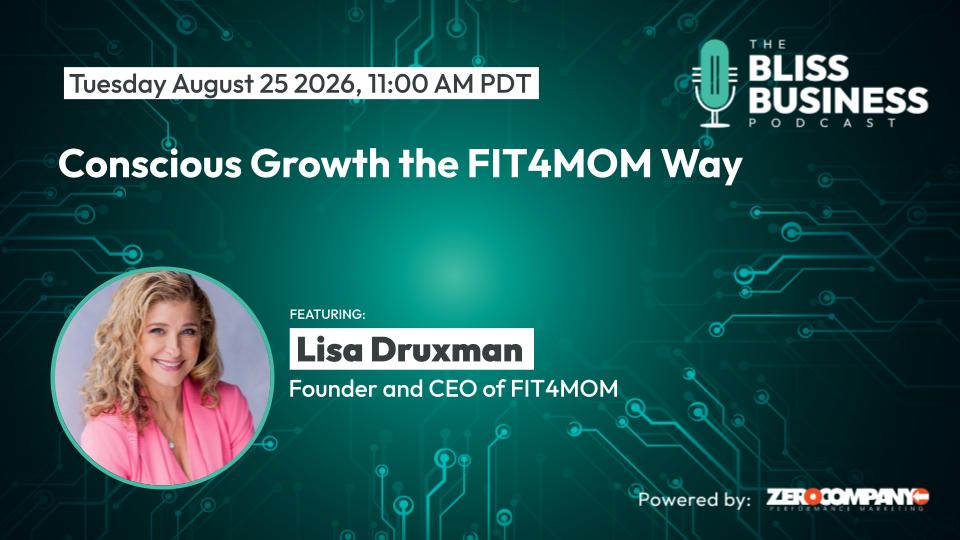
On The Bliss Business Podcast, we welcomed back Lisa Druxman, Founder of FIT4MOM, for a conversation about conscious growth and scaling without sacrificing culture. Lisa first joined the show in August 2024 to talk about building community and connection in business. In this return conversation, we explored growth without losing the soul of the business: what it means to grow with intention after 25 years of helping moms make strides in fitness, motherhood, and life. FIT4MOM offers pre- and postnatal health, wellness, and fitness programs for every stage of motherhood, while also creating local communities where moms feel seen, supported, and connected.
Lisa’s message was clear: growth is not automatically good. Healthy growth is what matters.
Growth Has To Mature With the Business
Lisa shared that FIT4MOM is celebrating its 25th anniversary, and that milestone has made her deeply reflective.
In the early years, growth meant more. More locations. More franchises. More programs. More reach. That kind of growth mattered because the company was building momentum, creating awareness, and expanding access to a community moms clearly needed.
But over time, her definition of growth changed.
Today, growth is not only about adding more. It is about becoming stronger. It is about making sure the business gets healthier as it grows. It is about asking whether moms are being served better, whether franchisees are building healthier businesses, whether the team is supported, and whether the culture that made FIT4MOM special is being protected.
That is conscious growth.
It is not growth for its own sake. It is growth that strengthens the foundation instead of stretching it beyond recognition.
The Origin Story Still Guides the Business
FIT4MOM began because Lisa was looking for something she needed in her own life.
She was a new mom who wanted to care for herself while staying connected to her baby. She was not trying to choose between fitness and motherhood. She was trying to integrate them. What began as a personal need became a business because many other moms were looking for the same thing.
That origin story still shapes the company.
FIT4MOM is not simply about workouts. It is about connection, community, belonging, identity, and support during one of the most transformative seasons of a woman’s life.
As the business scaled, Lisa kept coming back to the same question: how do we make sure every mom feels seen, appreciated, and valued?
That question is the anchor.
A business can change its programs, systems, training, technology, and operations. But if it loses the original human need it was created to serve, it loses the heart of the business.
Success Is Bigger Than the Dashboard
FIT4MOM is a business, and Lisa was clear that revenue, membership, and franchise health matter.
But those are not the only indicators of success.
Success is also the mom who finds her best friend at Stroller Strides. It is the woman who realizes she needs to prioritize her health again. It is the client who becomes an instructor. It is the instructor who becomes a franchisee. It is the franchise owner who builds a business that allows her to be present with her children while contributing to her family.
Those outcomes are harder to measure, but they are central to the mission.
Lisa said that when you strengthen a mom, there is a ripple effect. Her family feels it. Her friendships feel it. Her work feels it. Her community feels it.
That kind of impact may not fit neatly into a KPI dashboard, but it is one of the deepest reasons the company exists.
Culture Must Be Protected as the Business Scales
When a business is small, culture often lives through the founder.
The founder’s energy, beliefs, style, instincts, and relationships shape everything. But as the company grows, culture cannot depend on the founder being in every room.
Lisa described this as one of the major lessons of the past 25 years. FIT4MOM’s culture can no longer live only with her. It has to live through the team, the franchisees, the instructors, the training, the values, and the local communities that carry the mission forward.
That is one of the most important transitions in conscious growth.
The founder has to move from being the source of culture to becoming a steward of culture. The business has to develop shared language, shared practices, shared values, and shared systems that allow the original purpose to show up consistently without requiring the founder’s constant presence.
Values Cannot Be Decorative
Lisa emphasized that FIT4MOM is a values-driven business.
But values cannot simply be words on a screen. They have to shape decisions, training, strategy, hiring, franchise support, customer experience, and leadership behavior.
For FIT4MOM, the core is strength in motherhood and helping women feel seen and supported as moms. That core has to remain protected even as the business evolves. Lisa shared that the company returns to its mission and values during quarterly strategy meetings and annual planning, making sure the team stays directionally aligned.
That repetition matters.
Companies often talk about mission once and then move on to metrics. But conscious growth requires both. Metrics show what is happening. Mission helps explain why it matters and what must not be sacrificed along the way.
Data Tells What, But Not Always Why
Lisa made an important distinction about metrics.
Metrics matter because they show what is happening. They can show revenue, retention, cancellations, attendance, membership, franchise performance, and many other indicators of business health.
But metrics do not always tell the human story.
A cancellation tells you that someone left. It does not tell you whether she returned to work, felt disconnected, moved away, felt unwelcome, or simply entered a different stage of motherhood. The data gives a signal. The human story gives meaning.
Conscious growth requires leaders to look at both.
If a business only watches numbers, it may miss the emotional reality behind them. If it only listens to stories without measuring performance, it may miss operational risks. Healthy leadership brings the data and the human story together.
The Best Franchisees Reveal the Culture
Lisa shared a helpful exercise FIT4MOM used to clarify its values.
The team looked at their best franchisees, the ones who were successful in the business, wonderful to work with, aligned with the mission, and deeply representative of what FIT4MOM wanted to become. Then they asked: what do these people have in common?
Those patterns helped reveal the values the company wanted to protect and scale.
That is a powerful exercise for any business.
Rather than inventing values in a conference room, leaders can look at where the company is already at its best. The best customers, best employees, best franchisees, and best partnerships often reveal the culture that already wants to emerge.
The goal is not to create artificial values.
The goal is to identify and systemize the behaviors that make the company meaningful.
The Ripple Effect Is Designed Into the Experience
FIT4MOM teaches what Lisa calls the ripple effect.
The business looks at each phase of the client journey: awareness, the decision to say yes, the class experience, and retention. But the difference is that FIT4MOM does not treat these phases as purely transactional. Each stage is designed to create connection.
The company teaches instructors how to create mom-to-mom connections, mom-to-instructor connections, mom-to-child connections, and community connections. This is not a side benefit. It is part of how the classes are taught.
That is BLISS in action: building love into scalable systems.
A mom does not only need a workout. She may need to be seen. She may need a conversation. She may need reassurance that she is not alone. She may need a new friend. She may need one hour in the day where she feels strong again.
When the system is designed around that reality, the business becomes more than fitness.
It becomes a village.
Local Leaders Create the Magic
FIT4MOM now operates across thousands of class locations, but the magic still happens locally.
Headquarters can create programs, training, systems, tools, and brand standards. But the actual experience happens in class, mom to mom, instructor to mom, and community to community.
Lisa said the job of headquarters is to make sure local leaders understand that they are not simply teaching fitness classes. They are creating belonging.
That distinction matters.
A class can technically be well-designed and still feel emotionally empty. A class can include the right movements, timing, and structure but fail to create connection. FIT4MOM’s model depends on instructors understanding the human meaning behind the class.
They may be giving a mom the best hour of her day.
That is not a small responsibility.
Franchise Owners Need Support as Whole People
FIT4MOM’s franchise model is unusual because many franchise owners work part-time, often around 10 to 15 hours per week.
That is not a weakness in the model. It is part of the model.
Many women buy into FIT4MOM because they want to be moms first while also building a meaningful business. Lisa does not want to say the company supports moms and then create a business that requires them to sacrifice themselves in order to succeed.
That is an important example of alignment.
The business teaches franchisees to understand their why. Some want impact and community. Some want supplemental income. Some want a flexible lifestyle. Some want to grow toward a more significant business. Those different goals require different paths.
A conscious franchise model supports people as whole humans, not only as operators.
Ambition Should Not Require Burnout
Lisa wants her franchisees to be ambitious, but she does not want them to believe ambition requires burnout.
That is a powerful distinction.
Many business cultures still assume that serious growth requires constant sacrifice, exhaustion, and imbalance. FIT4MOM challenges that idea by helping franchisees think about time, energy, priorities, and life stage.
If a franchisee has only 15 hours a week, those hours need to be used wisely. Lisa talks about highest return on investment and highest return on energy. That matters because not every task deserves equal attention. Not every urgent request is strategic. Not every opportunity aligns with the life the franchisee is trying to build.
Conscious growth respects energy.
It asks not only what the business can produce, but what kind of life the business is creating for the people inside it.
Sometimes Growth Means Pausing
One of the boldest decisions Lisa shared was FIT4MOM’s choice to pause new franchise sales for the remainder of the year.
For the first time in more than 20 years of franchising, the company chose not to keep adding new franchisees. Instead, the team decided to focus on existing franchisees, strengthen programs, improve training, and build a stronger foundation for the future.
That was not an easy decision.
The assumption in business is often growth, growth, growth. More locations. More sales. More expansion. But Lisa recognized that existing franchisees were not feeling as successful as she wanted them to feel. Continuing to add new franchisees without addressing that would not be healthy growth.
So FIT4MOM paused.
That pause itself was an act of leadership.
Strengthening Can Be More Profitable Than Expanding
The decision to pause new franchise sales did not weaken the company.
In fact, Lisa shared that FIT4MOM has had some of its most profitable months since making the decision. New franchise sales require significant expense: sales staff, advertising, legal requirements, franchise disclosure documents, audits, and other growth costs. Pausing expansion reduced some of those costs and created more space to serve the business already in place.
This is an important lesson.
Growth is not only about adding. Sometimes growth comes from strengthening what already exists.
A business can improve profitability, culture, franchisee satisfaction, retention, and long-term health by going deeper before going broader.
That requires courage because the market often rewards expansion stories more than foundation-building stories.
But conscious leaders know the foundation matters.
Purpose Is a Decision Filter
Lisa described purpose as a filter.
There will always be more opportunities than a business can pursue: new products, partnerships, revenue streams, markets, programs, campaigns, and expansion paths. The question is not simply, “Could we do this?”
The better question is, “Should we do this?”
For FIT4MOM, the filter is whether an opportunity supports moms in living healthier, happier lives, strengthens franchisees, and aligns with the company’s mission.
That kind of filter is essential for conscious growth.
Without purpose, opportunity can become distraction. With purpose, leaders can say no more clearly, say yes more confidently, and protect the business from diluting itself.
Purpose Keeps Leaders Moving Through Hard Seasons
Lisa was honest that business ownership is hard.
No matter the size of the company, there are days when leaders feel exhausted, discouraged, or tempted to stop. What has kept Lisa moving forward is the purpose behind the company.
She believes deeply in what FIT4MOM does and why it exists. That belief gives her the capacity to keep going through challenges, look for new ways around obstacles, and protect the legacy of the business.
Purpose does not make business easy.
But it gives difficulty meaning.
That meaning matters, especially when growth tests the leader’s resilience.
Love Means Not Growing at Someone’s Expense
When asked how love should influence the way leaders think about growth, Lisa’s answer was powerful.
Sometimes the most loving thing a leader can do is tell the truth. Sometimes love looks like clarity. Sometimes it looks like accountability. And sometimes it looks like making decisions that protect the health of the organization, even when those decisions are not easy.
For Lisa, love means caring so much about the people and the mission that she will not pursue growth at their expense.
That is one of the clearest definitions of conscious growth.
It is not anti-growth. It is anti-extraction.
It refuses to sacrifice the very people the business exists to serve.
Ask What Must Never Be Lost
For founders or leaders entering a new season of growth, Lisa offered a practical question:
What must we never lose?
That question changes the conversation.
Instead of only asking how to grow, leaders should ask what customers would genuinely miss if it disappeared. What makes the experience different? Why do people believe in the business? What must be protected so growth does not dilute the soul of the company?
Lisa used the example of a favorite restaurant that gets acquired or expands and then loses what made it special. The ingredients change. The service changes. The recipes change. The feeling changes. The business may have grown, but the essence was lost.
Conscious growth starts by naming what must be protected.
Only then should leaders decide what kind of growth is right.
Key Takeaways
-
Growth is not automatically good. Healthy growth strengthens the business instead of diluting it.
-
FIT4MOM’s origin story still guides its mission to help moms feel seen, supported, and connected.
-
Success includes revenue and membership, but also friendship, belonging, health, leadership, and family impact.
-
Culture cannot live only with the founder. It must be carried through people, systems, values, and training.
-
Data tells what is happening, but the human story helps explain why.
-
The best franchisees, employees, and customers can help reveal the values worth protecting.
-
Community can be systemized through intentional touchpoints that create connection and belonging.
-
Franchise owners need support as whole people, not only as operators.
-
Pausing expansion can be an act of conscious leadership when the foundation needs strengthening.
-
Love in growth means refusing to pursue expansion at the expense of people, mission, or culture.
Final Thoughts
Lisa Druxman’s perspective is a reminder that growth reveals what a business is built on.
If the foundation is weak, growth exposes the cracks. If the culture depends entirely on the founder, growth stretches it. If the business is chasing more without protecting meaning, growth can become extraction.
But when growth is conscious, it can strengthen the mission.
FIT4MOM shows that scale and intimacy do not have to be opposites. A business can grow across thousands of locations while still creating local belonging. A franchise model can be ambitious while still supporting the lives of the women who lead it. A company can measure revenue and still care deeply about the mom who found her best friend in class.
The question is not simply how big the business can become.
The question is what must remain true as it grows.
Conscious growth protects the soul of the business while expanding its impact.
Where to Go Next
Listen to the full conversation on the episode page, watch it on the video page, or learn more about Lisa on her guest profile. Growth without losing the soul of a business starts with deciding what must never be sacrificed to get bigger. Explore more Featured Guest Series conversations.

Executive Producer | Host | Blog Contributor
Tullio Siragusa is a strategic advisor, dynamic speaker, author, and EQ coach with 36 years of experience as a technology disruptor rooted in Design Thinking. Since 2018, he has been creating, producing and hosting live podcasts, interviewing over 1,000 C-suite executives across a wide range of industries. His work behind the mic reflects his larger mission: using conversation as a catalyst for human-centric innovation.
Tullio’s commitment to purpose-driven leadership and ethical transformation is reflected in his advisory roles at the University of California, Riverside’s Design Thinking Executive Program, and the University of San Francisco School of Management’s Digital Marketing Program. As a Board Advisor at AI2030.org, he helps guide the responsible advancement of AI toward ethical and sustainable outcomes. A founding member of RadicalPurpose.org, Tullio believes empathy isn’t just a trait, it’s a non-negotiable foundation for leadership.

Belonging Is Built Into the Details