Marketing With Purpose Kit: Turning Marketing into a Revenue Engine
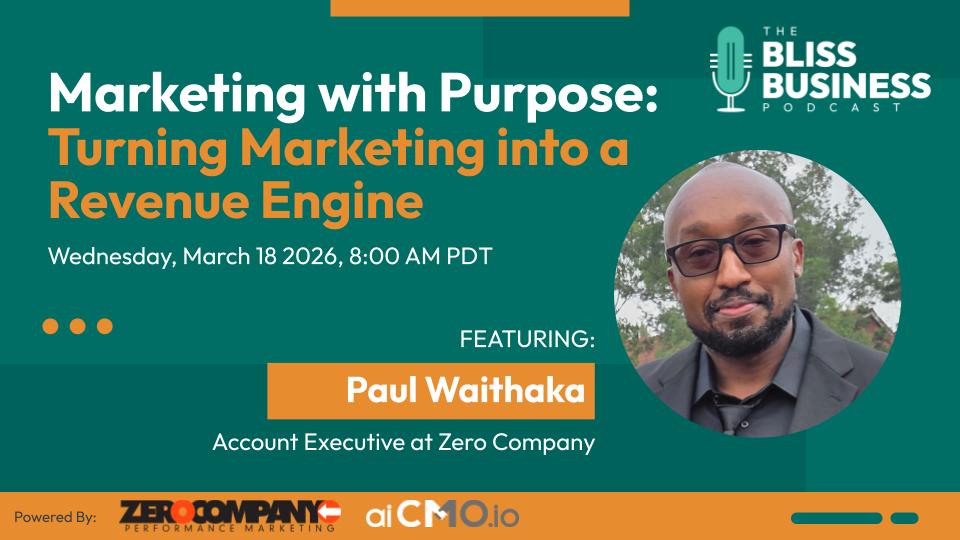
Paul Waithaka, Account Executive at Zero Company, joins the Marketing With Purpose Kit to take apart the marketing cost center myth, and to explain why the tracking chain from click to closed sale is what decides whether marketing can defend itself at all.
The marketing cost center myth is the reason the marketing department is often the first thing cut, and Paul Waithaka has been on the wrong end of it more than once. In this Marketing With Purpose Kit episode of The Bliss Business Podcast, host Michele Brasfield talks with the Account Executive at Zero Company, who brings a master's in marketing research and close to 20 years in the industry to the question of how marketing proves it makes money rather than spends it.
In this episode we explore:
• Why marketing gets cut first, and what the cut is really about
• Running a short-term revenue campaign and a long-term brand campaign at once
• The tracking chain from click to landing page to form to CRM to sale
• What to change when impressions are high and conversions are not
• Where sales over-promising and product reality collide
• Holding a client's budget steady through a downturn, and what that buys later
The Cut Is a Translation Problem
Paul has lived through the cuts he is describing. His diagnosis is not that leaders undervalue marketing out of malice, but that “they did not understand what the marketing department was for, because we looked at a cost center. We're costing the company money and not actually giving them money.” The work of the discipline, in his framing, is making the other half of that sentence provable.
The obstacle is rarely the campaign. Asked where the biggest pain point sits, his answer is immediate: “honestly leadership,” and not only the CMO. Executives want revenue and profit now, and a marketer can deliver that, but a one-time customer is not a business. “When you build a brand behind your product, behind the service you're selling, then that's a recipe of building a repeat customer.” The mechanics are the easy part, since a short-term revenue campaign and a long-term brand campaign can run side by side on separate budgets. “The difficult part is dealing with the personalities.”
Without the Data Chain, Everything After Is Guesswork
Asked what actually turns marketing into a revenue driver, Paul goes straight to plumbing rather than strategy. Conversion tracking, Google Tag Manager, CRM integration, analytics. “If you don't have a good data infrastructure behind it, then you can forget about running a successful campaign.” The chain he wants visible end to end is specific: a lead arrives from Google, hits a landing page, fills a form, enters the CRM, becomes a sale. Break any link and “anything after that is just your guesswork.”
He is realistic about the ceiling. His working split is roughly 80 percent data and 20 percent estimation, because life happens, but the 80 has to be real. And the diagnostic it enables is concrete: high impressions and high clicks with few conversions means the targeting is wrong, so change the audience or the message. If the next iteration drops impressions while clicks and leads rise, the targeting is right, and the job becomes figuring out what changed.
When the Data Contradicts the Obvious Answer
The story that makes the point is about a client who photographs marriage proposals. Paul assumed the peak was Christmas and Valentine's Day. The data said July through October, ahead of Thanksgiving, because people want to arrive at the holiday already engaged and do not want the proposal competing with the celebration. Valentine's turned out to produce a different question entirely, closer to “do you want to be my girlfriend” than a marriage proposal.
His account of it is unusually honest for a marketer: “My intuition was way off. I will not even lie about that.” What he takes from it is the discipline of changing his thinking fast when the numbers refuse to agree with him.
The last thread is what empathy looks like in an account relationship rather than in a campaign. Through the tariff disruption he reduced client budgets to put money back in their pockets while telling them plainly, we are in this together. One renovation client started at a $1,500 monthly budget and now runs close to $20,000 three years later, and the meetings that used to run 40 minutes of double-checking now last five. That is not a softer version of account management. It is the same discipline Zero Company builds client relationships on, and it compounds in a way no single campaign does.
Key Takeaways
• (1:45) Paul Waithaka on why marketing goes first in a downturn: companies “did not understand what the marketing department was for, because we looked at a cost center.”
• (2:54) Paul Waithaka on the real friction point: “honestly leadership,” and not only the CMO, when executives want revenue and profit immediately.
• (2:54) Paul Waithaka on why brand still matters to a performance marketer: “when you build a brand behind your product... that's a recipe of building a repeat customer.”
• (2:54) Paul Waithaka on the part nobody warns you about: running the campaigns is not hard, “the difficult part is dealing with the personalities.”
• (4:22) Paul Waithaka on communication as a learned skill: “you have to learn how to massage your words... if I give it to you straight, it's not going to sound nice.”
• (5:06) Paul Waithaka on holding clients through the tariff disruption: reduce the budget to give them breathing room, then say “we're in this together... your success means my success.”
• (7:47) Paul Waithaka on where go-to-market breaks: sales promises what the product will do in two months, and product marketing says it is four quarters out.
• (10:07) Paul Waithaka on the proposal-photography client, where the data put peak season in July through October rather than Christmas or Valentine's: “My intuition was way off. I will not even lie about that.”
• (13:23) Paul Waithaka on the prerequisite: “If you don't have a good data infrastructure behind it, then you can forget about running a successful campaign.”
• (13:50) Paul Waithaka on the chain that has to be traceable: Google to landing page to form to CRM to sale, or “anything after that is just your guesswork.”
• (13:50) Paul Waithaka on reading a campaign: high impressions and clicks with no conversions means “I'm targeting people, but not the right people.”
• (16:17) Paul Waithaka on keeping marketing talent: continuing education plus empathy, because bosses who forget past success and push through a bad stretch lose the person entirely.
• (18:55) Paul Waithaka on the renovation client who went from a $1,500 monthly budget to roughly $20,000 over three years, and from 40 minute meetings to five.
FAQ
Why is marketing treated as a cost center?
Paul Waithaka of Zero Company says it happens when the department's contribution has never been made traceable, so leadership sees spend without seeing return. His fix is not better argument, it is a data chain that follows a lead from the ad through the CRM to the closed sale.
What do you need in place before a campaign can prove revenue?
Paul Waithaka names conversion tracking, Google Tag Manager, CRM integration, and analytics as the minimum. Without that infrastructure, in his words, everything downstream is guesswork, no matter how good the campaign itself is.
What does it mean when a campaign gets clicks but no conversions?
Paul Waithaka reads high impressions and high clicks with low conversions as a targeting problem rather than a creative one: the ads are reaching people, just not the right people. The move is to change the audience or the message and watch whether leads rise as impressions fall.
Learn more about Paul Waithaka at his guest profile. Read the companion post, When Marketing Stops Defending Itself and Starts Driving the Business. More from the Marketing With Purpose Kit.

Paul Waithaka will be your primary Account Executive here at Zero Company. He puts his master’s degree in marketing research to use each day at Zero Company, and he enjoys the challenge of building, analyzing and optimizing PPC and social media campaigns for his clients and believes that providing services for clients from a wide range of industries makes coming to work an interesting experience. Not only has he earned Google Ads Search and Google Ads Measurement Certification, but he’s also fluent in three languages.
When’s not busy with client accounts, Paul enjoys spending time supporting the Philadelphia Eagles and the L.A. Lakers, as well as reading, hiking, skating or perhaps finding the world’s best carne asada tacos.