
Marketing With Purpose Kit: Turning Marketing into a Revenue Engine
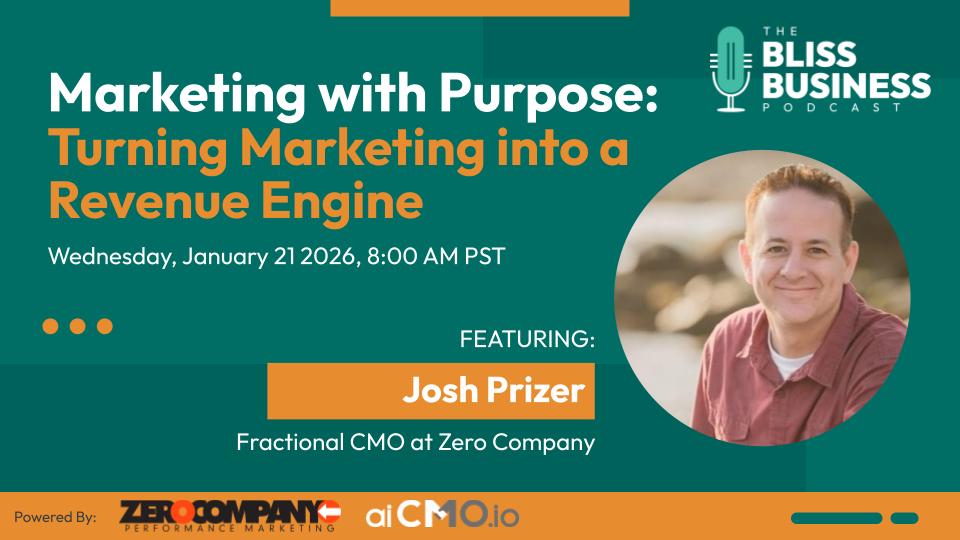
Josh Prizer, Fractional CMO at Zero Company, joins Mike Liwski on marketing peace of mind. He argues the job is not prettier dashboards but a predictable line from spend to revenue, and that growth is destructive when acquisition cost runs above contribution margin.
Marketing peace of mind is what Josh Prizer says he is actually selling, and he means it literally. Josh is a Fractional CMO at Zero Company who has been with the team since 2002, guiding clients with multi-million dollar ad budgets across Google, Bing, and programmatic platforms including display, video, and CTV. He joined host Mike Liwski on the Marketing With Purpose series.
In this episode we explore:
• Why most companies still run marketing as a cost center
• The moment growth turns destructive
• Asking why a metric is your KPI before you optimize to it
• The zip codes that cost more and paid triple
• Where the funnel actually leaks
• The three options he gave every client in March 2020
He starts with the owners and franchisees he keeps meeting, spending tens of thousands a month and emotionally exhausted because they cannot connect what goes in to what comes out. That, not reporting volume, is the problem he is solving.
The discipline underneath it is arithmetic. If customer acquisition cost sits below contribution margin, growth is good and you can push. If it is flipped, growth is destructive no matter how good the ads look. He is equally pointed about KPIs that nobody has interrogated, where a metric is important because someone said so years ago rather than because it reflects the business.
His best story makes that concrete. On a home services client, zip codes with a higher cost per lead turned out to produce three times the revenue per lead. Reallocating budget there dropped lead volume and raised profit. His line for it: some leads look expensive but they make you rich, and others look cheap but they make you poor.
Then the part most agencies skip, which is everything after the lead. If one franchise owner converts 65 percent and another converts 35 percent, sending the second one more leads solves nothing. And in March 2020 he called every client individually and gave each of them three real options, including firing his own agency. Being willing to say that out loud is what made the other two options trustworthy, and it is the standard Zero Company holds itself to.
Key Takeaways
• (2:35) The real deliverable: “most companies still treat marketing like a cost center instead of a revenue system,” and owners spending tens of thousands a month “don’t know if it’s working.” Fixing that is “about giving leaders peace of mind.”
• (4:14) The line that decides whether to scale: if acquisition cost is below contribution margin, “growth is good, right? Put your foot on the accelerator.” If it is flipped, “now that growth is actually destructive. No matter how pretty the ads look.”
• (5:42) On inherited KPIs: someone says cost per click matters most, and his question is “Well, why?” Somebody told them that once. “Is it the most important metric? Is it our primary KPI?”
• (12:49) The zip code case. Territories with a higher cost per lead were “producing three times the revenue per lead.” Reallocating dropped volume and raised profit. “Some might look expensive, but they make you rich. Others might look cheap, but they make you poor.”
• (15:53) Why he looks past lead generation: “how come franchise owner A is converting 65 percent of their leads and franchise owner B is converting 35 percent? I can send franchise owner B more leads, but to what end?” Close the leak first.
• (23:39) March 2020, and the option he put on the table first: if you truly cannot afford this, fire us, save the budget, and become your own marketer. Then stay the course, or lean in and take share. One client took option one and came back four months later.
FAQ
When is business growth actually bad?
When customer acquisition cost climbs above contribution margin. Josh Prizer of Zero Company calls that destructive growth, because revenue rises while the business gets more fragile underneath it.
Should marketers always chase a lower cost per lead?
No. Josh Prizer found zip codes with a higher cost per lead producing three times the revenue per lead, so optimizing for cheap leads was quietly steering the client toward worse customers.
What should a company do if its CRM cannot track the full funnel?
Work backwards from the last point you can track reliably, says Josh Prizer, then scale the budget 10 or 20 percent at a time and check whether revenue moved with it before scaling again.
The dashboard is not the product. The confidence is. Hear the full conversation with Josh Prizer, watch it on the video page, hear Paul Waithaka on the marketing cost center myth, and find more on the Marketing with Purpose Kit series.

Vice President, Digital Marketing of Zero Company
Since 2002, Josh Prizer has been a cornerstone of the Zero Company team, guiding clients with multi-million dollar ad budgets toward strategic growth. With deep expertise in Google, Bing, and programmatic platforms including Display, Video, and CTV, Josh brings both precision and purpose to every campaign.
What sets Josh apart is not just his mastery of digital advertising. It is his passion for helping businesses grow into their full potential and witnessing the ripple effect that growth has on the lives of the people behind them.
Outside of work, Josh is active in his community as a volunteer educator and local baseball umpire. Whether he is teaching empathy and compassion or calling plays on the field, he is committed to fostering integrity and human connection in everything he does.

