Why the Most Dangerous Marketing Cut Is the One That Feels Rational

One of the most common mistakes franchisees make does not usually look reckless.
It looks disciplined.
A location trims marketing because revenue still seems stable.
A campaign gets paused because the month looks soft.
A budget gets reduced because leadership wants to be prudent.
An operator decides to wait until “things pick back up” before investing again.
On paper, these decisions can feel responsible. They reduce cost. They simplify the P&L. They create the appearance of tighter control.
But in franchise businesses, that kind of short-term discipline often masks a deeper strategic mistake: treating marketing like a monthly expense instead of a growth system.
That is the real issue.
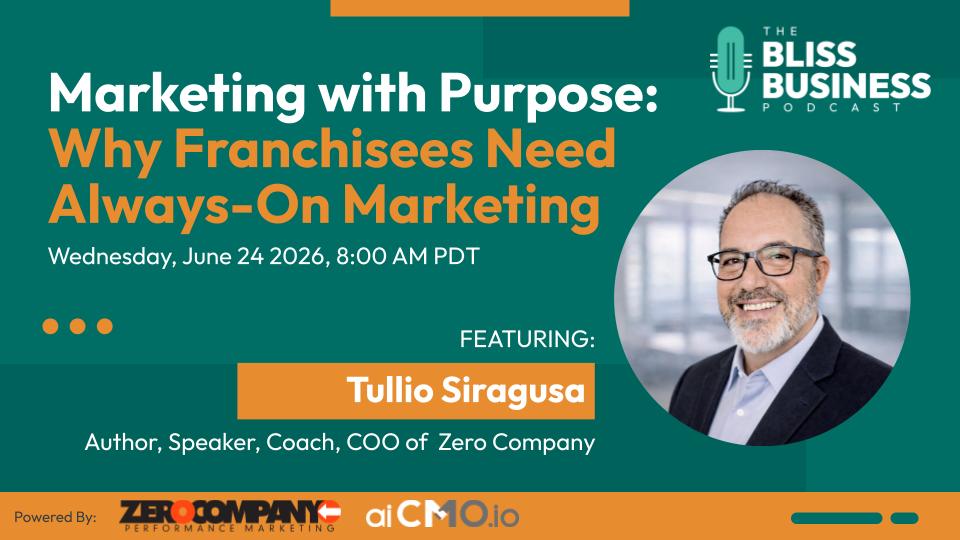
In a recent special monologue episode of the Marketing with Purpose series of The Bliss Business Podcast, Tullio Siragusa, COO of Zero Company, unpacked the cost of cutting franchise marketing and why so many operators misread the timing of marketing’s impact. His central point is one more franchise systems need to understand: local growth is rarely won only at the moment of transaction. It is won earlier, in the memory, trust, familiarity, and presence a business builds before the customer is ready to act.
That changes how marketing should be managed.
And it changes what leaders should fear.
Because the most dangerous marketing cut is often the one that feels rational while the damage is still invisible.
The Local Customer Journey Rarely Begins with the Ad They Clicked Today
A lot of marketing decisions get made as if customers move in straight lines.
They see the ad.
They click.
They buy.
The business counts the result.
That model is convenient. It is also incomplete.
In most local categories, customers do not behave like instant-response machines. They search. They compare. They ask friends. They read reviews. They revisit options. They notice who keeps showing up. They form judgments slowly, through repeated exposure and accumulated trust. Then, when the moment of need arrives, they choose from the brands that already feel credible and familiar.
That means a large share of local growth is built before the conversion ever happens.
It is built in awareness.
It is built in repeated signals.
It is built in reputation.
It is built in local memory.
This is why franchise marketing cannot be evaluated only by what happened this week or this month. If an operator is only looking at the final moment of transaction, they are missing most of the system that made that transaction possible in the first place.
The Lag Is What Makes Underinvestment So Easy to Misread
One of the most useful ideas in Tullio’s monologue is that franchise marketing has a lag structure.
That matters because it explains why bad marketing decisions often do not feel bad right away.
A franchisee can cut spend and still have leads coming in for a while.
They can go dark and still see appointments on the calendar.
They can pause a campaign and still think demand is holding.
That creates false confidence.
The operator concludes the cut was smart.
The finance line looks cleaner.
The decision feels justified.
But underneath the surface, the real decline may already be underway. Branded search may be softening. Retargeting pools may be thinning. Review momentum may be slowing. Search visibility may be fading. The business may still be harvesting trust and awareness created months earlier without realizing that the future supply of that trust is being depleted.
This is why always-on marketing matters. It protects continuity across time. It keeps the brand visible while the customer is still deciding, still comparing, and still not quite ready to buy.
Once that continuity breaks, the damage often shows up later, when leaders no longer connect the symptom to the decision that caused it.
A Healthy Franchise Marketing System Should Not Be Managed by Mood
A lot of franchise marketing still operates reactively.
Sales dip, so someone turns up spend.
Sales improve, so someone cuts it.
A campaign underperforms, so the whole strategy gets questioned.
Cash feels tight, so visibility disappears.
That is not a strategy.
That is emotional budgeting.
The problem with emotional budgeting is that it uses the wrong clock. It interprets local marketing as if it should produce instant and stable cause-and-effect every month, even though most franchise categories rely on slower-moving variables like familiarity, reputation, habit, trust, and repeated exposure.
That is why marketing intensity is such an important idea.
The exact formula may vary by category, market, or unit economics, but every franchise location needs a baseline level of presence that keeps it visible, credible, and conversion-ready in the local market. That baseline is not an arbitrary budget line. It is the minimum viable investment needed to protect demand continuity.
Once spend falls below that threshold, the business does not always collapse immediately.
It just begins weakening quietly.
Revenue Is a Scoreboard, Not a Diagnostic Tool
Another core point in this monologue is that raw revenue does not tell the full story.
That is especially important in franchise systems because local markets are not equal. They have different levels of category demand, different seasonality, different competitive density, different demographic shifts, and different market tailwinds or headwinds. Two units can post the same revenue trend while living in very different realities.
A store may grow by five percent and still be underperforming if the market around it grew by fifteen.
Another may stay flat and actually be doing strong work if demand in its area shrank.
That is why growth has to be measured in context.
Tullio’s framework around local demand, business outcome, share capture, marketing intensity, and lag structure is so useful because it pushes operators to evaluate performance relative to opportunity, not just in absolute terms. It asks a much better question than “Did revenue go up?” It asks whether the unit captured more than its passive share of the market.
That is a smarter way to understand growth.
And it produces better decisions.
Share Capture Is the Metric More Franchisees Should Be Watching
Many franchisees spend a lot of time looking at top-line revenue without really asking how well they are performing relative to local category demand.
This is where share capture becomes so valuable.
If the market is growing and the unit is growing faster than the market, the location is gaining share.
If the market is growing and the unit is growing slower than the market, the location is losing relative ground even if revenue appears healthy.
If the market is shrinking and the unit is holding steadier than competitors, that may be a win worth recognizing.
This kind of context changes the coaching conversation dramatically.
Instead of simply asking why sales are down, field leaders can ask better questions:
Is local demand changing?
Are competitors getting more aggressive?
Has the store’s visibility weakened?
Have review trends shifted?
Has response time gotten slower?
Has the business fallen below its baseline presence?
That is a much more strategic conversation than “marketing worked” or “marketing didn’t work.”
The Baseline Is Not Waste. It Is Infrastructure.
One of the most important reframes in the episode is that baseline marketing should be treated more like infrastructure than discretionary spend.
That is a useful shift because infrastructure is not judged only by whether it created an immediate transaction today. It is judged by whether it keeps the business functioning in a stable, predictable way over time.
In local markets, always-on marketing plays exactly that role.
It protects search visibility.
It sustains review growth.
It keeps the business present in retargeting environments.
It reinforces trust through repeated exposure.
It keeps the brand from disappearing between campaigns.
That does not mean every franchisee should spend blindly or endlessly. Quite the opposite. The point is disciplined continuity, not random activity. Always-on marketing is not about noise. It is about maintaining enough presence that the business remains easy to remember and easy to choose when local need appears.
That is a very different mindset from using marketing only as a tactical lever to pull when the numbers feel uncomfortable.
Leading Indicators Matter Because Revenue Arrives Late
If revenue is a lagging outcome, then leadership needs something else to watch before the final number arrives.
That means leading indicators.
The specific indicators vary by category, but the principle holds across almost every franchise system. Smart operators need visibility into the signals that move before revenue fully reflects what is happening. Search presence, branded demand, review velocity, average rating, website engagement, inquiry quality, appointment rates, referral flow, repeat behavior, and response time all tell a more immediate story about the health of the demand system than a month-end sales total by itself.
These signals are not vanity.
They are early warnings.
They help reveal whether the brand is becoming easier to choose or harder to find.
They show whether trust is strengthening or fading.
They signal whether the system is compounding or eroding before the P&L makes it obvious.
That is what good franchise measurement should do. It should help operators detect weakening conditions before they become expensive to reverse.
Efficiency and Underinvestment Are Not the Same Thing
Every franchisee should care about efficiency.
They should improve targeting.
They should sharpen messaging.
They should strengthen landing pages.
They should improve response time.
They should make sure spend is working.
All of that matters.
But Tullio draws an essential distinction: efficiency discipline is not the same thing as harmful underinvestment.
Efficiency reduces waste while protecting the growth system.
Underinvestment cuts below the level required to keep the system healthy.
Those two things often get confused, especially when leaders are under pressure. The operator says they are being disciplined, but what they are really doing is weakening continuity. The decision sounds rational because the damage is delayed, but the effect is still real.
This is where so many local businesses lose momentum. Not through one spectacularly bad campaign, but through repeated short-term decisions that erode the foundation they needed to keep showing up credibly in the market.
Strong Local Growth Requires More Than Spend
Another important point in the monologue is that marketing intensity alone is never enough.
A franchisee can maintain spend and still underperform if the execution is weak. The message can miss. Reviews can lag. response time can fail. The customer experience can break trust. Staffing can be unready. Operations can make it impossible to monetize the demand marketing is creating.
This is why always-on marketing is not an excuse for lazy marketing. It is a framework for disciplined growth, and that growth still depends on quality.
The message has to fit the market.
The brand has to capture demand when it appears.
The business has to build local memory over time.
Operations have to be ready to convert the opportunity.
Measurement has to be honest enough to reveal what is actually happening.
This is also where franchise systems have to do better work. If a brand wants franchisees to invest consistently, it also has to give them the tools, guidance, and visibility to understand how that investment behaves over time and what operational conditions improve or weaken the return on it.
The Real Goal Is Not More Spend. It Is Better Governance.
What makes this monologue especially strong is that it does not argue for more marketing in a vague sense.
It argues for better governance.
That means better definitions.
Better baselines.
Better local context.
Better leading indicators.
Better coaching.
Better understanding of the lag.
When those things are in place, marketing becomes less emotional and more governable. Franchisees can stop swinging between overconfidence and panic. Corporate teams can stop oversimplifying local performance. Field leaders can stop relying on blame and start diagnosing systems more effectively.
This is one of the clearest ways to build what B.L.I.S.S. stands for: Building Love Into Scalable Systems.
Love in business is not softness.
It is clarity designed in a way that reduces confusion, mistrust, and unnecessary stress.
It is a system that helps people make better decisions before those decisions become painful.
It is infrastructure that supports human judgment instead of constantly punishing it.
That is exactly what a better franchise marketing framework can provide.
Key Takeaways
The most dangerous marketing cuts are often delayed in impact. They feel rational because the pain does not show up immediately.
Local customer acquisition is a compounding system. Trust, familiarity, and repeated visibility often shape the outcome before the moment of purchase.
Revenue alone is not enough to judge performance. Franchise growth has to be measured in context, relative to local demand and share capture.
Baseline marketing should be treated like infrastructure. It protects visibility, credibility, and continuity across time.
Leading indicators matter. Search presence, reviews, referrals, appointment quality, and repeat behavior often reveal the system’s health before revenue fully responds.
Efficiency is not the same as underinvestment. Good operators reduce waste without weakening the continuity of demand.
Always-on marketing is about disciplined presence, not constant noise. The goal is to remain visible and trustworthy in the market before the customer is ready to act.
Final Thoughts
What this monologue from Tullio Siragusa, COO of Zero Company, makes clear is that franchisees need always-on marketing not because every business should spend more, but because every local business needs a growth system that does not disappear between moments of urgency.
That is the real issue.
Franchise growth is not usually lost in one dramatic moment.
It is lost in quiet inconsistency.
In fading local memory.
In weaker review flow.
In broken continuity.
In decisions made with the wrong time horizon.
The franchisees who grow more steadily are usually not the ones making the loudest moves.
They are the ones protecting the baseline, measuring the right signals, and understanding that local trust is built before the customer decides.
That is what always-on marketing protects.
And that is why it wins.
Where to Go Next
Listen to the full monologue: Why Franchisees Need Always-On Marketing with Tullio Siragusa.
Watch the video: Tullio Siragusa on the franchise marketing baseline.
Explore more Marketing With Purpose Kit episodes.

Guest Development | Producer | Blog Contributor
Martha is a connector who brings over two decades of experience in engineering, sustainability, education, and public relations. She is part of the integrated go-to-market team at Zero Company and serves as Guest Development Lead for The Bliss Business Podcast, where she connects with purpose-driven leaders to shape meaningful conversations. Martha also produces the Marketing With Purpose Kit segments with CMO guests.
Her career includes founding nonprofits, and speaking at global forums in Malaysia, Dubai, and Paris. A passionate community builder, Martha also mentors women entrepreneurs and supports environmental initiatives across Mexico and the U.S. Her work reflects a deep commitment to impact, inclusion, and authentic leadership.

Starting Over Deserves Community