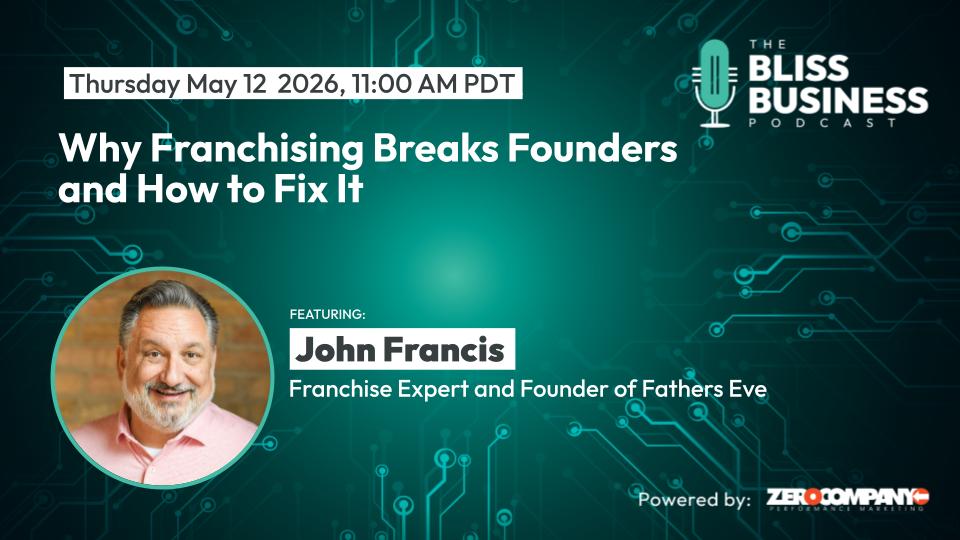
When Scale Breaks the Founder

Franchising is often marketed as a clean growth engine. The reality is messier. The model can be strong while the founder quietly becomes the bottleneck, the speed limit, and eventually the source of the organizational strain they cannot name.
On The Bliss Business Podcast, we sat down with John Francis, known throughout the industry as “Johnny Franchise.” John has spent more than 30 years across every side of franchising as a franchisor, franchisee, multi-unit owner, developer, advisor, and board member. He works with founders and leadership teams in the 30 to 300 unit range to reduce friction, strengthen leadership alignment, and build the infrastructure required for sustainable scale. He is also the founder of Father’s Eve, a community built around honest, judgment-free conversations that help fathers grow through real connection. His guiding rule for both: clarity beats comfort.
Franchising Is a Second Business
One of John’s most useful clarifications is the one founders underestimate: the business you started is not the business you are in once you franchise.
You might have built a tire shop, a service company, a retail concept, or a food business. Once you franchise, you now run a franchising business, which is fundamentally a relationship and leadership system layered on top of the original model.
That shift adds complexity fast: legal structure, audits, compliance, franchisee expectations, supplier dynamics, and a new class of stakeholders who are not employees and not traditional business partners, yet require deep trust and coordination. Founders who do not evolve for that reality feel it early. The fun fades. Pressure rises. Decision fatigue becomes constant.
The Founder Becomes the Speed Limit
John described a familiar pattern: early hustle works in the beginning, then becomes a growth problem. Founders stay deeply involved, make most decisions, and hold control tightly because that is what worked when the business was smaller. As the system grows, that same behavior turns into organizational drag.
A key line John shared is worth repeating: you do not scale effort, you scale decisions. If every decision has to route through one person, the organization hits a ceiling, even if the business model is strong.
He also pointed to the most visible warning sign: frustration. When teams consistently complain about slow decisions, incomplete context, shifting priorities, or unclear authority, the issue is rarely talent. It is usually structure. People are being held responsible without authority, which is a recipe for resentment.
Clarity Is a Form of Kindness
The most practical fix John returned to is clarity. Not motivational clarity. Operational clarity.
Clear focus on who you are and what you are building
Clear roles and decision rights
Clear meeting purpose and accountability
Clear performance measurement that is ongoing, not occasional
He said it bluntly: clarity beats comfort. Many founders want to be liked and avoid decisions that create short-term tension. That is a trap. Scale requires trade-offs. Leaders must be willing to create clarity even when it is uncomfortable, because confusion is more expensive than conflict.
Accountability Has to Be Structural
John described “structural accountability” as the thing that turns a founder-led brand into a scalable organization. It is not a task for one person. It is an environment where everyone holds commitments, with visibility and follow-through.
He shared how his own family’s business evolved when his father finally brought in outside leadership and added a board. The shift was not about taking the founder out of the story. It was about removing the founder from being the single decision bottleneck. Budgets, reporting, forecast discipline, and more thoughtful decision-making created a new operating system that allowed the organization to scale beyond one person’s capacity.
The First Thing to Let Go Of Is Hiring
An audience question asked what founders should stop doing first.
John’s answer was sharp: hiring. Founders often want hiring control more than anything, but holding it too long creates structural dysfunction. Leaders end up managing people they did not choose, accountability gets muddy, and teams start blaming each other when performance slips.
Delegation is part of the answer, but John made an important distinction: delegation is not “here, do this.” Delegation is authority plus responsibility plus clarity, supported by systems that keep work aligned.
Peer Accountability Is Where Ego Gets Checked
Tullio raised one of the most important founder questions: who keeps the founder accountable.
John’s position is that founders need a consistent outside feedback environment that is not family, not a neighbor, and not a one-off consultant dropping in cold. Boards, advisory boards, mastermind groups, peer groups, and coaches all serve the same purpose: keep leaders honest and prevent ego and greed from driving bad decisions.
He was direct that greed and ego often show up without leaders realizing it. They do not think of themselves as greedy. They simply start making decisions that serve status, control, or short-term cash instead of long-term health. Outside perspective catches that early.
Purpose Is the Decision Filter That Scales
Purpose came through as more than inspiration. John described it as a practical decision filter. He shared a story from his own franchise operator days: he would bring new employees to the mission statement on the wall, read it with them, and tell them that if they made decisions aligned to that purpose, he would back them 100 percent.
That is how founders get out of the middle of everything. People do not need the founder present if they have a clear North Star and permission to act within it.
An audience question asked what founders have in common when they stay happy, not just successful. John’s answer was impact. The happiest founders see the ripple effect of their work: franchisees, their families, their employees, vendors, communities. When founders anchor to that broader impact, the work stops being about ego and becomes about legacy.
The Father’s Eve Lesson Applies to Business
John’s Father’s Eve story is more than a fun side topic. It is a leadership signal.
He built a “third place” for fathers by creating a simple ritual, removing judgment, and making connection easy. It started as an accidental garage party, became a community, then expanded into an organized initiative that has raised significant funds and created real relationships across cities.
The lesson for founders is straightforward: community does not require complexity. It requires intention, rituals, and consistency. The same is true inside a franchise system.
Key Takeaways
Franchising is a second business, and it demands a different leadership operating system than the original concept.
Founders become bottlenecks when all decisions route through them. Scale requires scaling decisions, not effort.
Clarity beats comfort. Confusion is more expensive than tension.
Structural accountability is the foundation for sustainable growth, not heroic effort.
Founders should let go of hiring earlier than they want to. Control over hiring often keeps the system stuck.
Peer groups, advisors, and boards help founders check ego and make better decisions faster.
Purpose scales leadership. When the mission is clear, people can make aligned decisions without the founder in the room.
Final Thoughts
Franchising does not break founders because they are weak. It breaks them because the leadership requirements change and many founders try to scale using the same muscles that got them to the first level of success. The move from founder-led hustle to scalable leadership infrastructure is not optional. It is the work.
Where to Go Next
Listen to the full conversation: Why Franchising Breaks Founders and How to Fix It with John Francis.
Watch the video: John Francis on Delegation Without Losing Control.
Meet the guest: John Francis, founder of Fathers Eve.

Executive Producer | Host | Blog Contributor
Tullio Siragusa is a strategic advisor, dynamic speaker, author, and EQ coach with 36 years of experience as a technology disruptor rooted in Design Thinking. Since 2018, he has been creating, producing and hosting live podcasts, interviewing over 1,000 C-suite executives across a wide range of industries. His work behind the mic reflects his larger mission: using conversation as a catalyst for human-centric innovation.
Tullio’s commitment to purpose-driven leadership and ethical transformation is reflected in his advisory roles at the University of California, Riverside’s Design Thinking Executive Program, and the University of San Francisco School of Management’s Digital Marketing Program. As a Board Advisor at AI2030.org, he helps guide the responsible advancement of AI toward ethical and sustainable outcomes. A founding member of RadicalPurpose.org, Tullio believes empathy isn’t just a trait, it’s a non-negotiable foundation for leadership.

Starting Over Deserves Community