Empathy Becomes Culture When It Turns Into Action

Work culture is rarely shaped by what leaders say. It is shaped by what leaders do consistently, especially when nobody is watching. If you want a culture built on empathy, connection, and consciousness, empathy cannot live as a value on a slide. It has to become behavior, then it has to become system.
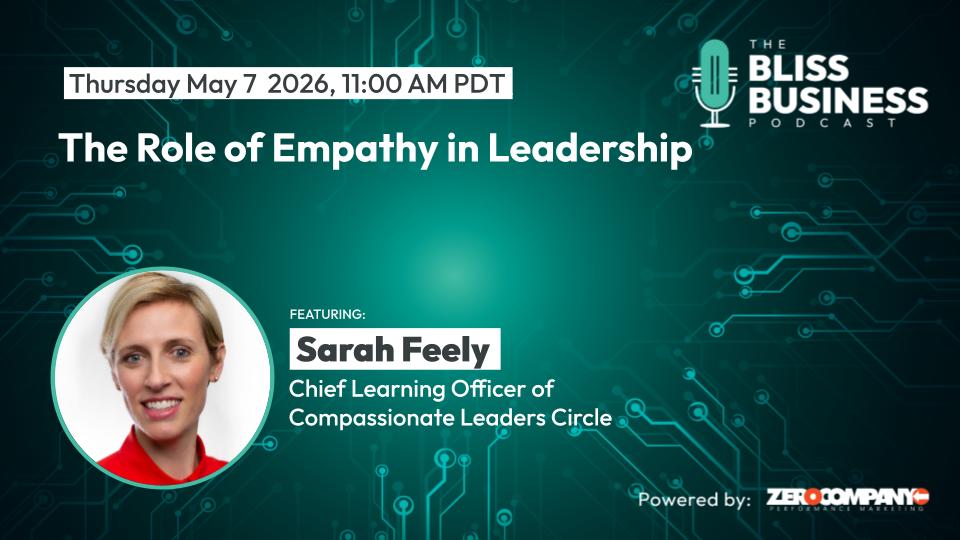
On The Bliss Business Podcast, we sat down with Sarah Feely, Chief Learning Officer of Compassionate Leaders Circle. Sarah helps organizations align business strategy with people strategy through leadership development, coaching, retreats, and organizational change initiatives. She brings deep experience from executive recruiting and leadership advisory through roles at Korn Ferry and other organizations, and she has built her work around one simple question: how do you help leaders become the kind of humans people actually want to follow. Her clearest lesson for doing that: purpose beyond the task, not the job title, is where real meaning comes from.
The Stories We Tell Become the World We Live In
Early in the conversation, Sarah shared a concept that deserves more attention in business. A self-fulfilling prophecy is not just psychology. It is culture. If a company repeatedly tells itself that people are lazy, untrustworthy, and motivated only by money, leaders will build systems based on suspicion. Those systems will generate the behavior they fear.
Sarah’s point was the counterweight. People are good. More people are good than not. If leaders choose to tell stories that highlight what is possible, they create a different kind of reality, one where people expect decency and rise to it.
That is why the Compassionate Leaders Circle Awards matter. The awards crowdsource thousands of nominations and highlight leaders around the world who are doing meaningful work, often quietly, in corners nobody sees. It becomes proof that compassionate leadership is not rare. It is everywhere, and it is worth elevating.
Authenticity Is Not Self-Expression, It Is Self-Awareness
Sarah brought needed clarity to a word that gets abused. Authenticity is not “I do what I want.” Authenticity is deeper. It includes self-awareness, real relationships, and an internal sense that the life you are living is aligned with who you actually are. Authenticity evolves over time, and it is work.
She also named the trap that catches high achievers. Many people derive identity and self-worth from title, status, and external validation. That creates a fragile leadership style because the leader is protecting image, not serving mission.
Her conclusion was simple and sharp. The first responsibility of a leader is to know thyself. When leaders do not know themselves, they unconsciously lead from fear, ego, or the need to be seen as competent. When they do know themselves, they can show up in a steadier, more grounded way that allows other people to relax and perform.
Meaning Is Not the Task, It Is the Impact
One of Sarah’s best contributions was her distinction between task and impact. A job might not feel glamorous. A bus driver might say, “My purpose isn’t driving a bus.” Sarah reframed it. Meaning is not derived from the task. Meaning comes from the impact.
A bus driver is helping someone get to a doctor’s appointment. Helping a student get to school. Helping a parent keep a job. That is meaning.
This matters in leadership because it shows what great leaders do: they connect people to impact. They help teams see how their work changes someone’s life. That is not marketing. That is motivation.
Sarah also offered an important nuance. Some people are not in a work role that feels aligned with their deepest purpose right now. That does not make their life purposeless. Purpose can live in chapters and roles: parenting, community service, caretaking, learning, building. Work is one part of a whole human life.
Empathy Is a Business Advantage Because the Brain Is Fear-Based
Sarah brought a useful neuroscience lens into the conversation. Humans are wired for protection. The limbic system reacts quickly, shuts down, fights, flees. Modern work has outpaced our brains. People live under constant pressure, then wonder why creativity and collaboration suffer.
Empathic human connection is one of the fastest ways to access human flourishing: wellbeing, creativity, collaboration. Leaders sometimes treat empathy as a nice extra. Sarah treated it as a mechanism. It is how you move people out of threat response and into contribution.
This is why empathy now shows up in data. Treat humans like humans, and performance improves. The human system drives the business system.
You Cannot Build Clean Leaders in a Dirty Pond
Sarah offered one of the sharpest metaphors in the episode: clean fish, dirty pond. Leaders are the fish. The company’s systems are the pond. You can train leaders in compassionate mindsets, then throw them back into systems designed around fear, short-term thinking, and metric worship, and you will watch them revert.
This is where most culture work fails. Organizations try to fix people while keeping systems intact.
Sarah’s alternative is a full-court press. Take high-level values and translate them into specific behaviors. Then align performance management, incentives, promotion criteria, and recognition systems to reward those behaviors. When values are operationalized this way, the culture becomes self-reinforcing.
A simple example surfaced in the conversation: recognition. If only one leader carries the torch, it stays fragile. When recognition becomes a shared behavior across peers, it becomes culture.
Love in Business Is a Commitment Problem
Stephen asked why we do not see more love in business. Sarah’s answer was direct. Fear-based protection is the default. People believe love is a nice-to-have, not a need-to-have. Then she added a deeper point. Love implies commitment.
Commitment to people. Commitment to community. Commitment to staying the course when it would be easier to discard someone.
She connected this to a larger erosion of community in society: remote work, transient lives, less shared affiliation, fewer natural places for cohesion. Some companies use this erosion as an excuse to cut costs and reduce commitment. Others realize the opposite: performance depends on connection and cohesion, and leaders must build it deliberately.
She also emphasized the most important leverage point: the direct manager. The team leader shapes the majority of a team’s climate. If the manager leads with care and empathy, people feel it daily. If not, no amount of corporate messaging can compensate.
One Step That Changes Everything
Stephen ended with a question meant to leave listeners with something tangible. Sarah’s answer was clear. Compassion includes empathy, but compassion requires action. If you want to start practicing compassionate leadership, take an action to cultivate a relationship.
It can be peer-to-peer, managing up, or managing a direct report. The point is to move. Do not wait until you feel ready. Take a step toward someone.
She also offered a powerful framing through the roles of coach, mentor, and sponsor. Leaders have tremendous power to elevate someone’s work experience. The most compassionate leaders do not just give advice. They advocate. They open doors. They show belief.
Key Takeaways
-
Culture becomes a self-fulfilling prophecy. The stories leaders tell about people shape the systems they build and the behavior they get back.
-
Authenticity is rooted in self-awareness, not self-expression. Leaders must know themselves before they can lead others well.
-
Meaning comes from impact, not tasks. Leaders build engagement by connecting daily work to human outcomes.
-
Empathy improves performance because it moves people out of fear-based brain states and into collaboration and creativity.
-
Clean fish cannot thrive in a dirty pond. Values must be operationalized in systems, incentives, and recognition.
-
Love is a commitment issue. Cohesion erodes when people feel disposable, and managers are the highest-leverage cultural influence.
-
Compassion requires action. One step this week is to take a real action to deepen a relationship or elevate someone else’s work experience.
Final Thoughts
Empathy in leadership is not a concept to admire. It is a discipline to practice and a system to build. When leaders align inner authenticity with outer behaviors, translate values into real incentives, and commit to people as humans rather than cogs, the culture stops being fragile.
Sarah Feely’s work is a reminder that compassionate leadership is not a luxury. It is a practical path to healthier teams, better performance, and a business people can feel proud to be part of.
Where to Go Next
Listen to the full conversation: The Role of Empathy in Leadership with Sarah Feely.
Watch the video: Sarah Feely: Clean Fish, Dirty Pond, and the Leadership Trap.
Meet the guest: Sarah Feely, Chief Learning Officer of Compassionate Leaders Circle.

Executive Producer | Host | Blog Contributor
Tullio Siragusa is a strategic advisor, dynamic speaker, author, and EQ coach with 36 years of experience as a technology disruptor rooted in Design Thinking. Since 2018, he has been creating, producing and hosting live podcasts, interviewing over 1,000 C-suite executives across a wide range of industries. His work behind the mic reflects his larger mission: using conversation as a catalyst for human-centric innovation.
Tullio’s commitment to purpose-driven leadership and ethical transformation is reflected in his advisory roles at the University of California, Riverside’s Design Thinking Executive Program, and the University of San Francisco School of Management’s Digital Marketing Program. As a Board Advisor at AI2030.org, he helps guide the responsible advancement of AI toward ethical and sustainable outcomes. A founding member of RadicalPurpose.org, Tullio believes empathy isn’t just a trait, it’s a non-negotiable foundation for leadership.

Belonging Is a Business Strategy