When Marketing and Growth Move Together

Campaigns launched. Leads generated. Traffic increased. Conversion rates improved.
Those numbers matter, but they can become misleading when they are disconnected from the larger business. A marketing team can improve its own metrics and still create pressure elsewhere in the organization. Demand can rise faster than operations can support it. Customer acquisition can accelerate while retention weakens. Short-term campaign performance can improve while long-term brand strength quietly erodes.
That is why aligning marketing with business growth requires a broader view of performance.
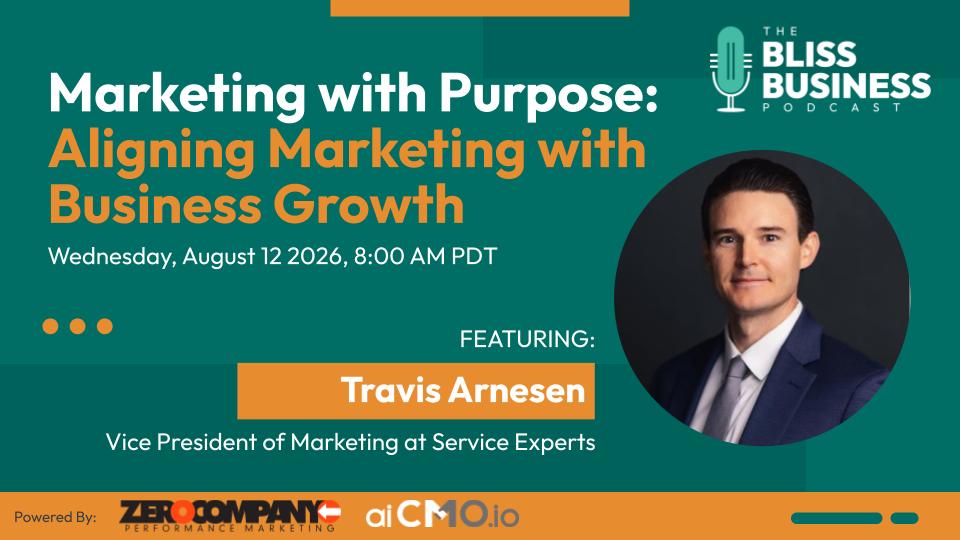
In a recent conversation with Travis Arnesen, VP of Marketing of Service Experts, on the Marketing with Purpose series of The Bliss Business Podcast, that point came through clearly. Travis leads marketing in a national home services organization where growth depends on balancing enterprise brand strategy, local market execution, customer trust, operational consistency, and measurable revenue impact.
His perspective is straightforward: marketing should be measured by business outcomes, not just marketing outputs.
That principle sounds simple, but it changes the way a marketing organization operates.
Marketing Metrics Need a Business Context
One of the easiest traps for marketers is reporting what is easiest to measure.
Reach, followers, clicks, traffic, impressions, and engagement all provide useful information, but none of them automatically answers the question leadership actually cares about: what did marketing contribute to the business?
Travis’s view is that marketing should ultimately influence outcomes such as customer acquisition, retention, lifetime value, revenue growth, and brand perception. Those measures bring marketing closer to the economics of the organization.
This does not mean every marketing activity needs to generate an immediate transaction. It means the organization should understand why the activity exists and which business outcome it is designed to improve.
That distinction becomes especially important when leadership is under pressure. If marketing cannot explain how its work connects to growth, it becomes easier for the function to be treated as a discretionary expense rather than a strategic investment.
Brand and Performance Marketing Work Better Together
One of the recurring tensions in marketing is the perceived tradeoff between short-term performance and long-term brand building.
Travis frames the relationship in a useful way: performance marketing captures demand that exists today, while brand marketing helps lower the cost of acquisition tomorrow.
That is a much healthier way to think about the issue.
The two disciplines are not competing philosophies. They are different parts of the same growth system. Performance channels help convert existing intent, while brand investment builds familiarity and trust that make future conversion more efficient.
The exact balance will vary by company, category, and stage of growth. Tools such as marketing mix modeling and multi-touch attribution can help leadership make better allocation decisions, but no model removes the need for judgment.
The important thing is to resist an either-or mindset.
A business that invests only in immediate conversion may eventually make acquisition more expensive because fewer people know or trust the brand. A business that invests only in awareness without enough demand capture may struggle to translate that equity into revenue.
The strongest systems connect both.
Franchise Growth Requires National Consistency and Local Relevance
Service Experts operates across a wide geographic footprint, which makes alignment more complicated.
Some marketing responsibilities belong at the corporate level, particularly upper-funnel brand activity, national media, sponsorships, and large-scale positioning. Local markets, however, still require local execution because home services are highly community-driven.
That creates an important tension.
A national brand needs consistency, but a local franchise needs enough flexibility to remain relevant to its market.
Travis’s approach is to create clear standards, playbooks, and expectations while allowing local teams and franchisees to execute against the realities of their own communities. The goal is for a customer in one state to receive the same core brand experience as a customer in another, even if the local marketing mix looks different.
This is where franchise marketing becomes more than centralized campaign management. It becomes a system for balancing consistency with local judgment.
Trust Should Be Protected Before the Balance Sheet
One of the strongest moments in Travis’s conversation involved crisis leadership.
He described working through a major product recall earlier in his career, where the company made the expensive decision to recall broadly rather than protect only the minimum financial exposure.
That choice reflected a deeper principle: customer trust was worth protecting even when the short-term cost was significant.
This matters because crises reveal what an organization actually values.
When something goes wrong, customers notice more than the problem itself. They notice whether the business communicates, whether it accepts responsibility, and whether it appears to be making decisions with their interests in mind.
Travis’s approach to crisis management is grounded in transparency, empathy, and facts. He also emphasizes the importance of slowing down emotionally while speeding up operationally.
That distinction is useful because poor crisis decisions are often driven by emotional urgency rather than strategic clarity. The business still needs to move quickly, but it needs to avoid reacting in ways that further damage trust.
Alignment Gets Stronger When Stakeholders Enter Early
Cross-functional alignment often breaks because teams are brought into the process too late.
Marketing develops the campaign.
Product develops the offer.
Operations figures out how to deliver it.
Sales gets the messaging shortly before launch.
By the time everyone realizes their assumptions are different, the organization is already in execution mode.
Travis advocates for bringing stakeholders into planning early and establishing a shared definition of success before the work accelerates.
This is less complicated than many companies make it.
Teams do not need identical responsibilities. They need clarity around the destination. Once everyone understands the desired customer outcome and the business objective, different functions can contribute through their own expertise without drifting into conflicting priorities.
Alignment is strongest when people understand the same end goal even if their paths toward it are different.
Predictable Revenue Starts With the Right KPIs
Marketing becomes more credible when leadership agrees in advance on what the function should influence.
That sounds obvious, but many organizations do the opposite. They begin with activity and determine later which metrics make the work look successful.
A stronger approach starts with the business.
Travis identifies several areas where marketing should have meaningful influence: customer acquisition, customer retention, lifetime value, brand position, and revenue growth.
That list reflects a more mature view of marketing because it goes beyond lead generation. It recognizes that growth is affected by how efficiently customers are acquired, how long they stay, how much value they create, and how the market perceives the brand.
When the organization agrees on those outcomes, measurement becomes much more useful. The conversation can move away from whether a particular channel produced an impressive metric and toward whether the overall growth system is becoming stronger.
The Marketing Environment Is Moving Faster Than Enterprise Systems
Another challenge Travis highlights is the speed of change in the digital environment.
Search behavior is evolving.
AI is reshaping how information is discovered.
Acquisition costs are changing.
Measurement systems that were dependable a year ago may need to be reconsidered.
That is difficult for any organization, but particularly for larger businesses with established systems and reporting structures.
The answer is not constant reinvention.
It is adaptability.
Strong marketing teams need to be curious enough to test new approaches while disciplined enough to preserve the fundamentals that still work. They also need the ability to distinguish meaningful change from noise.
That balance is becoming one of the most important capabilities in modern marketing leadership.
High-Performing Teams Need Ownership
Travis’s approach to developing talent reflects the same philosophy he applies to growth.
He looks for curiosity and adaptability in addition to technical expertise. Those qualities matter because the environment changes too quickly for employees to succeed only by knowing the current playbook.
He also emphasizes ownership.
People perform differently when they understand the objective and are trusted to solve the problem rather than simply execute a task. Travis connects this to the framework of autonomy, mastery, and purpose: employees are more motivated when they have meaningful responsibility, an opportunity to grow, and a clear understanding of why their work matters.
That creates a stronger marketing organization because decision-making is distributed across capable people instead of bottlenecked at the top.
For leaders, the goal is not to create dependency.
It is to create more leaders.
Purpose Makes Business Growth More Durable
Service Experts operates in a category where the product is not optional in the same way many consumer purchases are.
HVAC, plumbing, and electrical services affect safety, comfort, and everyday life. That makes the customer relationship inherently human.
Travis describes the company’s internal principle as treating every home as if it were one of their own.
That kind of mantra matters because it translates an abstract idea about customer care into a practical standard for behavior. It gives employees a common reference point for how they should approach decisions and interactions.
It also reflects the B.L.I.S.S. philosophy of Building Love Into Scalable Systems.
Purpose becomes useful when it can be repeated operationally. A value statement sitting on a wall has limited impact. A principle that influences how thousands of customer interactions are handled creates something much more powerful.
It aligns culture, experience, and growth.
Key Takeaways
Marketing should be judged by business outcomes, not activity alone. Metrics become more valuable when they connect directly to acquisition, retention, lifetime value, revenue, and brand strength.
Brand and performance marketing reinforce each other. Short-term demand capture becomes more efficient when long-term trust and awareness are consistently built.
Franchise marketing needs both consistency and flexibility. National standards protect the brand while local execution allows teams to respond to community realities.
Trust is a strategic asset. In a crisis, transparent and customer-centered decisions can preserve long-term value even when they create short-term costs.
Cross-functional alignment begins before execution. Bringing stakeholders into planning early reduces confusion and creates a shared definition of success.
Adaptability is becoming a core marketing capability. Leaders need teams that can respond to rapid digital change without abandoning disciplined strategy.
Purpose works best when it becomes operational. Clear principles help employees translate values into consistent customer experiences.
Final Thoughts
What this conversation with Travis Arnesen, VP of Marketing of Service Experts, makes clear is that aligning marketing with business growth requires marketing leaders to think beyond the boundaries of their own function.
Performance does not exist independently from operations, customer experience, brand trust, retention, or organizational capacity. The more closely marketing understands those connections, the more valuable it becomes to the business.
The strongest marketing organizations are not simply better at campaigns. They are better at connecting customer needs, commercial priorities, and long-term brand value into one coherent growth system.
That is where marketing becomes more accountable without becoming more short-sighted, and where growth becomes more sustainable because the entire organization is moving in the same direction.

Guest Development | Producer | Blog Contributor
Martha is a connector who brings over two decades of experience in engineering, sustainability, education, and public relations. She is part of the integrated go-to-market team at Zero Company and serves as Guest Development Lead for The Bliss Business Podcast, where she connects with purpose-driven leaders to shape meaningful conversations. Martha also produces the Marketing With Purpose Kit segments with CMO guests.
Her career includes founding nonprofits, and speaking at global forums in Malaysia, Dubai, and Paris. A passionate community builder, Martha also mentors women entrepreneurs and supports environmental initiatives across Mexico and the U.S. Her work reflects a deep commitment to impact, inclusion, and authentic leadership.

Starting Over Deserves Community