When Collaboration Becomes a Growth Strategy

Most silos do not begin as a problem.
They begin as structure.
Marketing has its goals. Sales has its goals. Product has its goals. Operations has its goals. Each team has its own priorities, systems, deadlines, and measures of success. That kind of specialization can help a business operate efficiently for a while.
The trouble starts when the walls between those functions become more important than the customer moving through them.
That is where fragmentation becomes visible.
The customer may not know which department owns the issue they are experiencing. They simply know that the experience feels inconsistent. One team may be succeeding by its own metrics while another is absorbing the consequences. Internally, that can look like a coordination problem. Externally, it feels like the brand does not have its act together.
That is why breaking down silos is not simply about improving communication. It is about protecting the coherence of the business.
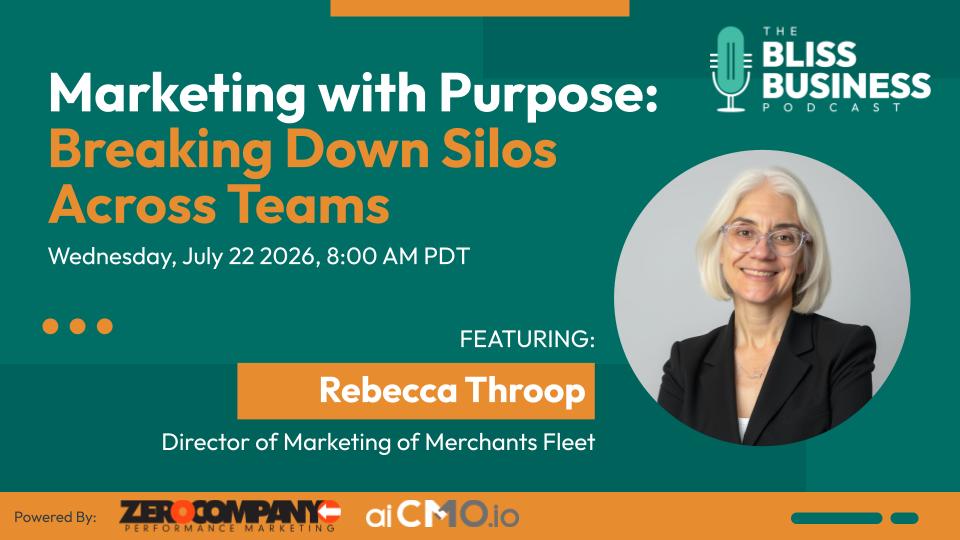
In a recent conversation with Rebecca Throop, Director of Marketing & Communications of Merchants Fleet, on the Marketing with Purpose series of The Bliss Business Podcast, that idea came through clearly. Rebecca’s perspective is deeply people-centered, shaped by more than twenty-five years across strategic planning, marketing, nonprofit work, and growth leadership. Her view is that successful business starts with human beings, which makes collaboration less of an operational preference and more of a strategic necessity.
When teams understand that they are solving for the same person, alignment becomes easier to build and much harder to dismiss.
The Customer Is the Best Place to Reunite the Organization
One of the most useful ideas in Rebecca’s approach is that cross-functional alignment gets stronger when teams stop starting with themselves.
Marketing tends to think from a marketing perspective.
Operations thinks from an operational perspective.
Sales thinks from a sales perspective.
That is natural. It is also exactly how silos deepen.
Rebecca’s framing at Merchants Fleet is different. The client sits at the center of the conversation. That gives teams a shared reference point when priorities compete or pressure rises.
This matters because most cross-functional conflict is not really about people being difficult. It is about different groups solving for different definitions of success. Once the customer becomes the common denominator, the conversation changes. The question becomes less about whose priority wins and more about what will create the strongest outcome for the person the business is ultimately serving.
That shift does not remove disagreement.
It makes disagreement more productive.
Curiosity Is One of the Best Antidotes to Siloed Thinking
Rebecca uses a simple but powerful idea with her team: curiosity over criticism.
That principle matters because silos are often reinforced by defensiveness.
When one team asks another why something is being done a certain way, the question can easily be interpreted as judgment. People protect their process, defend old decisions, and retreat further into their own function. Before long, teams stop asking useful questions because the interpersonal cost feels too high.
Curiosity changes the tone.
It creates room to understand why a process exists, what constraints another team is working under, and whether an assumption still makes sense. It also creates psychological safety, which is essential if organizations want people to surface problems early rather than hide them until they become expensive.
This is one of those leadership practices that looks soft from the outside and has very hard business consequences.
Teams that are curious with one another adapt faster because they are more willing to examine outdated habits. They also transfer knowledge more freely, which improves decision-making across the organization.
Alignment Is Not a Meeting. It Is a Repeated Practice.
One of the reasons companies struggle with silos is that they treat alignment like an event.
They hold a kickoff.
They agree on priorities.
They document a plan.
Then the business changes.
New demands appear.
A client need becomes urgent.
A market shifts.
Leadership introduces a new priority.
Capacity gets tighter.
Rebecca’s approach acknowledges that reality. Her team regularly reassesses its work against the broader commercial and strategic plan. That creates a more dynamic form of alignment, one that recognizes that priorities are not static but should still remain connected to the larger direction of the business.
This is especially important for marketing teams because they are often the recipients of last-minute requests from across the company. Without a clear decision framework, the loudest request wins and strategic work gets displaced by urgency.
The discipline is not in refusing every new request.
It is in knowing what must move when something new enters the plan.
That is a much more mature way to manage cross-functional work.
The Ability to Pause Can Make Teams Faster
Rebecca also makes a counterintuitive point about crisis leadership: sometimes the most important move is to pause.
That may sound inefficient in a moment when speed matters, but reaction is not the same thing as progress.
Her experience working in a large mental health organization during the onset of COVID offers a strong example. The existing annual plan became obsolete almost immediately. The organization had to support uninterrupted human care while also protecting staff in an environment changing by the day.
The response was not to move faster in every direction at once.
It was to separate what needed attention today from what could wait until next week or later in the month.
That sequencing matters.
In high-pressure environments, silos often intensify because each department begins protecting its own urgent priorities. A deliberate pause creates space to reestablish shared context before action accelerates again.
That is one of the most valuable forms of leadership: creating enough calm for the organization to decide what actually matters first.
Data Without Human Context Can Point Teams in the Wrong Direction
Rebecca’s perspective on analytics is equally important.
She shared an example from a previous role involving a B2B2C healthcare product. The company had gathered data from physicians and used that information to shape how the product would be positioned to patients. The upstream data looked credible, but downstream adoption remained weak.
The problem was that the physician perspective did not fully reflect the patient experience.
Once the team listened more closely to end users, the messaging, packaging, and instructional materials had to change significantly.
This is a valuable reminder for cross-functional teams because different departments often hold different slices of customer truth. Sales may know objections. Service may know frustrations. Product may understand usage behavior. Marketing may understand acquisition patterns. None of those views is complete on its own.
The danger comes when one team’s data is treated as the definitive version of reality.
Better decisions emerge when organizations combine quantitative evidence with the lived experience of the people they serve.
Breaking Silos Requires Leaders Who Actually Want Other People’s Expertise
One of the strongest parts of Rebecca’s leadership philosophy is her willingness to tell team members that they are better at their jobs than she is.
That is not just humility.
It is an operating principle.
Many leaders claim they want empowered teams while continuing to second-guess every decision. They hire expertise and then override it. They ask for input after the decision has already been made. That behavior teaches people very quickly that speaking up is not worth much.
Rebecca’s approach is different. She expects transparency and honesty, then gives people room to own their work. Her belief is that if issues are surfaced quickly, they can be solved together. That creates trust because the team learns that mistakes do not automatically lead to blame and that asking for help is not a sign of weakness.
This kind of leadership is especially important when trying to break down silos. People will not collaborate openly if they are worried that every disagreement or imperfect outcome will be used against them.
Trust is what makes information move.
Talent Grows Faster When Leaders Stop Occupying Every Seat
Rebecca also speaks candidly about how leaders can become the obstacle to their own teams.
That happens when leaders cannot let go.
They stay too involved in execution.
They hold onto decisions that should belong to others.
They confuse oversight with control.
The result is a team that may look busy but is not truly growing.
Rebecca shared the experience of watching one member of her team develop rapidly after being given more ownership, encouragement, and freedom to explore what she was interested in. That kind of growth is not accidental. It happens when leaders create space for people to stretch into their capabilities rather than constantly narrowing the boundaries around them.
This has a direct connection to silo-breaking.
Organizations become more collaborative when people have enough agency to work across boundaries, ask questions, and contribute beyond the smallest definition of their role.
Purpose Helps Teams Navigate Complexity Without Losing the Human Center
What makes Rebecca’s perspective especially relevant to the Marketing with Purpose series is that empathy is not something she adds onto the work.
It shapes how she approaches it.
For her, marketing should be truthful. It should not oversell. It should not promise what the business cannot deliver. And when a customer has a problem, even if the person hearing it cannot solve it personally, there is still value in listening carefully and helping connect them to someone who can.
That may sound simple, but it reveals something essential about how purpose-led organizations operate.
They do not reduce people to transactions or handoffs.
A person with a problem should not have to care which internal function owns the solution. They want to feel heard and to trust that the company will help them navigate what comes next.
That is why empathy is not separate from operational design.
It is one of the best ways to identify where the design is failing.
Key Takeaways
Silos become dangerous when functional success starts to undermine the customer experience. A department can hit its goals while the business still creates friction overall.
The customer is the best shared reference point. Cross-functional alignment improves when teams solve for the same human outcome instead of defending departmental priorities.
Curiosity reduces defensiveness. Asking why with genuine interest helps teams surface assumptions and improve processes without turning every conversation into a critique.
Alignment needs to be revisited continuously. Strategy changes, capacity shifts, and new demands emerge, so teams need a regular way to reassess priorities together.
Different departments hold different pieces of customer truth. Strong decisions come from combining data, feedback, and frontline experience rather than privileging one source.
Trust allows information to move faster. Leaders who empower expertise and reward transparency create teams that surface problems earlier and solve them more effectively.
Empathy is operational, not ornamental. Listening well helps organizations understand where the customer journey is breaking and where collaboration needs to improve.
Final Thoughts
What this conversation with Rebecca Throop, Director of Marketing & Communications of Merchants Fleet, makes clear is that breaking down silos does not require eliminating specialization.
It requires making sure specialization never becomes isolation.
The best organizations still have experts, distinct teams, and clear ownership. The difference is that those teams understand how their work connects, how their decisions affect others, and where the customer sits in the middle of the system.
That kind of alignment creates more than efficiency. It creates a business that can adapt faster, make better decisions, and preserve trust when conditions become difficult.
And ultimately, that is what breaking down silos should accomplish: not more internal harmony for its own sake, but a stronger organization for the people inside it and a better experience for the people it serves.

Guest Development | Producer | Blog Contributor
Martha is a connector who brings over two decades of experience in engineering, sustainability, education, and public relations. She is part of the integrated go-to-market team at Zero Company and serves as Guest Development Lead for The Bliss Business Podcast, where she connects with purpose-driven leaders to shape meaningful conversations. Martha also produces the Marketing With Purpose Kit segments with CMO guests.
Her career includes founding nonprofits, and speaking at global forums in Malaysia, Dubai, and Paris. A passionate community builder, Martha also mentors women entrepreneurs and supports environmental initiatives across Mexico and the U.S. Her work reflects a deep commitment to impact, inclusion, and authentic leadership.

Starting Over Deserves Community