The Brands People Trust Most Make Them Feel Understood

Marketing has always been about connection, but for a long time, many brands acted as if connection could be engineered through volume alone.
More impressions.
More messaging.
More channels.
More reminders.
More pressure.
The assumption was that if you said the right thing loudly enough and often enough, people would eventually respond. But that model is wearing thin. Customers have become more discerning, more skeptical, and far more sensitive to whether a brand is actually listening or simply trying to move them down a funnel.
That is why purpose and empathy matter now in a way they perhaps never have before.
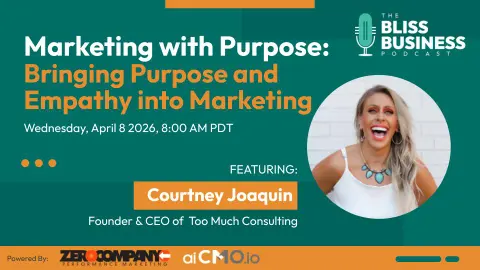
In a recent conversation with Courtney Joaquin, Owner and Founder of Too Much Consulting, on the Marketing with Purpose series of The Bliss Business Podcast, that truth came through with remarkable clarity. Courtney brought the perspective of a fractional CMO working in highly complex and regulated industries where trust is not optional and confusion is expensive. Her message was direct and deeply relevant: empathy is not a buzzword, and purpose is not a layer of polish. They are strategic necessities for any brand that wants to build trust, align teams, and create marketing that makes customers feel understood, not just targeted.
Because in the end, customers do not remember every message.
They remember whether they felt understood.
Empathy Is Not a Personality Trait. It Is a Daily Practice
One of the strongest ideas in this conversation is Courtney’s insistence that empathy is not something a company can claim. It is something it has to practice.
That distinction matters.
Many organizations talk about empathy as if it is a brand value that can simply be written on a slide, included on a website, or activated when a situation becomes sensitive. But Courtney is much sharper than that. She defines empathy as a sequence of actions: stop assuming, ask better questions, actively listen, identify what people are feeling, understand it clearly, and respond in a way that proves you actually heard them.
That is a much more demanding standard.
And it is exactly the right one.
Because without action, empathy becomes posture.
With action, it becomes trust.
This is true internally with teams. It is equally true externally with customers. People are constantly signaling how they feel, what they need, what frustrates them, what they fear, and what they value. The real question is whether the brand is listening carefully enough to notice and responsive enough to do something meaningful with what it hears.
Customers Are Already Telling the Brand the Truth
Another powerful insight Courtney offers is that customers are giving brands emotional data all the time, whether the brand is paying attention or not.
They are doing it in customer service messages.
They are doing it in complaints.
They are doing it on social media, on forums, on review sites, and in subtle behavioral patterns that reveal confusion, distrust, or hesitation.
That is why empathy is such an important strategic advantage.
It helps a business detect the signal inside the noise.
Courtney’s point is especially relevant today because so many companies still focus almost exclusively on what they want to say rather than what the customer is trying to communicate. They lead with their own features, their own priorities, their own timelines, and their own assumptions about what matters. Meanwhile, the customer is often waving a much more important set of clues right in front of them.
When brands ignore those signals, customers stop trusting them.
When they respond thoughtfully, customers start feeling seen.
That is the beginning of loyalty.
Trust Cannot Be Engineered Through Messaging Alone
One of the most important themes running through this conversation is that trust is not built by talking louder or more often.
That is especially important in the kinds of industries Courtney serves, where customers are making decisions under conditions of uncertainty, regulation, or personal significance. In those moments, clarity and credibility matter more than charisma.
This is where many traditional marketing models start to break down.
If the brand is still behaving as though it can talk at the customer, repeat itself enough times, and manufacture trust through volume, it is already behind. Customers now expect a more human exchange. They want to know that the company understands the problem they are trying to solve, the emotional stakes behind it, and the reality they are navigating.
That is why Courtney’s servant-leadership analogy is so powerful.
She asks what it would look like if marketers approached customers the same way strong servant leaders approach teams: listening first, sharing value, creating space for collaboration, and focusing on helping the other person succeed rather than simply extracting a transaction.
That is not soft thinking.
It is a stronger blueprint for relevance.
The Board Wants the Quarter. The Brand Needs the Future.
Another essential tension Courtney addressed is the pull between near-term performance and long-term brand building.
This is one of the hardest balancing acts in modern marketing.
Boards and executive teams often want visible results now. They want movement in the quarter, pipeline momentum, financial proof, and confidence that the spend is justified. At the same time, brand trust, customer affinity, and emotional connection do not fully operate on a quarterly rhythm. They accumulate over time. They deepen through consistency. They become valuable precisely because they are not built overnight.
Courtney’s answer here is strong and clear: marketers have to stop speaking only in marketing language and start translating brand work into financial logic.
That means helping leaders understand that long-term trust and retention are not optional extras. They are part of the revenue model. It will always be more expensive to constantly chase new customers than to build a base of people who trust the brand enough to stay, return, and recommend it.
This is the bridge CMOs and growth leaders have to keep building.
Not by pretending brand is immediate.
But by proving that it is essential to durable growth.
Crisis Reveals Whether Empathy Was Real All Along
When the conversation shifted to crisis, Courtney made a particularly important point: empathy is not something you switch on when things go wrong.
If it has not already been woven into the culture, it will not suddenly become believable under pressure.
That is a critical insight.
Because many companies try to perform empathy during a crisis. They release carefully worded statements, soften the tone, and attempt to sound human in the moment. But if the internal culture has not practiced empathy consistently before that point, the response often feels exactly what it is: reactive, defensive, and disingenuous.
Courtney’s perspective is much more demanding and much more useful.
She argues that brands must assume crisis will happen and build for it in advance, not only through operational planning, but through cultural muscle. If empathy is part of how the company already communicates, responds, and listens, then crisis response will feel like a continuation of who the brand already is. If it is not, no amount of damage control can fake it convincingly.
That is why consistency matters so much.
Customers do not only judge what a brand says in a crisis.
They judge whether that response feels aligned with what the brand has shown them all along.
Misalignment Across Teams Always Shows Up in the Customer Experience
One of the most practical and valuable parts of the conversation was Courtney’s view on go-to-market alignment.
She made the point that misalignment across sales, product, marketing, and leadership is not just an internal inconvenience. It becomes a customer problem.
That is exactly right.
If marketing is saying one thing, sales is promising another, and product or service delivery is operating from a different understanding altogether, the customer experiences the disconnect even if the internal teams do not want to admit it. The result is confusion, broken trust, and a slower path to revenue.
Courtney’s answer is not simply “have more meetings.”
It is much better than that.
She emphasizes smaller, more honest conversations, clearer shared definitions of success, and a willingness to stop assuming alignment exists just because no one has openly challenged it in a group setting. That is a sharp observation. Many teams look aligned in public while privately holding very different assumptions. It is only when those differences surface late that everyone realizes the gap was there all along.
This is where the CMO’s role becomes far more than external communication.
It becomes internal community building.
Data Without Listening Can Still Point You in the Wrong Direction
One of the most revealing examples Courtney shared came from a common marketing scenario: the data said one message would work, the leadership team aligned around it, and the whole company moved forward. But when the campaign hit the market, the response was underwhelming.
Why?
Because the interpretation of the data had been too narrow, too self-serving, or too attached to what the company wanted the message to be. What customers actually cared about was different.
This is a crucial lesson.
Data matters immensely. But data is not the same as truth if the team is only using it to reinforce the answer it hoped to find. That is why listening is so important. Listening helps catch the emotional or contextual realities the raw numbers alone may not fully explain.
Courtney put it beautifully: the real job is not just reading the data. It is pivoting when the data contradicts what you wanted it to say.
That is where maturity shows up in a marketing organization.
Not in whether it was right the first time.
But in whether it is humble enough to adjust when the customer reveals something better.
Revenue Follows the Feelings a Brand Creates
When asked directly about turning marketing into a revenue engine, Courtney gave one of the most useful answers in the entire conversation.
She said revenue follows the feelings a brand creates.
That is a powerful line because it reframes the whole conversation. Marketing is not merely generating transactions. It is shaping the emotional and relational conditions that make transactions more likely, more sustainable, and more repeatable.
This is especially true across the full customer journey.
A company may celebrate the first sale and then emotionally abandon the customer. It may stop listening. It may stop caring. It may stop treating retention like part of the brand experience. And when that happens, it is not just losing a customer. It is weakening the revenue engine it claims to want.
Courtney’s point is that marketing owns much more of this than many teams realize. It owns how people feel from first impression through conversion and long after the purchase. If those feelings are consistent, intentional, and aligned to real needs, retention improves. Advocacy grows. Revenue becomes more durable.
That is not sentimental thinking.
It is long-range commercial thinking.
The CRM Is Often Full of Missed Gold
Another practical and especially sharp point Courtney made concerns CRM systems and sales feedback.
She is right that many CRM systems become a graveyard of good intentions. Information gets logged inconsistently, valuable conversations stay trapped in sales calls, objections disappear into memory, and the richest insights about why someone almost bought but did not rarely make it back into the strategic loop.
That is a huge loss.
Because those objections, hesitations, and near-conversions are often some of the best marketing intelligence available. They reveal what is confusing, what is missing, what is not credible yet, and where the trust gap still lives. If marketing teams are not getting that information back, they are flying with a major blind spot.
Courtney’s call here is a smart one: marketing needs to be more insistent that these conversations get captured and turned into usable strategic input.
That is how CRM becomes more than a database.
It becomes a listening system.
Teams Mirror the Emotional Environment Leaders Create
The personal story Courtney shared near the end of the episode ties everything together beautifully.
She reflected on how leadership changes when you stop assuming a missed deliverable is laziness or disengagement and start asking a better question: is everything okay?
That question changes everything.
It creates room for truth.
It creates safety.
It creates a different kind of accountability, one rooted in seeing the person before judging the performance.
And as Courtney noted, when team members feel seen internally, they are far more likely to create customer experiences that help people feel seen externally. That may be one of the most important leadership truths in the whole conversation.
Because brands are not abstract entities.
They are collections of people communicating with other people.
If the internal environment is rigid, dismissive, or emotionally tone-deaf, that will eventually show up in the marketing. If the internal culture is attentive, curious, and grounded in empathy, that will also show up in the work.
Purpose Makes Marketing More Human. Empathy Makes It More Effective.
At the deepest level, what Courtney is arguing for is not marketing that sounds nicer.
It is marketing that works better because it is more humanly honest.
Purpose gives the brand a reason for existing beyond self-promotion.
Empathy gives it the discipline to understand the people it hopes to serve.
Together, they make the company’s strategy more grounded, more resilient, and more likely to matter in the real world.
This aligns closely with the B.L.I.S.S. philosophy—Building Love Into Scalable Systems.
Because love in business is not abstract sentiment.
It is reflected in whether systems make people feel invisible or understood.
Whether teams are encouraged to assume or to ask.
Whether crises are used to protect image or deepen trust.
And whether customers are treated as metrics to optimize or human beings trying to solve real problems.
That is what Courtney’s perspective gets exactly right.
Key Takeaways
Empathy is a practice, not a slogan. It requires asking, listening, understanding, and responding in a way that proves the customer or team member was actually heard.
Customers are constantly signaling what they need. Brands gain an advantage when they treat those signals as strategic input rather than background noise.
Brand trust cannot be built through volume alone. It grows when customers feel understood, respected, and supported over time.
Empathy must be cultural before it can be credible in crisis. If it is not already part of the company’s DNA, it will not feel real when pressure hits.
Go-to-market misalignment becomes a customer experience problem. Silos across sales, product, and marketing always show up externally.
Data still needs humility. Strong marketers pivot when customer truth challenges the story they hoped the numbers would tell.
Revenue is shaped by emotion across the full journey. The feelings a brand creates determine retention, advocacy, and long-term value.
Final Thoughts
What this conversation with Courtney Joaquin, Owner and Founder of Too Much Consulting, makes clear is that bringing purpose and empathy into marketing is not about softening the discipline.
It is about deepening it.
It is about building brands that are more trustworthy because they listen better.
More resilient because they prepare more honestly.
More aligned because they treat internal culture as part of market performance.
And more effective because they understand that behind every metric is a person trying to feel a little more certain, a little more confident, and a little more understood.
That is the kind of marketing people remember.
And increasingly, it is the kind of marketing that wins.
Where to Go Next
Hear the full conversation on the episode page, watch it on the video page, or learn more about Courtney Joaquin and Too Much Consulting. Customers feel understood when a brand listens first, and that's the whole idea behind this series.

Guest Development | Producer | Blog Contributor
Martha is a connector who brings over two decades of experience in engineering, sustainability, education, and public relations. She is part of the integrated go-to-market team at Zero Company and serves as Executive Producer and Guest Development Lead for The Bliss Business Podcast, where she connects with purpose-driven leaders to shape meaningful conversations. Martha also produces the Marketing With Purpose Kit segments with CMO guests and the ETF Marketing show.
Her career includes founding nonprofits, and speaking at global forums in Malaysia, Dubai, and Paris. A passionate community builder, Martha also mentors women entrepreneurs and supports environmental initiatives across Mexico and the U.S. Her work reflects a deep commitment to impact, inclusion, and authentic leadership.

Belonging Is Built Into the Details