Execution Improves When Leaders Remove What Gets in the Way

Every leader wants a team that can execute. They want people who take ownership, collaborate well, hit goals, solve problems, and keep moving when conditions get difficult.
But when teams underperform, leaders often focus immediately on effort, accountability, talent, or motivation. They assume people are not trying hard enough, are not committed enough, or simply need clearer consequences.
Sometimes the real issue is something else entirely.
People may want to perform but keep running into obstacles they cannot remove. They may be accountable for outcomes without having the authority, tools, information, cooperation, or support required to produce them. Over time, that creates frustration, disengagement, and eventually resignation.
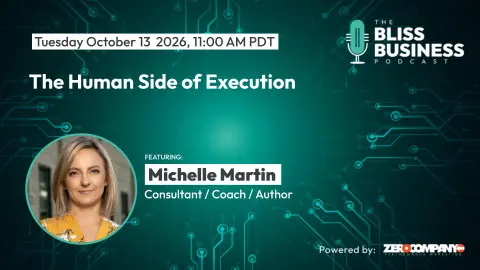
On The Bliss Business Podcast, we sat down with Michelle Martin, a leadership and team performance consultant, coach, and author, to explore the human side of execution. Michelle brings more than 20 years of experience navigating complex operating environments, beginning on the back of a garbage truck and eventually becoming a national director overseeing fleet operations across Canada for a Fortune 250 company. Today, she helps leaders and teams improve collaboration, navigate change, and uncover what is really standing between them and stronger results. The Human Side of Execution wit…
Her perspective offers a powerful reminder: sometimes the fastest way to improve performance is not to push people harder. It is to remove the resistance making good performance harder than it needs to be.
Underperformance Is Often a Symptom, Not the Problem
Michelle starts from a very different assumption than many leaders.
She believes most people want to do a good job.
They want to contribute. They want to feel useful. They want to succeed at the work in front of them. If that is true, then persistent underperformance should prompt a different question.
What is getting in the way?
Maybe priorities between departments conflict. Maybe a process is broken. Maybe a manager has given someone responsibility without authority. Maybe employees have raised the same operational problem repeatedly and eventually stopped believing anyone will address it.
Over time, those unresolved frustrations create what Michelle describes as daily heartburn. People face the same obstacle again and again until coping with the obstacle becomes part of the job.
That is when disengagement starts to make sense.
If people repeatedly experience a problem they cannot solve and leadership does not remove it, eventually they stop trying to change it. What looks like apathy may have begun as frustration.
Execution improves when leaders stop treating symptoms as character flaws and start investigating the conditions surrounding the work.
Accountability Without Empowerment Creates Resentment
Accountability is essential, but accountability by itself is not leadership.
If an employee is responsible for getting from one place to another, leadership also has to make sure they have access to the keys.
Too many organizations demand accountability while withholding the authority, resources, or information people need to succeed. When performance falls short, the conversation becomes focused entirely on the employee.
Michelle’s experience working her way from the frontline into senior leadership gave her a different perspective. She saw firsthand how employees reacted when leaders kept telling them what needed to improve while failing to examine their own role in creating the conditions employees were navigating.
The more important leadership question becomes: what am I doing, or failing to do, that affects this person’s ability to perform?
That does not remove employee accountability.
It adds leadership accountability.
When those two forms of accountability exist together, performance conversations become more productive because the organization is no longer pretending results belong entirely to the person at the bottom of the hierarchy.
Strong Leadership Often Means Flattening the Hierarchy
Michelle described effective leadership as a shift from directing people to working alongside them.
There are moments when hierarchy is necessary. Someone has to make the decision. Someone has to own the outcome.
But problem solving often improves when leaders temporarily flatten the hierarchy and approach the challenge as a team.
Instead of saying, “Here is what you need to do,” the conversation becomes, “Here is where we need to get. What is stopping us?”
That question creates room for information leadership may not possess.
Perhaps employees need a new piece of equipment. Perhaps that equipment will take nine months to acquire. That does not mean everyone waits nine months before improving anything. The leader can acknowledge the ideal solution while still asking what is possible now.
That balance matters.
Listening does not mean agreeing that every constraint is permanent. It means understanding the constraint before asking people to work around it.
A strong leader can say, “I hear that this would make the job easier. We cannot solve that immediately, so what can we change today?”
That feels very different from pretending the problem does not exist.
Team Problems Often Reveal Themselves Before Performance Drops
Michelle pays close attention to team dynamics because relational problems frequently appear before the numbers show anything unusual.
One signal is conflicting stories.
A leader describes the team one way, while employees describe a very different reality. Different perspectives are normal, but when the gap becomes extreme, something deserves investigation.
Another signal appears in meetings.
People can remain professional and polite while relationships are fundamentally broken. If departments only communicate through the leader instead of directly with one another, that often reveals a silo. If one person raises an issue that another department should already know about, the real problem may be the missing relationship between them.
There is also the absence of natural interaction.
When people respect and trust one another, communication tends to move both ways. When that pathway disappears, teams can still look functional on the surface while becoming increasingly fragmented underneath.
This is why execution is never only about process.
Relationships are part of the operating system.
Leaders Need a Personal North Star
As leaders move higher in organizations, it becomes easier to lose connection with what leadership felt like from the other side.
Politics increase. Responsibilities expand. Information becomes filtered. The employee experience can start to feel farther away.
Michelle recommends creating what she calls a leadership legacy.
The idea begins with three questions: What kind of leader do I want to be? How do I want my team and peers to remember me? How will the business be better because I led here?
Those answers become a North Star.
They give leaders something to return to when organizational pressure begins pulling them away from the person they intended to become.
The second discipline is remembering what it felt like to occupy earlier roles.
What did you need from your manager when you were on the front line? What frustrated you? What made you feel capable? What made you feel marginalized?
Experience becomes valuable when leaders use it to preserve empathy rather than distance themselves from where they started.
Leadership maturity means being able to hold both realities at once: the pressure from above and the human reality below.
Goals Work Better When People Find Their Own Why
Michelle is particularly passionate about goal setting because goals are often implemented badly.
Organizations frequently start with the target.
Reduce spending. Improve retention. Increase productivity. Hit the number.
Then leadership explains why the goal matters to the company and assumes employees should now feel motivated.
Michelle sees a problem with that approach.
Meaning is personal.
Imagine a fleet leader being asked to reduce vendor spending. The corporate reason might be financial efficiency. That is legitimate, but it may not be what creates emotional commitment for the person executing the work.
Perhaps reducing vendor reliance would allow internal technicians to perform more meaningful work. Maybe that leader was developed by mentors earlier in their career and wants to create the same growth opportunities for their own employees.
Now the corporate goal and the personal motivation intersect.
The company wants lower vendor spending. The leader wants to develop people.
That shared outcome creates a much stronger reason to act.
The next step is building the bridge between the current state and the desired state. What barriers have to be removed? What skills need to improve? What systems need to change?
At that point, a goal stops being a number handed down from leadership and becomes a shared project.
Strengths Matter Most When They Are Connected to Real Work
Teams frequently complete assessments and talk about strengths, but the insight disappears once everyone returns to their normal workload.
Michelle prefers to connect strengths directly to work already happening.
If a team has a real problem to solve, ask who naturally enjoys which part of that problem. One person may love analysis. Someone else may enjoy planning. Another person may be energized by conversations or conflict resolution.
This creates a better division of contribution.
It also prevents one of the most common mistakes in team design: repeatedly giving someone work simply because they are good at it.
Competence and passion are not always the same thing.
Someone can be highly skilled at something they hate doing.
Leaders need to understand not only what people can do, but also where their energy increases.
When teams know one another at that level, collaboration becomes less transactional. People begin seeking out the colleague whose strengths and interests naturally fit the challenge instead of routing everything through the hierarchy.
Difficult Conversations Improve When Leaders Put Down Their Story
Hard conversations often become unnecessarily personal because leaders enter them carrying an explanation they have already decided is true.
An employee misses a deadline several times, and the leader begins building a story.
They do not care. They are angry about a previous decision. They are intentionally being difficult. They do not respect me.
Once that story exists, human beings naturally start finding evidence to support it.
Michelle recommends something different.
Put the story on the shelf.
Start with the objective truth.
The report is late. It has happened multiple times. The employee is capable of doing the work. Something is preventing the expected behavior.
Now investigate.
Instead of beginning with accusation, ask, “I know you are capable of doing this, but it is still not happening. What is getting in the way?”
The answer may reveal something entirely different. Perhaps the employee keeps helping another team member. Maybe they are confused about part of the report. Maybe priorities are colliding.
Understanding the obstacle does not mean lowering the standard.
It means solving the actual problem.
Emotional Intelligence Becomes Powerful Through Relationship Management
Emotional intelligence is often discussed as self-awareness and self-management.
Those skills matter, but Michelle believes the relationship-management side can have an even greater impact on execution.
A leader who starts from the belief that employees want to contribute enters difficult conversations differently.
Instead of asking, “Why are you failing?” the leader asks, “If I believe you want to succeed, what is stopping that from happening?”
That creates curiosity instead of judgment.
Michelle also uses a phrase that captures the balance well: “We cannot stay here.”
A leader can communicate that the current situation is unacceptable without shaming the person involved. The message becomes: I want to understand how we got here, I believe we can move forward, and I am willing to help, but staying here is not an option.
That combination of empathy and standards builds trust.
Once trust exists, leaders can have far more difficult conversations without destroying the relationship.
Assessments Should Open Conversations, Not Put People in Boxes
Michelle uses tools that explore psychological safety, emotional intelligence, behavioral preferences, and work styles, but she is careful about how assessments are used.
The value is not the label.
The value is the conversation.
Two people can look at the same problem and worry about completely different things. One may be focused on speed. Another may be concerned about precision. One may enjoy ambiguity. Another may want more information before making a decision.
Without a framework for discussing those differences, people can easily misinterpret one another.
The cautious person looks resistant. The fast-moving person looks reckless.
Assessments can reveal that both are contributing something valuable.
Used well, they create curiosity about how other people think.
Used poorly, they become another way to stereotype people.
The goal should always be greater appreciation, not smaller boxes.
Resistance to Change Often Protects Something People Fear Losing
Change management frequently focuses on where people are going.
Michelle also pays attention to what they believe they are leaving behind.
Resistance can appear irrational until leaders understand the loss underneath it.
Someone may fear losing status, expertise, control, identity, stability, relationships, or even the competence they currently feel in their role.
Those fears are real even when the change itself is necessary.
Michelle likes to make the fear explicit.
Name it.
What is the worst thing that could happen? How likely is it? What happens if nothing changes? What would taking one safe step look like?
Once fear becomes specific, it often becomes more manageable.
The goal is not to convince people that nothing could go wrong.
It is to make uncertainty small enough that they can move through it.
Courage often starts with a very small step.
Love in Leadership Means Turning Back to Help the Next Person
When we asked Michelle what role love should play in business, she connected it directly to service.
Her career began on the back of a garbage truck. Someone helped her become a driver. Someone else helped her become a supervisor. Over time, those opportunities eventually led to senior leadership.
She remembers that.
For Michelle, love in leadership means reaching a point in your own journey and then turning around to help someone behind you move forward.
That might mean mentoring someone, developing their confidence, creating an opportunity, removing an obstacle, or simply being the person who believes they are capable of more.
Few experiences change someone’s trajectory more than having another person genuinely believe in their potential.
Leadership becomes meaningful when advancement stops being only about how far you can climb and starts including how many people you help climb with you.
Key Takeaways
- Underperformance is often a symptom of obstacles, unclear priorities, or broken systems rather than a lack of effort or commitment.
- Accountability works best when employees are also given the authority, tools, information, and support required to succeed.
- Strong leaders examine their own role in team performance rather than placing responsibility entirely on employees.
- Team dynamics often reveal problems through silos, conflicting stories, weak relationships, and indirect communication before performance metrics decline.
- A personal leadership legacy can help leaders stay grounded as organizational responsibility and politics increase.
- Goals become more powerful when employees connect the organization’s objective to a personally meaningful reason for achieving it.
- Strengths should be connected to real work, and leaders should distinguish between what someone is skilled at and what actually energizes them.
- Difficult conversations become more productive when leaders separate objective facts from the story they have created about another person’s motives.
- Emotional intelligence improves execution when leaders use curiosity, relationship management, and empathy without lowering standards.
- Assessments are most useful when they open conversations about differences rather than placing people into fixed categories.
- Resistance to change often protects something people believe they may lose, so leaders should explore the fear underneath the resistance.
- Love in leadership means using your own progress to help create opportunity, development, and belief for someone else.
Final Thoughts
Michelle Martin’s perspective reframes execution as something much more human than simply pushing people toward targets.
Performance happens inside relationships, systems, emotions, constraints, motivations, and expectations. When those elements work together, people often need far less pushing than leaders assume.
The job of leadership is not only to demand results.
It is to create the conditions where good people can produce them.
That means removing obstacles, building trust, connecting work to meaning, helping people use their strengths, listening before assuming, and remaining accountable for the environment leadership creates.
Sometimes that requires setting a harder standard.
Sometimes it requires giving someone more authority.
Sometimes it means admitting that the person who has been blamed for the problem has been working inside a system that made success unnecessarily difficult.
And sometimes leadership is as simple as remembering the person who once helped you and deciding to become that person for someone else.
Execution becomes stronger when people feel capable, trusted, supported, and connected to what they are trying to accomplish.
That is the human side of performance.
Check out our full conversation with Michelle Martin on The Bliss Business Podcast.

Executive Producer | Host | Blog Contributor
Tullio Siragusa is a strategic advisor, dynamic speaker, author, and EQ coach with 36 years of experience as a technology disruptor rooted in Design Thinking. Since 2018, he has been creating, producing and hosting live podcasts, interviewing over 1,000 C-suite executives across a wide range of industries. His work behind the mic reflects his larger mission: using conversation as a catalyst for human-centric innovation.
Tullio’s commitment to purpose-driven leadership and ethical transformation is reflected in his advisory roles at the University of California, Riverside’s Design Thinking Executive Program, and the University of San Francisco School of Management’s Digital Marketing Program. As a Board Advisor at AI2030.org, he helps guide the responsible advancement of AI toward ethical and sustainable outcomes. A founding member of RadicalPurpose.org, Tullio believes empathy isn’t just a trait, it’s a non-negotiable foundation for leadership.

Belonging Is Built Into the Details