
Market Engineering: Building Markets That Win with Bruce Cleveland
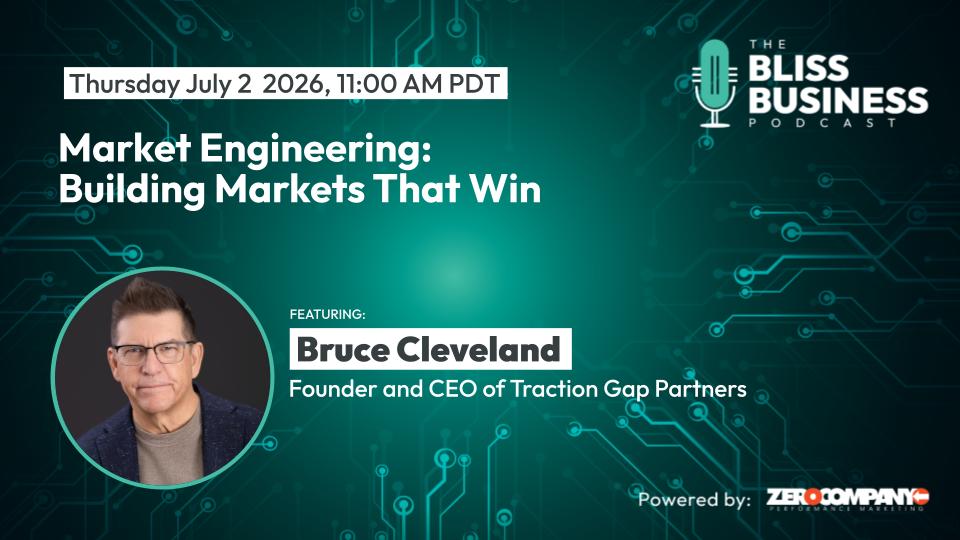
Bruce Cleveland, Founder and CEO of Traction Gap Partners, returns to The Bliss Business Podcast to unpack market engineering: the five-tenet framework, category design, positioning, messaging, storytelling, and thought leadership, that helps companies build the market their product deserves, not just the product itself.
Great products fail all the time, not because the technology is weak, but because the company assumes the market will understand the product on its own. Market engineering is the discipline of making sure it does.
Bruce Cleveland is returning to The Bliss Business Podcast. When he first joined us in May 2025, we explored how companies move from promising ideas to repeatable, scalable growth. This time, he returns to discuss his new book, Market Engineering: Because Markets Don't Build Themselves, and why building a strong product is no longer enough to create lasting market leadership.
In this episode, we explore:
• Why successful companies engineer markets, not only products
• The five tenets of Market Engineering
• How leaders know whether a market narrative is working
• Why category and context create durable advantages in the AI era
• How startups and established enterprises can use the framework
• The highest-impact first step for teams with limited resources
Markets Are Inherited. Categories Are Designed.
"Markets are generally inherited. They exist," Bruce Cleveland explained. "Categories are things that we can create." His example: the automobile industry is a market; the EV is a category inside it. Without a clearly named category, he said, "there's nowhere to play."
The Stadium, the Rules, and the Teams
Bruce uses a sports metaphor to explain category design: "The stadium is the category. It's the place where the game is played... The teams are brands." A well-designed category attracts competitors, and Bruce says that's the point. Multiple clients have asked him to trademark their category name; his answer is always no. "There is no category of one," he said.
Write Your Positioning in Crayon
Bruce is blunt about clarity: "You have to write it in crayon for people. You can't make them try to figure it out." Confusing messaging doesn't read as sophisticated, he said. It just adds a longer sales cycle.
AI Makes Market Engineering More Important, Not Less
Bruce built an AI application in three days that would once have taken a team of engineers. His conclusion: technology is no longer a durable moat. "What's really needed is market engineering, and that still is expensive," he said, "because it requires intelligence, speaking differently, talking about new things and ideas."
Empathy Is a Strategic Requirement
Asked where empathy fits into market engineering, Bruce didn't hesitate: "You have to be authentic... Glassdoor and these other sites will tell you the impedance mismatch between what's being said by the company and what's actually going on inside the company. Those two things have to align, or you will struggle."
That alignment between what a brand promises and what it actually delivers is exactly where Zero Company helps companies turn positioning and storytelling into audience trust, not just messaging.
Products can be copied and features can be matched. But the company that defines the market can shape how customers understand the problem, and who they trust to solve it.
Key Takeaways
• (3:50-10:37) Why Bruce wrote a second book: product engineering gets you into the game, market engineering determines who wins
• (11:22-16:45) Markets are inherited, categories are designed: the automobile/EV example
• (17:11-20:42) The five tenets: category design, positioning, messaging, storytelling, thought leadership
• (20:20-20:42) Why Bruce tells clients not to trademark their category name
• (29:06-33:58) Why AI makes market engineering the real moat, not product features
• (34:22-37:13) The “market charter”: the internal cause behind the external category
• (45:08-51:21) Why Bruce interviews candidates for culture, not skill, and lets them interview him back
FAQ
What is market engineering?
Bruce Cleveland defines market engineering as five tenets working together: category design, positioning, messaging, storytelling, and thought leadership. It’s the deliberate work of shaping how a market understands a problem and who it trusts to solve it, not just building a good product.
What’s the difference between a market and a category?
Markets already exist, they’re inherited. Categories are designed. Bruce’s example: the automobile industry is a market, and the electric vehicle is a category inside it. A category names and frames the problem so customers, analysts, and investors know what game is being played.
Why does Bruce Cleveland say AI makes market engineering more important, not less?
Because AI has made product features easy to copy, sometimes rebuilt in days instead of years, technology is no longer a durable moat. What still takes real work, and still differentiates a company, is shaping the category, story, and trust around the product.
Learn more about Bruce Cleveland and Traction Gap Partners at tractiongappartners.com, or catch his first appearance on Building Companies from Ideation to Scale.
🎙️ Hosted by Stephen Sakach and Tullio Siragusa
🎧 Produced by Martha Huerta

Author | Founder and CEO of Traction Gap Partners
Bruce Cleveland is the founder and CEO of Traction Gap Partners and a former technology operating executive, venture capitalist, and entrepreneur. He has held senior executive positions at Oracle, Apple, Siebel Systems and C3.ai. He has been a General Partner in two venture capital firms, and he was the founder and CEO of Ziplines Education.
His venture capital successes include companies such as Marketo, C3.ai, Vlocity, and Doximity. Many of his investments were just ideas at the time he invested – no product or revenue- and went on to become $B+ outcomes.
Cleveland is also the author of the bestseller “Traversing the Traction Gap” and “Market Engineering: Because Markets Don’t Build Themselves, prescriptive guides for startups and enterprise product teams in mature companies navigating growth challenges.
Today, Cleveland acts as a board and executive advisor to startups, enterprises, and venture firms using the Traction Gap Framework to generate “market engineering” strategies and market success.

