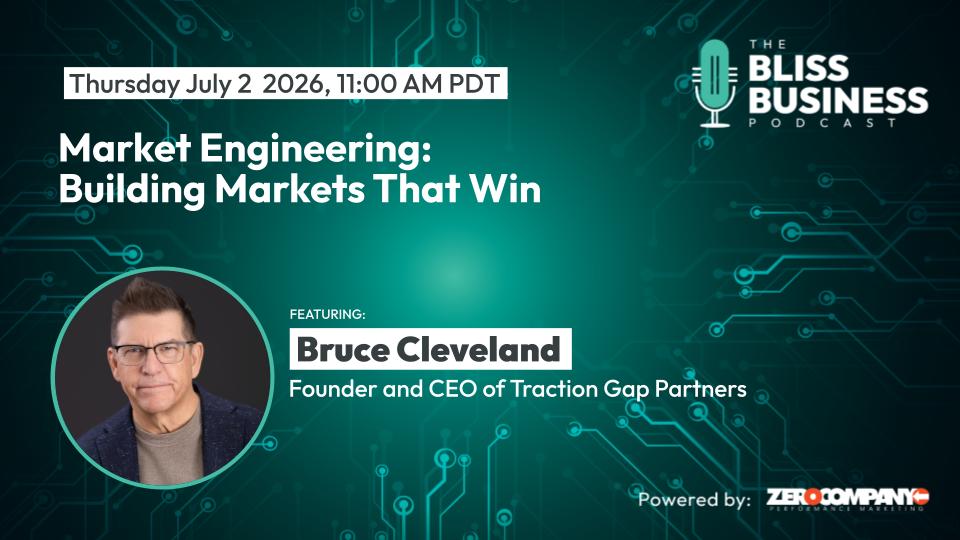
Market Engineering: Why Markets Do Not Build Themselves

Great products fail all the time. Not because the technology is weak. Not because the team lacks talent. Not because the market opportunity is imaginary. They fail because the company assumes the market will understand the product on its own.
It will not.
On The Bliss Business Podcast, we welcomed back Bruce Cleveland to talk about building market categories: Founder and CEO of Traction Gap Partners, author of Traverse the Traction Gap, and author of the new book Market Engineering: Because Markets Don’t Build Themselves. Bruce has held senior executive roles at Oracle, Apple, Siebel Systems, and C3 AI, served as a venture capitalist, and invested in companies including Marketo, C3 AI, Velocify, and Doximity.
In this conversation, Bruce made the case that product innovation alone is no longer enough. Companies have to engineer the market around the product with the same rigor they apply to engineering the product itself.
Product Engineering Gets You Into the Game
Bruce’s first book, Traverse the Traction Gap, gave startups a roadmap for moving from idea to scalable growth. It focused on what happens after product introduction, when companies have to prove repeatability, traction, and market momentum.
His new book goes deeper into a missing discipline: market engineering.
The idea is simple but often ignored. Building a product is not the same as building demand. A company may have a strong product, a strong team, and good funding, but without a clear category, narrative, positioning, messaging, and market understanding, it may still lose to a competitor that tells the story better.
Product engineering gets you into the game. Market engineering helps you win it.
Markets Are Inherited. Categories Are Designed.
Bruce made an important distinction between markets and categories.
Markets usually already exist. They are made up of companies, customers, problems, budgets, and behaviors. Categories are how we name and frame the problem inside that market.
His example was simple: the automobile industry is a market. Electric vehicles are a category inside that market.
That distinction matters because companies often confuse having a product in a market with owning a category. A product may solve a problem, but if the category is unclear, customers do not know where to place it, analysts do not know how to define it, and buyers do not know what budget it belongs to.
A category gives the market a game to play.
The Stadium, the Rules, and the Teams
Bruce used a sports metaphor to explain how category design works.
The category is the stadium. It is where the game is played. The attributes of the category are the rules. The companies are the teams. The customers, analysts, media, and investors are the fans and commentators watching the game.
Without a stadium and rules, nobody knows where to show up or how to evaluate the players.
This is why category creation is not cosmetic. It gives the market a mental model. It tells people what problem is being solved, what language to use, what success looks like, and how competing companies should be compared.
The irony is that a strong category will attract competitors. Bruce was clear about this. There is no category of one. If no one else joins the category, the market probably does not believe it exists.
The Five Tenets of Market Engineering
Bruce defines market engineering around five core tenets: category design or redesign, positioning, messaging, storytelling, and thought leadership.
Category design names and frames the problem. It tells the market what game is being played. Sometimes companies create a new category. Sometimes they revive or redefine a failed one, as Marketo did with marketing automation.
Positioning explains where the company fits and how it stands out. Buyers need to know where the solution belongs in their architecture, budget, and business priorities. If they cannot understand that quickly, sales cycles get longer and confusion grows.
Messaging creates the language the market will use. Bruce emphasized that companies need provocative, differentiated language. If you sound like everyone else, people tune out.
Storytelling turns the message into something humans remember. Bruce pointed to Steve Jobs as one of the greatest business storytellers because he could change how people perceived reality. Great companies do not just present slides. They tell stories that make the problem, the stakes, and the solution feel meaningful.
Thought leadership is the result of doing the first four well. When a company defines the category, positions clearly, uses distinctive language, and tells a compelling story, people want to gather around it. They want to attend the events, read the content, hear the ideas, and associate with the company.
Why Messaging Has To Be Written in Crayon
One of Bruce’s strongest points was that companies often make buyers work too hard.
If someone visits your website and still cannot explain what you do after reading the first paragraph, the company has created unnecessary friction. That confusion does not make the product more sophisticated. It simply adds time and cost to the sales process.
Positioning and messaging need to be clear enough for the buyer to immediately understand:
-
what problem you solve
-
where you fit
-
why you matter
-
how you are different
-
what value changes because of you
Bruce called this “writing it in crayon.” That is not a call to be simplistic. It is a call to be unmistakable.
AI Makes Market Engineering More Important, Not Less
AI is changing the economics of product creation. Bruce shared that he recently built an application in a few days that would have previously required a team of engineers. His larger point was clear: technology is becoming less of a durable moat.
If product features can be copied faster, the advantage shifts.
The moat is no longer only the product. The moat becomes market understanding, category leadership, customer trust, data, domain expertise, and the ability to shape how people think about the problem.
That makes market engineering more important in the age of AI. Companies need to be known for how they understand the market, not just what they built this quarter.
AI Does Not Replace the Human Story
Bruce was also clear that AI is not a replacement for human invention, empathy, or strategic thinking. Current large language models can generate language, summarize patterns, and support execution, but humans still carry the responsibility for insight, invention, judgment, and meaning.
This matters because markets are not only rational. They are human.
Buyers want to associate with companies that understand their world. Employees want to join companies with a cause. Investors want to back teams that can shape belief, not just ship features.
Market engineering is fundamentally human because it requires empathy for the buyer’s problem and the courage to name that problem in a way the market can finally see.
The Missing Artifact: A Market Charter
Bruce shared an insight that emerged after the book was already in motion: the best companies do not only have positioning and messaging. They have a cause.
He described this as a market charter, the internal expression of why the company exists and why people should care.
This is where market engineering connects directly to culture. A market charter helps employees understand the larger purpose behind the company’s work. It gives the team something to rally around beyond revenue. It helps customers, partners, and employees see the company as part of something meaningful.
Patagonia was mentioned as an example of a company with a cause beyond selling products. The cause creates gravity. It attracts people who want to be part of the mission.
Empathy Is a Strategic Requirement
Tullio asked where empathy fits into market engineering. Bruce’s answer was direct: it has to be authentic.
Companies have to understand the lived reality of the customer. What are they dealing with every day? What are they trying to fix? What pressure are they under? What language do they use? What happens if the problem is not solved?
If a company can speak authentically to that problem, people pay attention. If the message is manufactured, they feel the mismatch.
This is especially important in B2B, where many leaders still treat the market as transactional. But even in B2B, humans make the decisions. Humans feel pressure. Humans seek trust. Humans want to work with companies that understand them.
Culture and Category Have To Align
Bruce reflected on his own career and acknowledged that business has evolved. Earlier in his career, especially in environments like Oracle, performance pressure could be ruthless. Over time, he saw that companies could still be successful without creating miserable environments.
That evolution matters because a company’s external market narrative cannot be disconnected from its internal culture.
If you claim to solve a human problem but treat your own people transactionally, the market will eventually feel the misalignment. If your category narrative is bold but your culture is fear-based, the story breaks under pressure.
The companies that win are the ones where market, culture, and purpose reinforce one another.
Hire for Skill, Then Sell for Culture
One of the most useful leadership insights came near the end of the conversation, when Bruce discussed hiring.
He said that when he interviewed candidates as a venture investor, he did not focus primarily on skill if others had already validated that. He focused on culture. He wanted to know whether the person would fit the company’s way of operating, and he also believed the candidate should be interviewing the company.
That is a healthier approach than treating hiring as a one-way evaluation.
The best candidates should understand why the company matters, why the investor believes in it, what the culture is really like, and whether they want to commit to the mission. If people are going to help build the market, they need to believe in the cause behind it.
Key Takeaways
-
Great products do not sell themselves. Markets have to be intentionally shaped.
-
Markets are inherited, but categories are designed or redesigned.
-
Category design gives customers, analysts, investors, and competitors a game to understand and join.
-
Market engineering includes category design, positioning, messaging, storytelling, and thought leadership.
-
Clear messaging reduces friction and shortens the path to understanding.
-
AI makes market engineering more important because product features are easier to copy.
-
A market charter helps connect the company’s cause to its culture and market narrative.
-
Empathy is essential because buyers respond to companies that authentically understand their problem.
Final Thoughts
Bruce Cleveland’s message is timely: the age of AI will not reward companies that only build faster. It will reward companies that understand markets better, tell clearer stories, build stronger categories, and align their culture with the cause they claim to serve.
Markets do not build themselves. They are shaped through language, narrative, positioning, trust, and leadership.
The companies that win will not only engineer better products. They will engineer belief.
Where to Go Next
Hear the full conversation on the Market Engineering: Building Markets That Win episode, watch the video version, or learn more about Bruce Cleveland. Building market categories isn't a one-time launch decision. It's an ongoing discipline of positioning, messaging, and storytelling.

Executive Producer | Host | Blog Contributor
Tullio Siragusa is a strategic advisor, dynamic speaker, author, and EQ coach with 36 years of experience as a technology disruptor rooted in Design Thinking. Since 2018, he has been creating, producing and hosting live podcasts, interviewing over 1,000 C-suite executives across a wide range of industries. His work behind the mic reflects his larger mission: using conversation as a catalyst for human-centric innovation.
Tullio’s commitment to purpose-driven leadership and ethical transformation is reflected in his advisory roles at the University of California, Riverside’s Design Thinking Executive Program, and the University of San Francisco School of Management’s Digital Marketing Program. As a Board Advisor at AI2030.org, he helps guide the responsible advancement of AI toward ethical and sustainable outcomes. A founding member of RadicalPurpose.org, Tullio believes empathy isn’t just a trait, it’s a non-negotiable foundation for leadership.

Learning to See Is a Leadership Skill