Purpose Is Only Powerful When the Business Can Prove It

Purpose has become one of the most overused words in branding.
Nearly every company wants to say it stands for something larger than the transaction. Brands talk about impact, values, community, belonging, and making the world better. None of those ideas are inherently empty. The problem begins when purpose becomes primarily a communications exercise rather than an operating discipline.
Customers can usually feel the difference.
A purpose-led brand is not defined by how eloquently it explains its mission. It is defined by how consistently that mission shapes decisions, culture, customer experience, leadership behavior, and the way the business responds when conditions become difficult.
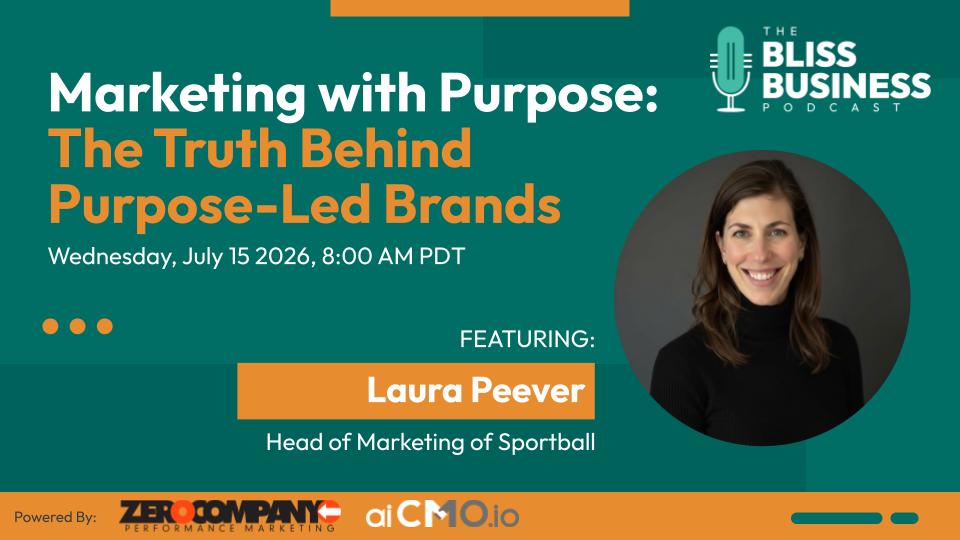
That distinction sat at the heart of a recent conversation with Laura Peever, Head of Marketing of Sportball, on the Marketing with Purpose series of The Bliss Business Podcast. Laura leads marketing for a brand built around helping children develop confidence and a lifelong relationship with movement through fun-first sport experiences. Her perspective on purpose is especially valuable because she does not treat it as something marketing invents. In her view, marketing’s job is to reveal what the organization already lives.
That is the truth behind purpose-led brands: the message only works when the operating reality underneath it is strong enough to support it.
Purpose Cannot Be Manufactured by the Marketing Department
One of Laura’s clearest points is also one of the most important: purpose does not begin with marketing.
Marketing can articulate it, package it, amplify it, and help customers understand it. But if the organization itself is not committed to the underlying values, communication eventually becomes performative.
This is where many brands get into trouble.
They begin with the campaign and work backward. Leadership wants a stronger emotional story, a social impact initiative, or a more meaningful brand platform, so marketing is asked to create one. The organization may even fund a charitable effort or launch a purpose-themed activation. But if the behavior of the company remains unchanged, the initiative stays at the surface.
Laura shared an early-career example that captures this perfectly. While working in agency strategy, she helped develop ideas for a major food brand that wanted to do something meaningful around giving back. The creative possibilities were substantial, including programs that could have connected directly to the brand’s product and addressed issues like child hunger. In the end, the company primarily wanted to make a charitable donation.
There is nothing wrong with donating money. The lesson is that philanthropy and purpose are not the same thing.
Purpose becomes strategically powerful when it shapes how the company operates over time. It needs enough depth to survive beyond the campaign window.
A Real Purpose Survives Pressure
The best test of a company’s purpose is not what it says when everything is going well.
It is what happens when something breaks.
Laura described a major internal crisis at Sportball after the rollout of a new registration platform created serious sales problems. Franchisees were frustrated, the source of the issue was not immediately clear, and the business had to respond quickly. What followed is a useful example of purpose translated into culture.
Leadership communicated transparently. Teams worked across functions. People focused on solving the problem rather than assigning blame. Daily responsibilities were clarified, problems were systematically ruled out, and the organization improved several adjacent processes along the way.
That response did not come from a crisis communications playbook. It came from an existing culture.
This is the part many brands overlook when they talk about values. Values are only useful if they affect behavior under pressure. A crisis does not create culture; it exposes it. If trust, accountability, empathy, and shared responsibility are already present, they become stabilizing forces. If they are missing, no amount of brand language can manufacture them in the moment.
For purpose-led organizations, the goal should not be to look principled during a crisis. It should be to build the kind of operating system that makes principled behavior the natural response.
Purpose Creates a Stronger Basis for Long-Term Brand Building
The pressure on marketing leaders to produce immediate results can make purpose feel difficult to defend.
Revenue goals are real. Acquisition costs matter. Campaign performance matters. Leaders still need measurable outcomes, and purpose cannot become an excuse for vague marketing.
But Laura’s perspective reveals why purpose can actually strengthen long-term performance rather than compete with it.
When a company’s purpose is deeply connected to the value it creates, it gives the brand a durable foundation. The organization is not constantly searching for the next emotional campaign theme because the story already exists in the work. Marketing has a richer source of material: customers whose lives changed, employees whose work matters, franchisees creating impact in local communities, and a product or service tied to a meaningful outcome.
That makes purpose much more than positioning.
It becomes a source of differentiation that is harder to copy because competitors can copy a message far more easily than they can copy a culture.
Cross-Functional Alignment Is Where Purpose Becomes Real
A brand cannot credibly claim to be purpose-led if marketing is the only department responsible for expressing that purpose.
The customer experiences the full organization. They encounter operations, service, product, billing, digital systems, franchisees, and frontline employees. If those experiences contradict the promise, the brand story loses credibility.
Laura’s approach at Sportball is instructive because marketing planning is integrated with operations and customer care. The organization starts with growth goals, considers the operational capacity required to support them, determines what customer acquisition and retention will demand, and then builds marketing around that shared reality.
That order matters.
It prevents marketing from making promises the operation cannot keep. It also forces marketing leaders to think more like business operators, which Laura describes as one of the most important ways she has improved in her role.
This is a valuable lesson for CMOs. Purpose is not protected by stronger messaging alone. It is protected by stronger alignment between what the business says and what the business is capable of delivering.
A Purpose-Led Brand Still Needs Clear Accountability
There is sometimes a false assumption that purpose-oriented cultures are less demanding.
Laura’s leadership philosophy suggests the opposite.
She uses a sports analogy to explain how strong teams operate. A winning team is not simply a collection of talented individuals. It has a shared goal, clear roles, high expectations, and accountability. People understand where they contribute and what is expected of them.
That structure is important because purpose without accountability can quickly become sentiment.
Sportball uses clear project ownership and OKRs to define why work is happening and what success should look like. Leadership helps remove blockers, while individuals are trusted to execute within their areas of expertise.
This is what makes purpose scalable.
People need to believe in the mission, but they also need clarity about their role in advancing it. The strongest cultures combine emotional commitment with operational precision.
Customer Insight Keeps Purpose Grounded in Reality
One of the risks with purpose is becoming too inward-looking.
A company can become so attached to its own mission that it stops paying attention to what customers are actually experiencing. Laura’s approach avoids that trap by balancing intuition with data and direct customer learning.
Sportball’s analysis of seasonal lifetime value is a good example. The company discovered that customer value varied substantially by season, which challenged the assumption that strong new-customer acquisition automatically translated into healthy long-term growth. That insight led the team to examine retention more closely, improve program quality, test win-back campaigns, introduce skill-progression tools for parents, and better understand why families were not returning.
The lesson is important for any purpose-led brand.
Purpose should influence the questions a company asks, but it should not predetermine the answers.
Listening remains essential. The business has to understand whether customers are receiving the value it believes it is creating. Data can reveal where reality diverges from intention, while qualitative feedback helps explain why.
That combination keeps purpose from becoming self-congratulatory.
The Best Brand Stories Usually Already Exist Inside the Business
One of the most compelling aspects of Laura’s role at Sportball is her focus on surfacing stories that were already there.
Long-tenured team members.
Children who became coaches.
Parents who saw confidence emerge in children who had struggled in traditional sports environments.
Franchise partners doing meaningful work in their communities.
These are powerful marketing assets precisely because they were not invented by marketing.
They are evidence.
For purpose-led brands, this is one of the most valuable shifts in mindset. Instead of constantly asking, “What story should we create?” marketers can ask, “What truth inside this organization have we failed to tell well enough?”
That is a much stronger starting point.
When the underlying work is meaningful, storytelling becomes an act of discovery rather than fabrication. The brand becomes more authentic because communication is grounded in lived experience.
Purpose Also Helps Attract the Right People
Laura points out that purpose can be a powerful filter for talent and franchise development.
That is especially relevant for organizations like Sportball, where the work requires people who genuinely care about children, community, sport, and development. The goal is not simply to attract anyone who sees the economic opportunity. The organization needs people whose motivations align with the mission because those motivations will shape how the customer ultimately experiences the brand.
The same principle applies to employees.
People increasingly want meaningful work, opportunities to grow, strong relationships, and leaders they respect. A company with a real purpose can offer something deeper than a job description. But that promise only works if the internal experience supports it.
Laura is also candid about the importance of moving quickly when a hire is clearly not a fit. That may seem unrelated to purpose, but it is actually part of protecting it. A values-led culture cannot be sustained if leaders avoid difficult people decisions out of discomfort. Empathy matters, but empathy also extends to the rest of the team and to the health of the organization.
Purpose needs stewardship.
Meaning Can Become a Competitive Advantage
There is a broader strategic argument underneath Laura’s perspective.
As products, technology, and tactics become easier to replicate, meaning becomes more valuable.
A competitor can copy an offer.
It can imitate creative.
It can adopt similar language.
It can chase the same audiences.
What is much harder to reproduce is an organization whose values are deeply embedded in how it operates.
That is where purpose becomes more than a brand asset. It becomes part of the company’s defensibility. Customers feel it through the experience. Employees reinforce it through their work. Franchisees carry it into local markets. Stories emerge naturally because the culture keeps generating them.
This is also where the B.L.I.S.S. philosophy—Building Love Into Scalable Systems—fits naturally. Purpose becomes sustainable when care, meaning, and human impact are translated into systems people can actually repeat. It is not enough to feel strongly about the mission. The organization has to design processes, incentives, leadership practices, and customer experiences that keep that mission alive as the company grows.
Key Takeaways
Purpose is an operating model before it is a marketing message. Marketing can reveal and amplify purpose, but it cannot compensate for a business that does not live it.
Crisis is the real test of culture. Values become credible when they guide behavior under pressure, especially when blame and fear would be easier responses.
Purpose can strengthen long-term brand building. When meaning is embedded in the business, marketing gains a deeper and more differentiated story to tell.
Cross-functional alignment protects the brand promise. Operations, customer care, product, and marketing all contribute to whether purpose is actually experienced by the customer.
Data keeps purpose honest. Customer behavior and feedback should challenge assumptions and reveal whether the organization is delivering the value it believes it is creating.
Authentic stories usually come from real impact. The strongest purpose-led marketing often involves uncovering evidence that already exists inside the organization.
Purpose is also a talent filter. It helps attract employees and franchise partners who are motivated by the mission and more likely to strengthen the culture over time.
Final Thoughts
What this conversation with Laura Peever, Head of Marketing of Sportball, makes clear is that purpose-led branding has very little to do with finding more inspirational language.
It is about building an organization that gives marketing something true to say.
When purpose shapes leadership behavior, operating decisions, customer experience, talent choices, and the way the business responds under pressure, the brand becomes more credible almost automatically. The story feels stronger because the evidence is stronger.
That is the real opportunity for companies that want to lead with purpose.
Do not begin by asking how to sound more meaningful.
Begin by building a business that is.

Guest Development | Producer | Blog Contributor
Martha is a connector who brings over two decades of experience in engineering, sustainability, education, and public relations. She is part of the integrated go-to-market team at Zero Company and serves as Guest Development Lead for The Bliss Business Podcast, where she connects with purpose-driven leaders to shape meaningful conversations. Martha also produces the Marketing With Purpose Kit segments with CMO guests.
Her career includes founding nonprofits, and speaking at global forums in Malaysia, Dubai, and Paris. A passionate community builder, Martha also mentors women entrepreneurs and supports environmental initiatives across Mexico and the U.S. Her work reflects a deep commitment to impact, inclusion, and authentic leadership.

Starting Over Deserves Community