AI Is Making Work Faster. Why Isn’t It Making Business Better?

Artificial intelligence is making individuals more productive. That part is becoming increasingly difficult to dispute.
People are writing faster, analyzing information more quickly, producing work that once took hours in a fraction of the time, and gaining access to capabilities that previously required specialized expertise. Yet something strange is happening inside organizations. Individual productivity is rising, but the improvement is not consistently translating into better organizational performance.
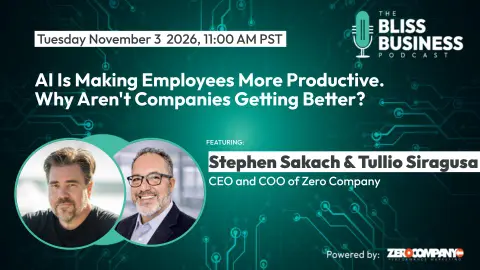
That disconnect became the focus of a recent conversation between Stephen Sakach and me on The Bliss Business Podcast. The discussion grew directly out of an article I had written after looking across several studies on AI adoption and organizational performance. One recent McKinsey study we discussed suggested a striking gap between employees reporting productivity improvements and companies reporting meaningful enterprise-level impact.
If you want the full background behind the argument that sparked this conversation, you can read my original LinkedIn article, AI Is Making Employees More Productive. Why Aren’t Companies Getting Better?
The instinctive conclusion is that AI has not lived up to the hype. I think that misses the bigger story.
The technology may be working exactly as advertised.
The organizations surrounding it may not be.
Faster Employees Inside Slow Organizations
One of the mistakes companies are making with AI is assuming that improving individual productivity automatically improves the organization.
It does not.
An employee may use AI to complete an analysis in twenty minutes that previously required three hours. But if the recommendation then moves through several layers of review, crosses departmental boundaries, requires executive approval, and waits inside someone else’s queue, the business has not become dramatically faster.
The task became faster. The system did not.
This is an important distinction because many organizations were designed during an era when information moved slowly and decision-making needed to be centralized. Managers controlled information, approvals reduced risk, and hierarchy provided coordination.
AI changes that equation.
Information can now move almost instantly. Employees can analyze problems, generate options, and identify solutions faster than many organizations can authorize action.
That creates an unusual situation. We are giving people access to extraordinary new capabilities while forcing those capabilities through operating models designed for a much slower world.
It is the organizational equivalent of putting a high-performance engine inside a vehicle whose transmission cannot handle the power. The problem is not horsepower. It is the architecture surrounding it.
AI Is Exposing Problems We Have Avoided for Decades
This is one reason I believe AI implementation is revealing organizational weaknesses rather than creating them.
Centralized decision-making is one example. Excessive management approvals are another. Functional silos create additional friction because one department may discover something valuable but have limited authority to coordinate the response across the rest of the organization.
There is also a persistent problem around accountability without authority. Organizations tell employees they are responsible for an outcome while withholding the authority required to achieve it.
AI makes this contradiction much more visible.
Imagine a customer service employee who can use AI to diagnose a customer’s problem in seconds. The employee understands the situation, knows the appropriate resolution, and could potentially solve the issue immediately. But company policy requires two or three levels of approval before the employee can act.
The customer still waits.
The technology improved the employee’s ability to understand the problem, but the organization prevented that intelligence from becoming a better customer experience.
This is where many AI initiatives stall. Companies optimize tasks without redesigning the system through which those tasks create value.
The result is faster work trapped inside slow organizations.
Creating Value Is Different From Extracting It
There is another reason many companies are struggling to realize AI’s potential: they are asking it the wrong question.
Much of the current conversation focuses on efficiency. How many tasks can be automated? How much headcount can be reduced? How much cost can be removed? How much more work can each employee produce?
Those questions are understandable, particularly when executives are under pressure to improve margins. But they reflect an extraction mindset. They ask how AI can help the organization take more value from the system.
A more imaginative question would be: how can AI help us create more value?
Suppose AI gives an employee 30 percent of their time back. The most obvious response is to assume the organization now needs 30 percent fewer people.
But that is only one option.
What if the company instead used that capacity to improve responsiveness to customers? What if employees spent more time eliminating recurring customer problems? What if they explored new markets, developed new services, strengthened relationships, improved product quality, or tested ideas that never made it beyond the annual strategy meeting because nobody had enough time?
Suddenly, AI is not merely a cost-reduction tool. It becomes a capacity-creation tool.
That is a much larger opportunity. It is also harder to quantify immediately, which helps explain why many companies gravitate toward headcount reduction. Payroll savings show up quickly. The value created by deeper customer relationships, innovation, and new market opportunities may take longer to appear.
But short-term measurability should not be confused with long-term value.
The Metrics We Choose Will Determine What AI Becomes
Stephen made an important point during our conversation based on his experience using AI and machine learning in advertising.
These systems are extraordinarily effective at optimization. Give them a target and they will relentlessly pursue it.
That should make leaders think very carefully about the target.
If the primary objective is cost reduction, AI will help find ways to reduce costs. If the objective is short-term profitability, it can help optimize toward that. If the objective is maximizing shareholder value while ignoring every other stakeholder, the system has no inherent reason to care about what happens to employees, customers, communities, or the environment.
That is not because the technology is malicious. It is because the objective is incomplete.
The same problem already exists in traditional businesses. AI simply magnifies it.
A company can make its customer service operation more efficient while simultaneously making the customer experience worse. It can process more interactions per hour, reduce labor costs, and improve internal efficiency metrics while frustrating the very people the business exists to serve.
That is why organizations need broader definitions of success.
Profit matters. Businesses have to remain economically sustainable. But profit is one outcome within a much larger system of value creation.
If AI is going to become deeply integrated into how businesses operate, leaders will need to become much more intentional about the outcomes being optimized. Are we improving customer outcomes? Are we strengthening relationships? Are we helping employees grow? Are we reducing unnecessary friction? Are we creating something genuinely useful? Are we helping people flourish?
Those questions change what the technology is asked to do.
Decentralization May Matter More Than Automation
AI thrives on speed.
Traditional management structures often thrive on control.
That tension may become one of the defining organizational challenges of the next decade.
The more capable employees become through AI, the more painful unnecessary approval structures will become. If people can understand a problem, evaluate options, and generate solutions dramatically faster, forcing every decision upward through management layers increasingly becomes a bottleneck.
That does not mean organizations should eliminate leadership. It means leadership may need to change its role.
Instead of controlling decisions, leaders can establish purpose, define guardrails, provide context, develop people, and create the conditions for good judgment closer to where the work happens.
This is the difference Stephen described between dominator systems and partnership systems.
In a dominator hierarchy, authority primarily exists to control the people below it. In a partnership system, leadership is increasingly in service to the people doing the work. Expertise still matters. Accountability still matters. Some decisions still require senior leadership.
But the default shifts from permission to empowerment.
That distinction is important because AI can support either model. It can become one of the most sophisticated tools of centralized monitoring and control ever created, or it can put extraordinary problem-solving capability into the hands of people throughout the organization.
The technology does not choose between those futures.
Leadership does.
Empowerment Requires More Than Giving People AI
There is another side to this conversation that organizations cannot ignore.
Not every employee will immediately feel comfortable with increased authority.
Many people have spent years working inside systems where initiative carried risk. They learned that mistakes could bring consequences, that decisions belonged to management, and that the safest approach was often to wait for direction.
Then an organization announces that everyone should suddenly become empowered.
That transition is not automatic.
People may need coaching. They may need clearer guardrails. They need psychological safety to make decisions without fearing that every imperfect outcome will be punished. They need practice using judgment and learning from mistakes.
We have experienced this ourselves at Zero Company while moving toward a more self-managed model. People who were initially quiet or hesitant can become remarkably strong leaders when the environment gives them space to develop confidence and ownership.
But that transformation has to be designed.
You cannot spend years conditioning people to seek permission and then become frustrated because they do not immediately behave autonomously.
AI will make this leadership challenge more urgent because the technology increases capability much faster than organizations increase confidence, authority, or trust.
The human system still matters.
Empathy May Be the Missing Ingredient in AI Transformation
This brings us to something we frequently explore on The Bliss Business Podcast.
Empathy is often treated as a leadership soft skill. In the context of AI transformation, I think it may become a strategic capability.
Empathy asks leaders to consider how a decision affects more than one stakeholder. It expands perspective.
Instead of asking only how AI can improve margins, an empathetic leader also considers how it might improve the customer experience, expand employee capability, strengthen partnerships, or create more meaningful work.
That does not mean avoiding difficult decisions.
There will absolutely be situations where AI changes the economics of a role and workforce reductions become necessary. Markets change. Technologies replace activities. Businesses have to remain financially viable.
Compassionate leadership is not the avoidance of reality. It is the willingness to consider the human consequences alongside the financial ones.
The danger is making massive workforce decisions before organizations have seriously explored what else the newly created capacity could accomplish.
Eliminating a position creates immediate savings.
Redeploying that capacity toward creating new value requires imagination.
That is the choice many organizations are facing now.
Key Takeaways
-
Individual productivity improvements do not automatically translate into organizational performance.
-
AI can accelerate tasks while traditional approval structures and hierarchies continue slowing decisions.
-
Many AI implementation problems are actually organizational design problems involving centralized authority, functional silos, and accountability without empowerment.
-
The most important strategic distinction may be between using AI to extract more value and using it to create more value.
-
Time saved through AI can be redirected toward better customer experiences, innovation, new products, stronger relationships, and new markets rather than automatically becoming headcount reduction.
-
AI will aggressively optimize whatever objective organizations give it, making the choice of metrics and outcomes increasingly important.
-
Decentralized decision-making can allow AI-enabled employees to act on insights faster while leadership focuses on purpose, guardrails, coaching, and context.
-
Employees who have spent years inside command-and-control structures may need coaching and psychological safety before they are comfortable exercising greater autonomy.
-
AI can strengthen centralized control or distributed empowerment. Leadership determines which model emerges.
-
Empathy helps leaders consider the consequences of AI decisions across employees, customers, communities, shareholders, and other stakeholders instead of optimizing around a single outcome.
Final Thoughts
The biggest opportunity presented by AI may not be making our existing businesses cheaper. It may be giving us the capacity to build better businesses altogether.
We are being handed tools capable of accelerating analysis, knowledge work, creativity, and execution on a scale that would have been difficult to imagine only a few years ago. But if we pour those capabilities into outdated organizational models, we should not be surprised when the results disappoint us. Faster employees cannot compensate indefinitely for slow decision-making, fragmented incentives, rigid silos, and cultures built around permission rather than ownership.
The more interesting question is what becomes possible when that capacity is intentionally redirected toward creating value. Businesses could use AI to deepen customer relationships, eliminate recurring problems, develop employees, explore new markets, design new offerings, and create organizations where people have greater authority to solve the problems directly in front of them. That requires more than technology. It requires imagination, empathy, trust, and the courage to redesign systems that many leaders have spent their careers learning how to operate.
AI may dramatically expand what organizations are capable of doing, but it will not decide what is worth doing. That remains our responsibility. The companies that understand this may discover that the real advantage of AI is not how many people it allows them to remove, but how much more value their people are finally able to create.
Check out the full conversation between Stephen Sakach and Tullio Siragusa, co-founders and hosts of The Bliss Business Podcast.

Executive Producer | Host | Blog Contributor
Tullio Siragusa is a strategic advisor, dynamic speaker, author, and EQ coach with 36 years of experience as a technology disruptor rooted in Design Thinking. Since 2018, he has been creating, producing and hosting live podcasts, interviewing over 1,000 C-suite executives across a wide range of industries. His work behind the mic reflects his larger mission: using conversation as a catalyst for human-centric innovation.
Tullio’s commitment to purpose-driven leadership and ethical transformation is reflected in his advisory roles at the University of California, Riverside’s Design Thinking Executive Program, and the University of San Francisco School of Management’s Digital Marketing Program. As a Board Advisor at AI2030.org, he helps guide the responsible advancement of AI toward ethical and sustainable outcomes. A founding member of RadicalPurpose.org, Tullio believes empathy isn’t just a trait, it’s a non-negotiable foundation for leadership.

Connection Is the Experience