Reinvention Is a Discipline, Not a Moment

Innovation is often romanticized as the moment someone has a brilliant idea. A founder sees something others missed, imagines a new product, and suddenly an industry begins to change.
The reality is usually much harder.
Ideas matter, but businesses are built through the long stretch between inspiration and execution. They require the willingness to question what worked yesterday, the humility to recognize when an existing model has reached its limits, and the discipline to keep moving when the outcome is far from certain.
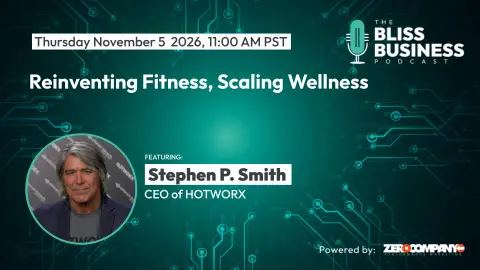
That was at the heart of my conversation with Stephen P. Smith, Founder and CEO of Hot Works and Planet Beach, on The Bliss Business Podcast. Stephen has been an entrepreneur since 1986, with a career spanning fitness centers, franchising, competitive bodybuilding, and the development of new fitness concepts. After watching major changes disrupt the tanning industry that had been central to Planet Beach, he spent years searching for what should come next. That journey eventually led to the development of a patented infrared fitness sauna and the launch of Hot Works in 2017. Today, the system has grown to more than 900 locations.
His story is not simply about fitness or franchising. It is about what happens when an entrepreneur refuses to confuse a successful past with a guaranteed future.
Sometimes You Have to Invent Your Way Out
Reinvention becomes much easier to discuss when the existing business is doing well. It is far harder when circumstances force the issue.
Stephen experienced that firsthand.
Planet Beach had been operating in an industry that faced significant disruption from economic pressures, regulation, and changing attitudes toward indoor tanning. He described a period when the industry contracted dramatically and he spent years waking up under what felt like a dark cloud, trying to determine what the business could become next.
That is where reinvention stopped being an interesting strategic option and became necessary.
His response was not to keep making incremental improvements to the same model. He began looking for something fundamentally different.
The early idea was surprisingly simple: what would happen if people exercised inside an infrared sauna?
The first prototype was designed to fit into the footprint of an existing tanning room. The original concept was centered more heavily around detoxification. But as Stephen experimented with the product, something changed in how he saw it.
This was not simply a sauna.
It could become an entirely different fitness platform.
That shift is significant because innovation often evolves after the original idea. Founders can become overly attached to their first interpretation of what they have created. Stephen allowed the idea to teach him what it could become.
Sometimes the breakthrough is not having the idea.
It is recognizing that the idea is bigger than the original plan.
Discipline Turns an Idea Into a Business
Stephen repeatedly returned to one word during our conversation: discipline.
His athletic background shaped that perspective. As a former college and arena football player and competitive bodybuilder, he learned early that results do not come from intensity once in a while. They come from patterns of behavior repeated long enough to create an outcome.
Business works the same way.
Stephen described discipline not as something we think about, but something we consistently do. It can begin with something as basic as making the bed in the morning, but the principle extends into strategy, creativity, operations, and leadership.
One discipline he considers particularly important is thinking time.
Entrepreneurs are often extraordinarily busy. They move from meetings to emails, customer issues, operating problems, staffing decisions, and financial concerns. Activity can become so constant that very little time remains for the kind of uninterrupted thinking required to see what the organization should become next.
That is dangerous because innovation is not limited to products.
Operations need innovation. Management systems need innovation. Customer experiences need innovation. Old processes need to be reconsidered when they stop producing the intended outcome.
Stephen’s advice is to create the space to think until a better answer emerges.
Then comes the harder part: execution.
His philosophy can be summarized by a phrase he literally had etched onto the felt of a pool table at his home: “Dream big, never quit.”
Dreaming big creates the direction.
Not quitting supplies the energy required to get there.
Technology Works Best When It Removes Friction
Hot Works was designed from the beginning as a technology-forward fitness business.
Its consumer app functions as the center of the member experience. Customers can access locations around the clock, schedule different workout formats, track exercise and calories, connect fitness devices, participate in groups, monitor nutrition, and access additional training capabilities.
Virtual instruction allows workout experiences to operate continuously without requiring an instructor to be physically present for each class.
That creates enormous scalability.
But one of the more interesting parts of our conversation was Stephen’s recognition that more technology is not automatically better.
He acknowledged that the company has sometimes pushed automation too far, particularly around customer communication. Automated messaging can increase efficiency, but too much of it can hurt sales and weaken the experience.
That lesson matters well beyond fitness.
Technology should remove friction where friction adds no value. It should provide convenience where convenience matters. But businesses still need to understand where human interaction creates trust, reassurance, motivation, or connection.
The goal should not be maximum automation.
It should be the right combination of human connection and technological leverage.
Hot Works has discovered that customers respond well to virtual workout instruction within its particular model. In other areas, personal interaction remains important.
The challenge for leaders is knowing the difference.
Consistency Is What Makes Innovation Scalable
Creating an innovative concept is one challenge. Delivering it consistently across hundreds of locations is another.
This is where franchising becomes an operational discipline.
Stephen believes brand consistency is essential because customers need to understand what experience they can expect regardless of location. But maintaining that consistency requires systems that give franchise owners support while still holding them accountable for performance.
One notable change Hot Works made was rethinking the role traditionally called a franchise consultant.
Stephen does not believe “consultant” accurately describes what those people should be doing.
They are coaches.
Hot Works calls them franchise performance coaches, and each coach is responsible for a defined group of locations. Rather than relying heavily on physical travel, much of the interaction happens through video. Franchisees are expected to appear on camera rather than simply join by audio.
That seemingly small requirement is intentional.
Video creates stronger communication, allows people to see one another, and makes remote coaching more personal. It also eliminates hours spent traveling through airports and driving between locations, allowing coaches to spend more time actually working with franchisees.
It is an example of technology increasing human connection rather than replacing it.
The broader principle is important: scaling does not mean removing relationships.
Sometimes it means redesigning how those relationships happen.
Innovation Has to Continue After the Breakthrough
Businesses often talk about innovation as something that happens during startup.
Stephen sees it differently.
A successful product creates the obligation to keep improving it.
Hot Works has continued developing new workout formats, digital capabilities, equipment, and training experiences. Because the workout content is delivered virtually, the company can introduce an updated experience across hundreds of locations quickly.
That gives the organization an unusual ability to innovate at scale.
But Stephen also cautioned against changing simply for the sake of novelty.
Fitness depends on consistency. Customers need enough repetition to measure progress and become comfortable with a workout. Constantly changing everything would undermine that.
This creates a useful tension.
Companies need enough innovation to remain relevant and enough consistency to allow customers to trust the experience.
Strong leaders understand that innovation is not synonymous with constant disruption.
Sometimes the most innovative decision is preserving what works while selectively improving what does not.
Customer Bliss Comes From Delivering the Result People Actually Want
Stephen described the company’s mission in terms that fit naturally with the philosophy of The Bliss Business Podcast: creating franchisee profits through customer bliss.
That connection matters.
Profitability is not separated from the customer experience. It is created through it.
For Hot Works, the fundamental customer promise is straightforward: more workout in less time.
People are busy. They want to improve their health, but fitness has to compete with careers, families, commuting, responsibilities, and countless other demands for attention.
The business was designed around that human reality.
Twenty-four-hour access gives people more flexibility. Virtual instruction removes dependence on a specific class schedule. Multiple workout formats create variety. Technology helps members measure progress.
Each of those elements is a business decision, but each begins with a human need.
That is what turns customer experience into strategy.
When customers consistently get the result they came for, they are more likely to become advocates. They stay longer, tell others, and create the kind of loyalty that makes scale sustainable.
The experience becomes the growth engine.
Leadership Requires Both Empathy and Standards
Toward the end of our conversation, we explored the role love should play in business.
Stephen’s response was practical rather than sentimental.
He described a leadership philosophy he calls the “velvet brick.”
The idea came from a management discussion he heard years earlier. The metaphor stayed with him because it captured something essential about leadership.
Communication should be velvet.
Standards should be brick.
Leaders can communicate with empathy, respect, patience, and understanding while remaining completely firm about the principles and expectations required for the organization to succeed.
Stephen embraced the concept so strongly that Hot Works now presents annual “Velvet Brick” awards to both a franchisee and a corporate team member who exemplify that philosophy. He even makes the velvet-covered bricks himself.
That distinction matters because compassionate leadership is sometimes mistaken for lowering expectations.
It should be the opposite.
If we genuinely care about people, we should want them to grow, succeed, improve, and reach their potential. That occasionally requires uncomfortable conversations.
The delivery can be kind.
The standard does not have to disappear.
Key Takeaways
-
Reinvention often begins when leaders recognize that improving the existing model is no longer enough.
-
Great ideas rarely emerge fully formed. Founders need enough flexibility to allow an idea to evolve beyond its original purpose.
-
Discipline is not an attitude. It is a pattern of consistent behaviors that turns vision into execution.
-
Leaders need intentional thinking time not only for product innovation, but also for improving operations, management, and customer experience.
-
Technology creates the most value when it removes friction without eliminating human connection where that connection matters.
-
Scaling an innovative concept requires strong systems and consistent execution, particularly in franchising.
-
Remote technology can actually increase connection when it is used intentionally, as Hot Works demonstrates through video-based franchise coaching.
-
Innovation requires balance. Businesses need to keep evolving without constantly disrupting the parts of the experience that already work.
-
Customer experience becomes a growth strategy when the business is designed around helping people achieve the result they actually value.
-
Compassionate leadership can combine empathetic communication with uncompromising standards, which Stephen describes as the “velvet brick.”
-
Entrepreneurs should fall in love not only with their idea, but with the work required to bring that idea into the world.
Final Thoughts
Stephen P. Smith’s journey is a useful reminder that reinvention rarely begins from a place of certainty. Sometimes it begins because the industry around you changes, the old business model stops working, or circumstances make it clear that continuing along the same path is no longer an option. Leaders can respond by protecting what they already know, or they can become curious about what the disruption might make possible.
But imagination alone is not enough. The difference between an interesting idea and a scalable business is execution. That requires disciplined habits, strong operating systems, technological leverage, consistent customer experiences, and a willingness to continue refining the model long after the initial breakthrough. It also requires leaders who know when to listen, when to adapt, and when to remain firm about the standards that make the organization successful.
The most compelling part of the Hot Works story may be that technology is not ultimately the center of it. The technology exists to meet changing human needs. People want better health, greater flexibility, measurable results, convenience, and experiences that fit more naturally into their lives. The business scales when the systems make those outcomes easier to achieve.
Innovation, at its best, is not about novelty. It is about seeing what people need, imagining a better way to provide it, and developing the discipline to keep working until that vision becomes something real. That is how entrepreneurs transform an idea into a business, and eventually, a business into something capable of changing an industry.
Check out our full conversation with Stephen P. Smith of Hot Works on The Bliss Business Podcast.

Executive Producer | Host | Blog Contributor
Tullio Siragusa is a strategic advisor, dynamic speaker, author, and EQ coach with 36 years of experience as a technology disruptor rooted in Design Thinking. Since 2018, he has been creating, producing and hosting live podcasts, interviewing over 1,000 C-suite executives across a wide range of industries. His work behind the mic reflects his larger mission: using conversation as a catalyst for human-centric innovation.
Tullio’s commitment to purpose-driven leadership and ethical transformation is reflected in his advisory roles at the University of California, Riverside’s Design Thinking Executive Program, and the University of San Francisco School of Management’s Digital Marketing Program. As a Board Advisor at AI2030.org, he helps guide the responsible advancement of AI toward ethical and sustainable outcomes. A founding member of RadicalPurpose.org, Tullio believes empathy isn’t just a trait, it’s a non-negotiable foundation for leadership.

AI Is Making Work Faster. Why Isn’t It Making Business Better?