Growth Breaks Down When Marketing Is Measured Too Narrowly

One of the most common ways businesses weaken growth is by asking marketing to prove its value too quickly and too narrowly.
The pressure usually sounds familiar: show me the leads, show me the conversions, show me what worked this month. On the surface, that seems reasonable. Marketing should absolutely be accountable. But when accountability is reduced to only the most immediate lower-funnel signals, companies often create a distorted view of what is actually driving performance.
They start starving the very activities that make demand generation more efficient in the first place.
That is why aligning marketing with business growth is not just about reporting better metrics. It is about understanding how the business actually grows, what role marketing plays across that full system, and which investments create compounding value over time rather than short-lived spikes.
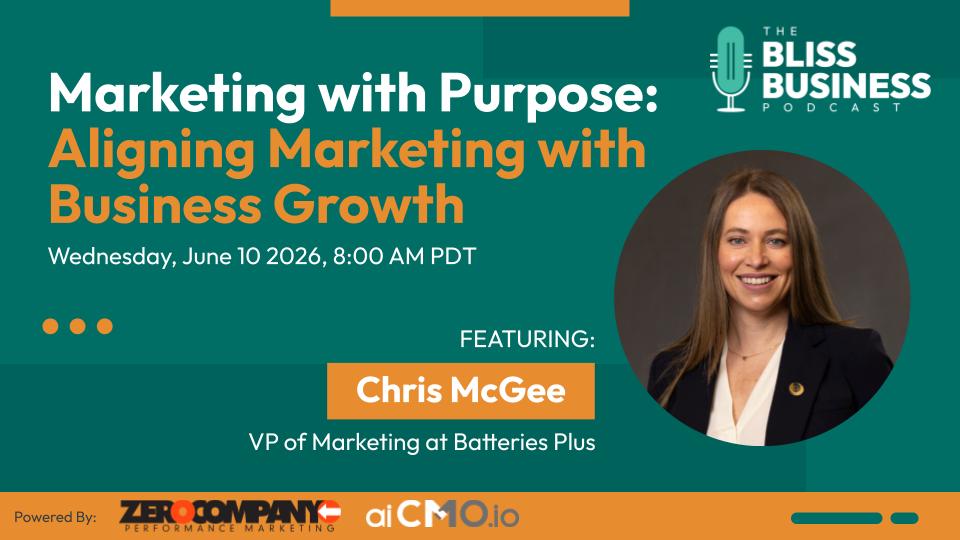
That broader truth came through clearly in a recent conversation with Chris McGee, VP of Marketing of Batteries Plus, on the Marketing with Purpose series of The Bliss Business Podcast. Chris brought a perspective shaped by large-scale budgets, full-funnel strategy, and a deep understanding of how media, merchandising, operations, and brand must work together if marketing is going to drive real business outcomes. What stood out most was her clarity around one essential point: growth gets harder when marketing is judged in a vacuum.
The businesses that outperform tend to understand something deeper. Marketing does not create value only at the moment of conversion. It creates value all the way through awareness, trust, consideration, purchase, and retention. Once a company starts measuring it that way, better decisions become possible.
The Lower Funnel Cannot Carry the Whole Business
Many companies over-index on bottom-funnel performance because it feels safer.
Search clicks look measurable.
Return on ad spend looks measurable.
E-commerce conversion looks measurable.
That kind of visibility is comforting, especially when budgets are tight and leadership wants quick answers. But the danger is that these metrics can become so dominant that they crowd out a more complete understanding of growth. A company starts treating the bottom of the funnel as if it can generate demand on its own, when in reality it is often harvesting demand that other efforts have already created.
This is where brands begin to make themselves more fragile.
If awareness has not been built, trust has not been established, and the market does not understand what differentiates the business beyond price, then lower-funnel efficiency becomes harder and more expensive to sustain. Paid search costs more. conversion rates get squeezed. customer acquisition becomes more transactional and less durable.
Chris’s point is especially important here: brand building and demand generation are not competing priorities. They are parts of the same system. Long-term brand investment is often what gives short-term acquisition its leverage. Without it, the business keeps trying to win with the most expensive and least defensible part of the funnel.
Marketing Can Look Inefficient When the Real Problem Lives Elsewhere
One of the strongest insights in this conversation is that marketing performance cannot be interpreted in isolation from the broader business environment.
A campaign may underperform for reasons that have little to do with creative quality or media strategy. Inventory may be low. Pricing may be out of step with competitors. Reviews may be dragging down trust. The customer experience may be inconsistent. The product promise may not be clear enough once someone reaches the store or site.
These are not marketing-only problems.
But they absolutely affect marketing outcomes.
This is why alignment matters so much. When marketing, operations, merchandising, and customer experience are disconnected, the business starts making bad assumptions. It blames the ad for a pricing issue. It blames the channel for an inventory problem. It blames awareness for a customer experience gap.
The result is usually reactive decision-making.
What Chris points to is a more mature model: understand the full set of business realities shaping demand before drawing conclusions about what marketing is or is not doing. That is what allows marketing to function as a growth driver rather than a scapegoat.
The Best Growth Strategies Behave More Like Portfolio Management
Another useful lens from Chris’s thinking is the idea of treating marketing investment like a portfolio.
That is a much smarter way to think about growth than simply dividing spend into “what works” and “what doesn’t.” A portfolio approach recognizes that different investments play different roles. Some channels are designed to capture demand that already exists. Others are designed to build future demand by increasing familiarity, trust, and relevance over time.
Those roles should not be confused.
The problem is that companies often want every dollar to behave like immediate-response media. They expect every campaign to prove itself instantly and in the same way. But growth does not work like that. If everything is forced into short-term justification, the business ends up underinvesting in the activities that make later conversion cheaper and stronger.
A portfolio mindset creates balance. It protects room for upper-funnel investment while still holding lower-funnel tactics accountable. It forces leaders to ask not just what drove sales this week, but what will make the next six months more efficient and more resilient.
That kind of thinking is especially important in categories where purchase timing is unpredictable. Businesses like Batteries Plus do not always get to dictate when the customer enters the market. A battery fails when it fails. A phone breaks when it breaks. In those moments, the brand that is already known and trusted has a major advantage.
Reach Matters More When the Category Is Need-Based
One of the more interesting strategic lessons in this conversation is how category dynamics shape media decisions.
For a need-based brand, the customer is not always browsing leisurely. Often they are reacting to a problem that needs solving. That means the business has to be mentally available at the moment of need. It cannot rely only on campaigns that happen to be running in short bursts or in highly fragmented ways. If the brand is not present when the need appears, someone else gets the business.
That is why Chris’s emphasis on maintaining broad, efficient reach is so important.
In categories like this, visibility is not just about brand vanity. It is about preparedness. It is about staying present enough in the market that when the moment comes, the customer thinks of you first and trusts that you can solve the problem. That kind of awareness does not happen through scattered, inconsistent exposure. It requires continuity.
This is also why a media plan can fail even when it looks technically sound on paper. If it cannot sustain enough reach over time, it may not be building the kind of memory structure that a need-based business depends on.
Efficiency Improves When Silos Shrink
A recurring challenge in many organizations is that teams often optimize locally instead of collectively.
A merchandising team may focus on inventory turns.
An operations team may focus on staffing and execution.
A sales team may focus on immediate close rates.
A marketing team may focus on conversion and cost metrics.
All of those are valid concerns. But when they are not connected, the business starts producing friction for itself.
Chris’s perspective makes clear that marketing works better when it is tightly connected to those surrounding functions. Not because marketing should absorb all their responsibilities, but because growth depends on how well those systems reinforce one another. If one group is making a decision that weakens the customer experience or changes the economics of conversion, marketing needs visibility into that. Otherwise it is optimizing against an incomplete picture.
This is one reason strong CMOs and marketing leaders spend so much time outside the marketing department. The job is not only to launch campaigns. It is to understand enough about the whole business that marketing can be aligned to what the business is actually capable of delivering.
Customer Understanding Is Often Hiding in Plain Sight
One of the most compelling details in the conversation was the realization that many consumers did not fully understand what a “battery store” really meant.
That is a deceptively simple insight, and a powerful one.
From the inside, it may feel obvious what the company does. The name is clear. The category seems self-explanatory. But customer understanding is not shaped by insider logic. It is shaped by what people actually know, assume, and misunderstand when they encounter the brand in the real world.
That gap matters enormously.
If consumers do not understand the breadth of the offer, the level of expertise, or the problem-solving capability of the business, then marketing has to do more than advertise products. It has to educate. It has to position. It has to shape perception in a way that makes the company easier to choose.
What Chris’s team recognized is that the store itself, and the expertise inside it, needed to become more central to the story. That shift is bigger than a creative tweak. It reflects a deeper truth: growth often accelerates when a brand stops assuming the customer understands it and starts communicating with more clarity and empathy.
Data Is Most Powerful When It Leads to Better Questions
A lot of companies say they want to be data-driven, but what they really mean is that they want data to confirm what they already believe.
That is not what strong marketing teams do.
The strongest teams use data to ask better questions. They use it to challenge assumptions, not simply support them. They pay attention to what the numbers are saying, but they also pay attention to why those numbers may be changing. That is where better strategy usually begins.
Chris’s work around attitudinal awareness, media mix modeling, and market-level performance reflects exactly that kind of thinking. Rather than taking channel performance at face value, the team looked at the relationship between awareness and business outcomes. What they found was that stronger awareness correlated with stronger e-commerce conversion and better local sales performance. That is a meaningful insight because it helps prove what many marketers intuitively know but often struggle to defend: brand investment improves downstream efficiency.
This is why sophisticated analytics matter. Not because they produce prettier dashboards, but because they allow leadership to make smarter allocation decisions with greater confidence.
Growth Becomes More Sustainable When Leadership Trusts the Long Game
One of the hardest parts of aligning marketing with business growth is helping leadership stay committed to a strategy that may not always deliver instant gratification.
This is where many organizations falter. They know intellectually that brand matters, reach matters, and trust matters. But the moment pressure rises, they are tempted to overcorrect toward whatever looks most immediate. That shortens the horizon of the business and often undermines the very performance they are trying to protect.
Chris’s approach pushes in the opposite direction. It is disciplined without being rigid. It recognizes the importance of responsiveness, but also protects the investments that keep the system healthy over time.
That kind of leadership matters because growth rarely comes from constant tactical scrambling. It comes from consistency, clarity, and enough strategic courage to resist starving the long-term just to soothe the short-term.
Teams Stay Stronger When They Know the Work Matters
The final theme worth underscoring is leadership.
Chris’s conversation makes it clear that a strong marketing organization is not only built on technical capability. It is built on connection to purpose, visibility into impact, and a real understanding of who the work is serving. In a franchise environment, that matters even more because behind every store is an owner, a team, and a livelihood.
That changes the emotional weight of the work.
The marketing team is not just moving numbers in a dashboard. It is helping real business owners succeed. That creates a very different kind of motivation when it is made visible. It also creates a healthier culture, because people understand that the work has meaning beyond the immediate metric.
This is often what keeps good teams engaged. Not just challenge, though that matters. Not just growth, though that matters too. But the sense that the work connects to something concrete, human, and valuable in the world.
Key Takeaways
Marketing should not be judged in a vacuum. Performance is shaped by inventory, pricing, customer experience, reviews, and operations, not just campaign execution.
Brand and demand generation work better together than apart. Long-term brand investment often improves the efficiency of short-term acquisition efforts.
A portfolio mindset creates stronger marketing decisions. Different investments play different roles, and not every dollar should be expected to perform the same way.
Need-based categories require sustained visibility. When demand is unpredictable, reach and memory matter because the moment of need cannot always be planned.
Customer understanding cannot be assumed. Brands often grow faster when they communicate their value more clearly instead of assuming the market already understands it.
Data should sharpen strategic thinking. The most useful analytics challenge assumptions and reveal how different business levers work together.
Purpose strengthens team performance. Marketing teams stay more engaged when they understand the human impact of the work, especially in franchise environments.
Final Thoughts
What this conversation with Chris McGee, VP of Marketing of Batteries Plus, makes clear is that aligning marketing with business growth is not just about proving that campaigns can drive sales.
It is about building a system where marketing is connected to the whole business strongly enough to influence the outcome in a lasting way.
That means understanding the category.
Understanding the customer.
Understanding the economics.
Understanding the handoffs.
And understanding that growth is rarely created by one department acting alone.
The companies that do this well do not treat marketing as a standalone function that reports upward.
They treat it as part of the operating engine itself.
That is when marketing becomes more credible.
That is when it becomes more efficient.
And that is when it starts contributing to business growth in ways leadership can no longer afford to underestimate.

Guest Development | Producer | Blog Contributor
Martha is a connector who brings over two decades of experience in engineering, sustainability, education, and public relations. She is part of the integrated go-to-market team at Zero Company and serves as Guest Development Lead for The Bliss Business Podcast, where she connects with purpose-driven leaders to shape meaningful conversations. Martha also produces the Marketing With Purpose Kit segments with CMO guests.
Her career includes founding nonprofits, and speaking at global forums in Malaysia, Dubai, and Paris. A passionate community builder, Martha also mentors women entrepreneurs and supports environmental initiatives across Mexico and the U.S. Her work reflects a deep commitment to impact, inclusion, and authentic leadership.

Starting Over Deserves Community