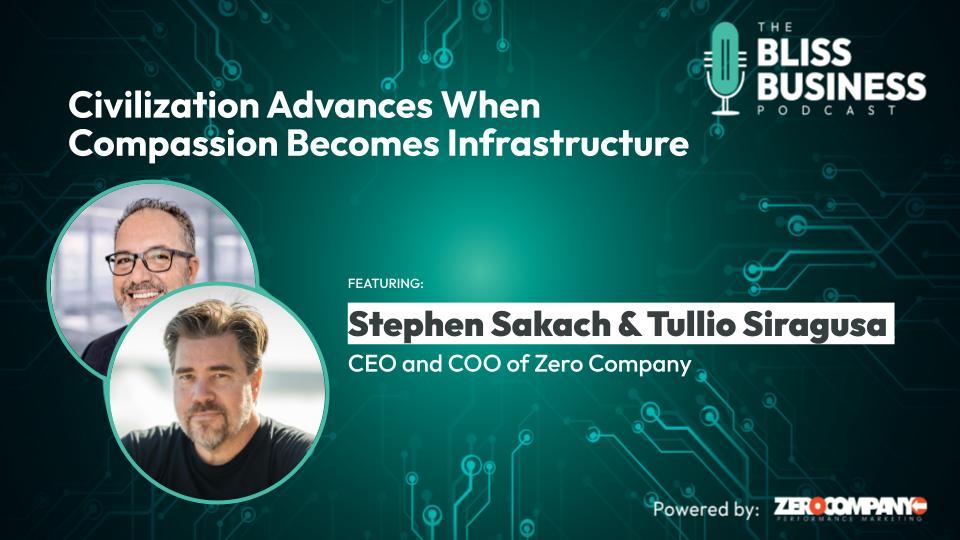
Compassion as Infrastructure: The Systems That Advance Civilization

Technology is often treated as proof of progress. Fire, the wheel, the printing press, the steam engine, the internet, AI. We point to new tools and call it civilization advancing. The problem is that technology does not arrive with a moral compass. It can connect people or divide them, create abundance or concentrate power, democratize information or flood the world with misinformation.
On The Bliss Business Podcast, Stephen Sakach and Tullio Siragusa challenged the default narrative and named the systems that advance civilization: not individual acts of compassion, but compassion becomes infrastructure, built into the architecture itself rather than left to occasional good intentions.
Compassion Is More Durable Than a “Good Leader”
One compassionate manager can change a team. One thoughtful founder can change a company. The issue is durability. Leaders leave. Leadership changes. Mission statements get rewritten. When compassion depends on personalities, it stays fragile.
Infrastructure is different. Infrastructure makes compassion repeatable. It makes care the default, not the exception. Stephen used a simple example: civilization did not advance because a few factory owners chose not to send children into dangerous work. It advanced when child labor laws became structural protection. Compassion became system.
Every Company Is a Mini Civilization
A company is not just a place where work happens. It is a system that shapes behavior more hours per week than most institutions in modern life. Businesses decide how resources flow, how people spend their time, what gets rewarded, what gets tolerated, and what “success” means.
Stephen made a distinction that should be uncomfortable for every leader: every company has a constitution, whether leaders admit it or not. Not the employee handbook. The real constitution is:
-
What gets rewarded
-
What gets tolerated
-
Who gets promoted
-
What truth is safe to speak
-
Who has voice and who does not
Culture is not what you say. Culture is what your system produces. If you claim teamwork but only reward individual heroics, the system is teaching competition, not collaboration.
Four Forces Shape Every System
Stephen introduced a framework that explains why some organizations become regenerative and others become extractive: love, fear, power, and wisdom.
Love expands the circle of care. It keeps customers, employees, partners, vendors, community, and future consequences in the room when decisions are made. Leaders operating from love tend to think longer-term and ask different questions, such as “How much value can we create with people?”
Fear contracts the circle of care. It becomes an operating system disguised as urgency, pressure, or “performance management.” People become afraid to fail, afraid to speak, afraid to challenge bad ideas. Departments protect themselves. Information stops flowing. Innovation slows.
Power is inevitable. Someone allocates resources. Someone sets incentives. Someone decides. The question is what guides power. Power amplifies what is already there. Fear-based leadership amplifies fear. Love-based leadership amplifies love.
Wisdom is the most overlooked force. Wisdom sees second-order effects. It asks, “What happens next, and after that?” Wisdom is what prevents leaders from optimizing this quarter at the cost of the next decade.
Extraction Works Until the Bill Arrives
Stephen and Tullio made the point most leaders avoid saying out loud: extractive systems can look fantastic, until they do not.
Extraction asks, “How much can I get?” Regeneration asks, “How much can we create?”
Extractive systems can extract employee energy, customer trust, and community goodwill and still post strong short-term numbers. Then the bill arrives later as burnout, turnover, customer churn, politics, and collapsing cooperation.
Regenerative systems ask different questions:
Can our teammates leave stronger than when they arrived?
Can our customers be better off because they worked with us?
Can our communities be healthier because we exist?
Those questions do not abandon profit. They tend to produce profit as a result because they create expansive people, higher trust, stronger cooperation, and compounding discretionary effort.
Why Systems Drift Toward Extraction
A key insight in the episode is that extraction becomes easiest when decision-makers are separated from consequences.
-
The executive does not experience employee burnout
-
The polluter does not breathe the pollution
-
The decision-maker does not live with downstream cost
When that separation happens, people stop seeing relationships and start seeing resources. Employees become headcount. Customers become conversions. Communities become markets. Hierarchy can increase distance, and distance weakens empathy. Partnership systems reduce distance, increase voice, and make stewardship more likely.
Compassion as Infrastructure Is a Design Challenge
The episode closed with a direct leadership challenge. Whether you lead a company, a team, a family, or a community, you are shaping a civilization. Every system you build teaches people something: what matters, how to behave, what success is, and what truth is safe to speak.
The question is not whether you are building systems. You already are. The question is what those systems are teaching: fear or trust, extraction or regeneration, a shrinking circle of care or an expanding one.
Key Takeaways
-
Technology amplifies the human system it enters. It does not fix trust, leadership, or culture.
-
Compassion becomes durable when it is embedded into systems, not left to individual acts by good people.
-
Every company has a real constitution defined by what it rewards, tolerates, and promotes.
-
Love expands the circle of care. Fear contracts it. Power amplifies whichever force dominates. Wisdom decides the long-term consequences.
-
Extraction works until the bill arrives. Regeneration builds durable performance through trust and commitment.
-
The most dangerous drift happens when power becomes separated from the consequences of decisions.
Final Thoughts
Civilization will not be shaped by faster tools alone. It will be shaped by whether leaders build systems that help people flourish, tell the truth, and care beyond themselves. Compassion becomes civilization’s advantage when it stops being occasional and becomes infrastructure.
Where to Go Next
Listen to the full conversation: Civilization Advances When Compassion Becomes Infrastructure.
Watch the video: Why AI Won't Fix a Broken Culture.
Explore more Producers BLISS Series conversations.

Executive Producer | Host | Blog Contributor
Tullio Siragusa is a strategic advisor, dynamic speaker, author, and EQ coach with 36 years of experience as a technology disruptor rooted in Design Thinking. Since 2018, he has been creating, producing and hosting live podcasts, interviewing over 1,000 C-suite executives across a wide range of industries. His work behind the mic reflects his larger mission: using conversation as a catalyst for human-centric innovation.
Tullio’s commitment to purpose-driven leadership and ethical transformation is reflected in his advisory roles at the University of California, Riverside’s Design Thinking Executive Program, and the University of San Francisco School of Management’s Digital Marketing Program. As a Board Advisor at AI2030.org, he helps guide the responsible advancement of AI toward ethical and sustainable outcomes. A founding member of RadicalPurpose.org, Tullio believes empathy isn’t just a trait, it’s a non-negotiable foundation for leadership.

Systems Should Fit People, Not the Other Way Around