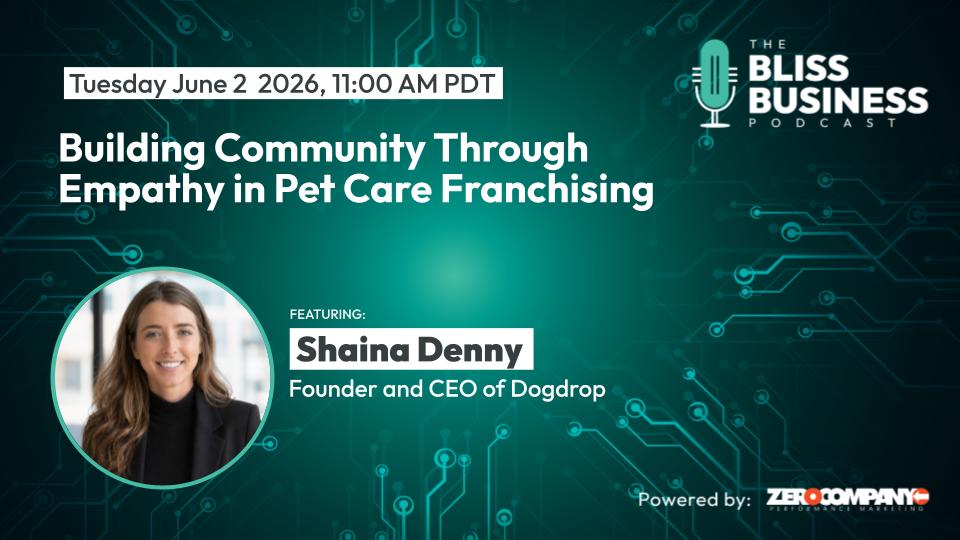
Building Community Through Empathy in Pet Care Franchising

Pet care is not a convenience category. It is a trust category. When someone drops off their dog, they are handing over a family member. That means safety, communication, consistency, and emotional intelligence are not “nice-to-haves.” They are the product.
On The Bliss Business Podcast, we sat down with Shaina Denny, Founder and CEO of Dogdrop, to talk about what community driven pet care actually looks like inside a modern dog daycare brand built around flexible care, small-footprint locations, membership-based service, and a franchise model designed for local ownership. Shaina started Dogdrop after her miniature dachshund, Poppy, struggled with traditional daycare and she saw a gap in the market that was less about dogs and more about how modern pet parents actually live.
A “Dog Daycare Fail” Revealed the Real Market Need
Shaina’s origin story is the kind that creates clarity fast. She got a puppy while working China hours from Southern California and quickly realized that “free until 3 p.m.” does not mean free. What she needed was not a full-day warehouse daycare off the freeway. She needed a few hours, on demand, near where she lived, with the flexibility to pick up and drop off without rigid windows.
Traditional daycare missed three basics that modern pet parents feel immediately:
-
Availability when the need happens, not after planning a week ahead
-
Convenience, meaning locations near where people already live and work
-
Flexibility, meaning pick up and drop off that fits real life
Dogdrop’s model starts there: meet pet parents where they are, not where legacy operations want them to be.
Empathy Starts With the Team, Not the Customer
Shaina framed empathy in a way that is both simple and operational. Empathy begins with how the business treats the care team. If leadership is empathetic toward the team, the team can pass that empathy to members and their dogs.
She also shared a practical truth that every service business should internalize: when a pet parent receives a message about their dog, their attention shifts instantly. That means communication is not just informational. It is emotional. Tone, timing, and clarity matter because the customer’s nervous system is already engaged.
Empathy here is not sentiment. It is understanding what the other person is experiencing and responding in a way that reduces stress and builds trust.
Trust Is Built Through Consistency and Owning Mistakes
Shaina was clear that trust is not something you “prove” on day one. It is earned through showing up consistently, across every touchpoint, over time.
She also said the quiet part out loud: brands are not perfect, and when you get it wrong, you should admit it. When a customer is upset and the business tries to “talk its way out,” trust drops. When the business says, “If I were you, I would feel the same way,” and then fixes it, trust strengthens.
That posture is rare. It is also one of the fastest ways to stand out in a care-based industry.
Community Happens in Layers, Not in One Big Program
When the conversation moved into community, Shaina’s answer was nuanced. Dogdrop builds community in layers:
-
Franchise owners build community with other owners who understand the same business pressures
-
Care teams build community with each other across locations through shared standards and shared identity
-
Members build community locally, through shared routines, shared stories, and the natural social fabric of pet parenting
She also shared a founder evolution that is worth noting. Early on, the company tried to “create” community directly. Over time, the goal shifted toward facilitating community and letting it grow organically. The best communities do not feel manufactured. They feel natural.
A Membership Model That Makes Personal Care Realistic
One of the most strategic parts of Dogdrop’s design is the membership model paired with small-footprint locations.
Shaina explained why this matters operationally. A location with roughly 300 to 350 monthly members is a number humans can actually know. The care team can learn names, behaviors, and routines. That level of familiarity is not feasible in a model where a single location tries to manage thousands of members.
This is a key point many brands miss: the operating model must match the emotional promise. If you promise personalized care but build a structure that makes personalization impossible, your culture will drift into transactional behavior.
Dogdrop’s model is designed so the expectation of relationship-based care stays realistic.
Scaling Empathy Depends on Who You Choose as Owners
Shaina did not pretend scaling empathy is easy. It is harder than scripting a call center. It requires proactive leadership and constant reinforcement.
Her answer to “how do you scale empathy” was grounded in franchising reality: it starts with selecting the right franchise partners. Owners shape the tone. If the owner is not empathetic, it is unrealistic to expect team members to consistently carry empathy on their own.
She also shared a moment that captures what great franchise partners do. Owners know their members, remember their stories, and go above and beyond. The tension is that “above and beyond” still has to fit a model. Leaders have to protect care without turning the business into an unsustainable set of exceptions.
That is the real scaling challenge: maintain humanity while preserving unit economics and operational clarity.
Clear Accountability Beats “Gray Area” Franchising
Shaina shared why Dogdrop breaks down franchise support and fees more transparently than many systems. She wants franchisees to understand exactly what they are paying for, what Dogdrop is accountable for delivering, and what the owner must own.
This eliminates gray areas, which matter more than most founders realize. When responsibility is unclear, franchisees fill it in, and then point back to the brand when expectations are missed. Clarity prevents resentment.
It also reinforces a deeper truth in franchising: the franchisor-franchisee relationship works best when it is explicit, structured, and honest.
Conviction, Not Passion, Is What Carries Founders Through “No”
Shaina offered strong advice for anyone considering entrepreneurship or franchising. The path includes being told no constantly: by landlords, customers, partners, vendors, and reality itself.
Her filter was simple: if you still do it after hearing “no,” you might be built for it. Not because you are stubborn, but because conviction is stronger than mood.
She also cautioned against romanticizing entrepreneurship. Learning under someone else’s roof is not failure. It is leverage. Many people rush into ownership without understanding how relentless the pressure can be.
Conviction is the anchor that keeps you building when the honeymoon ends.
Community Is Not for Every Business, and That Honesty Matters
Shaina closed with an important corrective. Not every business should force a community strategy. The question is whether your customers actually want it.
Pet care naturally creates community because dogs create social interaction. Some customers want meetups, puppy socials, and breed-specific gatherings. Others want care, trust, and convenience, and they do not have time for another commitment. Both are valid.
The leadership lesson is to meet customers where they are, not where you want them to be. Community should be an option that strengthens the brand, not an obligation that drains the customer.
Key Takeaways
-
Pet care is a trust business, and empathy is part of the product.
-
Flexibility and convenience are not perks in modern services. They are table stakes.
-
Trust grows through consistent delivery and owning mistakes quickly.
-
Membership and small-footprint design make personalized care operationally realistic.
-
Empathy scales through franchise owner selection and the culture they model daily.
-
Clarity in franchising prevents resentment and protects execution.
-
Conviction is what carries founders through rejection, not motivation alone.
-
Community works best when it is facilitated, not forced.
Final Thoughts
Dogdrop is a useful case study in what modern franchising can look like when the model is built around human reality. People want care that fits their lives. They want trust without friction. They want local businesses that feel like community, not just transactions.
Scaling empathy in a care-based industry is not automatic. It is designed through locations, membership structure, owner selection, and daily operational discipline.
Where to Go Next
Listen to the full conversation: Building Community Through Empathy in Pet Care Franchising with Shaina Denny.
Watch the video: Scaling Empathy in Franchise Care.
Meet Shaina on her guest profile.

Executive Producer | Host | Blog Contributor
Tullio Siragusa is a strategic advisor, dynamic speaker, author, and EQ coach with 36 years of experience as a technology disruptor rooted in Design Thinking. Since 2018, he has been creating, producing and hosting live podcasts, interviewing over 1,000 C-suite executives across a wide range of industries. His work behind the mic reflects his larger mission: using conversation as a catalyst for human-centric innovation.
Tullio’s commitment to purpose-driven leadership and ethical transformation is reflected in his advisory roles at the University of California, Riverside’s Design Thinking Executive Program, and the University of San Francisco School of Management’s Digital Marketing Program. As a Board Advisor at AI2030.org, he helps guide the responsible advancement of AI toward ethical and sustainable outcomes. A founding member of RadicalPurpose.org, Tullio believes empathy isn’t just a trait, it’s a non-negotiable foundation for leadership.

Systems Should Fit People, Not the Other Way Around