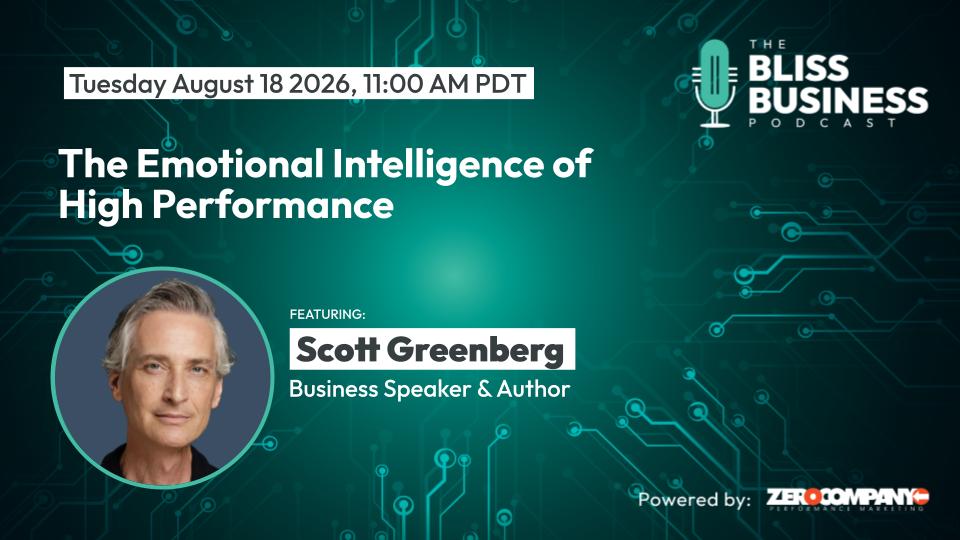
The Emotional Intelligence of High Performance

Every business leader wants high performance.
They want happier customers, stronger teams, greater consistency, better execution, higher resilience, and more reliable results when pressure rises or conditions change.
But high performance is not only a function of process, talent, strategy, or systems. It is also shaped by what happens beneath the surface: mindset, emotion, self-awareness, trust, and the way leaders make people feel.
On The Bliss Business Podcast, we sat down with Scott Greenberg, business performance expert, workforce leadership speaker, and a leading voice on emotional intelligence and employee experience, author of The Wealthy Franchisee and Stop the Shift Show. Scott is a former multi-unit franchise owner and operator for Edible Arrangements, where his locations earned strong sales rankings, customer service recognition, and management awards. That experience shaped his practical approach to mindset, emotional intelligence, leadership, frontline teams, customer experience, and performance culture.
His message was clear: emotional intelligence is not separate from business performance. It is part of the engine that drives it.
Emotional Intelligence Is What Happens Under the Hood
Scott compared emotional intelligence to what happens under the hood of a car.
A business can look polished from the outside. It can have a strong brand, clean systems, good products, and a clear strategy. But the real performance depends on what is happening underneath. For human beings, that means emotion, mindset, confidence, fear, trust, self-awareness, and the ability to understand what others are experiencing.
Leaders often focus on the task. They want the product made, the service delivered, the call answered, the customer served, the numbers improved, and the work completed.
But people do not perform as machines.
They perform through emotional states. A person who feels trusted, supported, respected, and clear performs differently than a person who feels unseen, anxious, dismissed, or constantly criticized.
That is why emotional intelligence belongs in any serious conversation about performance.
Leaders Create Emotional Conditions
One of the most important points Scott made is that leaders often underestimate their own emotional influence.
A leader’s mood travels.
If a leader is stressed, reactive, impatient, fearful, or dismissive, the team feels it. If a leader shows up with clarity, respect, steadiness, and care, the team feels that too. Leaders are always creating emotional conditions, whether they realize it or not.
That is why the advice to “just be yourself” can be incomplete.
Being authentic matters, but authenticity without awareness can become carelessness. If a leader is in a bad mood and simply shares that mood with everyone, that is not emotional intelligence. That is emotional leakage.
The better question is not only, “Am I being myself?”
The better question is, “What conditions am I creating for the people around me?”
High Performers Understand the Human Element
Scott has worked with many franchisees and business owners. When he looks at the top performers, they are not always the ones with the best locations, the longest hours, or the easiest circumstances.
Many top operators are able to take a struggling location and turn it around.
What separates them is not only discipline, work ethic, or adherence to the system. It is their awareness of the human element of the business. They manage their own emotions. They avoid being driven by fear, greed, mistrust, or panic. They understand that customers and employees respond to how they feel, not only to what they receive.
That is a key performance insight.
People may come for the product or service, but they return because of the experience. Employees may accept a job for the pay, but they stay because of the environment, growth, relationships, and meaning they experience.
High performers understand that emotion is not a distraction from the business. It is part of the business.
Customer Experience Starts With Employee Experience
Scott made the point that no discussion of customer service is complete without discussing employee experience.
Employees deliver the service. They bring the brand to life. They respond to pressure. They solve problems. They absorb customer frustration. They represent the company when leaders are not in the room.
If employees feel disconnected, unsupported, ignored, or mistreated, customers will eventually feel it too.
That is even more true today because companies can no longer easily hide the gap between what they say and how they operate. Customers leave reviews. Employees leave reviews. Social media creates instant accountability. A company that speaks about trust, care, and integrity externally but fails to live those values internally will be exposed over time.
The brand promise and the employee experience have to align.
Customers can feel when they do not.
Employees Are Customers of Leadership
One powerful idea from the conversation is that leaders should think of employees as customers too.
Employees are buying into the leader’s vision, behavior, culture, and expectations. They are consuming the leadership experience every day. If that experience is poor, transactional, or inconsistent, they disengage. If it is meaningful, supportive, and growth-oriented, they are more likely to stay, contribute, and care.
That does not mean leaders should avoid accountability. It means leaders should recognize that employees are human beings whose emotional experience shapes their performance.
Many companies measure customer satisfaction through Net Promoter Score. Scott also advocates for thinking about employee Net Promoter Score: would employees recommend this employer to a friend?
That question matters.
A company that wants customer loyalty must also ask whether it is earning employee loyalty.
Clarity Is More Powerful Than Positivity
Scott introduced the idea of a point of clarity.
Leaders are often told to be positive, but positivity alone can be dangerous if it becomes impulsive or disconnected from reality. A leader who is overly excited can make poor decisions just as easily as a leader who is angry or afraid.
The goal is not constant positivity.
The goal is clarity.
A point of clarity is the emotional state where a leader is not being driven by anger, fear, greed, mistrust, or even excessive excitement. It is the place where decisions can be made with steadiness, data, and awareness.
That is emotional intelligence in action.
It is the ability to pause long enough to ask, “What am I feeling, and how is that feeling influencing what I am about to do?”
Emotional Habits Can Weaken Leadership
Leaders become less effective when they are driven by emotions they have not examined.
Fear can make them controlling.
Greed can make them short-sighted.
Mistrust can make them micromanage.
Anger can make them reactive.
Envy can make them compare instead of lead.
The problem is not that leaders feel these emotions. Everyone does. The problem is when leaders do not notice them and allow those emotions to run the business.
Emotional intelligence does not remove emotion from leadership.
It brings emotion into awareness so it can be managed, directed, and used wisely.
Systems Can Build Emotional Connection
On the show, we often talk about BLISS: Building Love Into Scalable Systems.
Scott brought this idea into practical focus by describing how businesses can systemize emotional connection at different stages of the employee journey.
For example, many employers complain that job candidates do not show up for interviews. Instead of only blaming the candidate, Scott encourages leaders to examine the emotional experience the candidate has before the interview. One manager he mentioned improved interview attendance by creating a more personal connection during the initial phone call.
That is a small system with emotional intelligence built into it.
The goal is not only to schedule an interview. The goal is to make the candidate feel seen enough to show up.
Onboarding Should Build Belonging
Scott also spoke about the gap between accepting a job and showing up for the first day.
Some employers lose people before they even begin because the emotional connection is weak. A handwritten note, a thoughtful text, a welcome message, or a small gesture can reinforce that the person is wanted and expected.
That matters even more for frontline and hourly employees.
Scott shared the example of his daughter’s first job at a fast food restaurant. She was nervous the night before, wondering whether people would like her and whether she would succeed. When she arrived, the experience was cold and procedural. She was asked for her shirt size, given a uniform, and placed in front of training videos for hours.
Imagine if the experience had been different.
Imagine if the team had welcomed her. Imagine if the uniform felt like joining something meaningful instead of receiving work clothes. Imagine if the first day included belonging, not just compliance.
The job would be the same, but the emotional experience would be completely different.
Frontline Workers Need More Love
Scott’s book Stop the Shift Show focuses on managing frontline hourly workers, a group that is often treated more transactionally than salaried employees.
Hourly workers frequently receive less attention, less development, less cultural investment, and fewer signs that they matter. They may be viewed as replaceable labor instead of essential carriers of the customer experience.
That is a mistake.
Frontline workers are often the closest people to the customer. They are the ones who make the brand feel human or indifferent. They carry the emotional tone of the business into every interaction.
When leaders show frontline teams more respect, recognition, hospitality, and growth support, the impact reaches customers quickly.
Recognition Should Be a Ritual
Scott described an exercise he used with employees where the team would spend time recognizing each person specifically.
For several minutes, one employee would stand while others shared what they appreciated about that person and how they contributed. Some employees were moved to tears because they were not receiving that kind of positive reinforcement elsewhere in their lives.
That kind of ritual is powerful because it turns appreciation into culture.
Culture is not built only through statements. It is built through repeated behaviors that communicate what matters. When recognition becomes part of the rhythm of a company, people begin to look for what others are doing well. They become more aware of contribution. They become more generous with appreciation.
That is how emotional intelligence becomes a shared practice.
Hospitality Applies to Employees Too
Hospitality is often discussed in the context of customers, but Scott encouraged leaders to apply hospitality to employees.
A candidate arriving for an interview can be treated with hospitality. A new hire can be treated with hospitality. A frontline worker can be treated with hospitality. A long-term employee can be emotionally welcomed again through ongoing appreciation, mentoring, feedback, and care.
This does not require extravagant spending.
In fact, Scott pointed out that employees may accept less compensation for a better work experience. That does not mean companies should underpay people. It means leaders should understand that emotional value is real. People stay where they feel they matter.
A better workplace experience becomes a competitive advantage.
Healthy Franchise Relationships Require Role Clarity
An audience question asked about the secret to a healthy, profitable relationship between a franchisee and franchisor.
Scott said trust matters, but he emphasized something even more foundational: clarity of roles.
Franchisees need to understand what the franchisor is responsible for and what they must own themselves. The franchise agreement matters. Expectations matter. Misunderstanding creates resentment when one side expects the other to do something that was never promised or agreed upon.
The franchisee has to honor the system, represent the brand, invest appropriately, and take ownership of the business.
The franchisor has to make good on its promises, listen seriously, support the brand, and recognize how decisions affect the franchisee.
When both sides understand their roles and act with trust, transparency, and mutual service, the relationship is much healthier.
Transactional Service Can Become Transformational
Scott describes customer experience as a movement from transactional to transformational service.
Transactional service completes the task. Transformational service changes how someone feels.
That shift requires emotional intelligence. It requires leaders to ask not only whether the customer received the product or service, but whether the experience elevated them in some way. Did they feel respected? Did they feel seen? Did they feel relief? Did they feel confidence? Did they feel cared for?
This applies to employees too.
A leader can treat employment as a transaction: labor in exchange for pay. Or the leader can treat employment as an opportunity to help people grow, belong, contribute, and feel proud of their work.
The transaction matters.
The transformation creates loyalty.
Accountability Requires Empathy
Empathy does not mean avoiding accountability.
In fact, accountability without empathy often becomes harsh, reactive, or fear-based. Empathy helps leaders understand what someone is experiencing so they can hold them accountable in a way that actually improves performance.
If an employee makes a mistake, the leader has a choice.
They can lash out because they are angry. Or they can pause, regulate themselves, understand the situation, and respond in a way that corrects the issue while still preserving the employee’s dignity.
The difference matters.
One response may produce fear. The other can produce growth.
Empathy is not softness. It is awareness applied to performance.
Business Is Never “Just Business”
The phrase “it is just business” often functions as an excuse to remove humanity from decisions.
Scott pushed back on that idea.
When people are involved, business is never just business. People bring emotion, thought, fear, hope, pressure, family responsibilities, personal histories, and human needs into every workplace and customer interaction.
A leader can ignore that reality, but ignoring it does not make it disappear.
The most effective leaders understand that human emotion is part of the operating environment. If they want influence, loyalty, performance, and trust, they have to work with that reality, not against it.
Love Creates Business Value
When asked what role love should play in business, Scott said love should drive everything.
He defined love as elevating others and putting value into the world. That is not only morally good. It is also good business.
When businesses serve people well, those people are more likely to return. When leaders show loyalty, they are more likely to receive loyalty. When companies make people feel valued, people are more likely to advocate for them.
Love has a boomerang effect.
What the company puts into the world often returns through trust, loyalty, retention, referrals, stronger culture, and greater resilience.
Love is not opposed to profit.
Love is one of the most reliable paths to sustainable profit.
Grace Matters Too
Scott also made an important point about grace.
Leaders should aspire to emotional intelligence, but they are still human. They will sometimes miss a thank you, use the wrong tone, become impatient, or fail to show up at their best.
That does not excuse poor behavior, but it does remind us that everyone needs grace.
The same emotional intelligence leaders should extend to employees and customers should also be extended to themselves and others when imperfection shows up.
A high-performance culture is not a culture where nobody ever makes mistakes.
It is a culture where people are aware enough to repair, learn, and keep growing.
A Practical First Step
For leaders who want to become more emotionally intelligent, Scott offered a practical first step.
Several times throughout the day, ask yourself:
How am I feeling right now?
Then ask:
How are these feelings affecting what I am thinking, saying, deciding, and doing?
At the end of the day, leaders can also ask a powerful reflective question:
What was it like to be led by me today?
That question can reveal a lot. It invites leaders to look honestly at the emotional wake they leave behind. Did they create clarity or confusion? Confidence or fear? Trust or tension? Energy or exhaustion?
Self-awareness is the starting point.
Key Takeaways
-
Emotional intelligence is what happens under the hood of business performance.
-
Leaders create emotional conditions whether they are aware of it or not.
-
High-performing operators understand the human element of business, not only the operational system.
-
Customer experience and employee experience are deeply connected.
-
Employees should be treated as customers of leadership because they buy into the culture every day.
-
Clarity is more powerful than positivity because it supports better decision-making.
-
Emotional connection can be built into hiring, onboarding, training, recognition, and frontline management systems.
-
Frontline hourly workers need more respect, recognition, hospitality, and growth support.
-
Empathy strengthens accountability when leaders use it to correct behavior without damaging dignity.
-
Love in business means elevating others and putting value into the world.
Final Thoughts
Scott Greenberg’s perspective is a reminder that high performance is not created by systems alone.
It is created by people.
And people are emotional beings.
The best leaders understand that business performance depends on the emotional conditions they create for employees, customers, franchisees, and everyone else touched by the business. They know that culture is shaped by rituals, habits, recognition, clarity, accountability, and care. They understand that frontline workers need more than instructions. They need belonging, confidence, and respect.
High performance is not about removing emotion from business.
It is about leading emotion intelligently.
When leaders elevate others, they elevate the business.
Where to Go Next
Hear the full conversation with Scott Greenberg, watch it on the video page, and see more on Scott Greenberg's guest profile. Emotional intelligence and employee experience are not two different conversations, they are the same one. Explore more Featured Guest Series conversations.

Executive Producer | Host | Blog Contributor
Tullio Siragusa is a strategic advisor, dynamic speaker, author, and EQ coach with 36 years of experience as a technology disruptor rooted in Design Thinking. Since 2018, he has been creating, producing and hosting live podcasts, interviewing over 1,000 C-suite executives across a wide range of industries. His work behind the mic reflects his larger mission: using conversation as a catalyst for human-centric innovation.
Tullio’s commitment to purpose-driven leadership and ethical transformation is reflected in his advisory roles at the University of California, Riverside’s Design Thinking Executive Program, and the University of San Francisco School of Management’s Digital Marketing Program. As a Board Advisor at AI2030.org, he helps guide the responsible advancement of AI toward ethical and sustainable outcomes. A founding member of RadicalPurpose.org, Tullio believes empathy isn’t just a trait, it’s a non-negotiable foundation for leadership.

Hospitality Begins With Making People Feel Seen