Profit and Social Responsibility in Mission-Driven Startups with Mike Ma
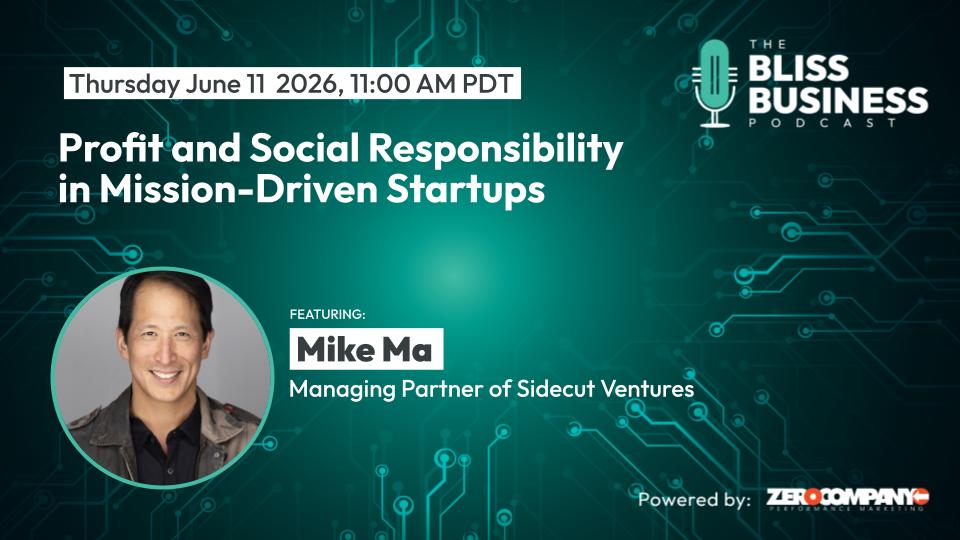
In this episode of The Bliss Business Podcast, Mike Ma, Managing Partner and Head Coach at Sidecut Ventures, explores profit and social responsibility in mission-driven startups: why coachable founders, not fast capital, build companies that scale responsibly and create lasting impact.
Can startups scale with ambition while staying grounded in responsibility?
In this episode of The Bliss Business Podcast, we welcome Mike Ma, Managing Partner and Head Coach at Sidecut Ventures, to explore Balancing Profit and Social Responsibility in Mission-Driven Startups.
Mike invests in and coaches what he calls “coachable superheroes”: early-stage, mission-driven founders tackling systemic challenges in areas like economic mobility, healthcare, climate, and education. Sidecut Ventures uses a “coach first, capital second” approach, combining investment with hands-on operational support and mentorship.
Mike’s screening starts before a term sheet: “Describe in your own words what evil you’re fighting,” he asks every founder pitching Sidecut, and if the mission isn’t real, it shows fast. Founders then get thirty days of hands-on coaching before any capital moves. “Revenue is not traction,” Mike says, pointing to how easy it is to chase a recognizable logo instead of the customer the company actually set out to serve. “Love is a growth strategy,” he adds, not because profit doesn’t matter, but because the founders who build lasting companies treat impact as the primary filter, with the financials following in kind.
In this episode, we explore:
• Why mission-driven founders need both purpose and discipline
• How investors can support impact without sacrificing scale
• Why coachability is essential for early-stage founders
• How social responsibility becomes part of venture building
• What adaptive snow sports can teach us about unlocking potential
• How founders can grow companies that serve both markets and humanity
Key Takeaways
• (3:05) The two screening questions Sidecut asks every founder before any pitch talk: “tell me about the best coach or teacher you ever had and why,” and “describe in your own words what evil you’re fighting.”
• (5:13) What makes a founder mission-driven and coachable: “action-oriented self-awareness,” because “it has to be a calling, not a job... you need to answer with your feet, not your mouth.”
• (14:50) The Elastic Energy story: a technical founder admits his sales pipeline shrank by a third, and Mike commits to the check because of that honesty, not despite it: “that’s exactly why I’m going to write this check.”
• (20:15) “Revenue is not traction”: why chasing a recognizable logo or an ARR number can quietly pull a founder away from the customer the company actually set out to serve
• (25:56) The “go first” model: Sidecut coaches founders for 30 days, unpaid, before any capital moves. “You don’t like our advice and the way we work? Don’t take our money.”
• (35:00) The Love Question: love should sit at the center of every business decision, with the financial metrics following in kind, “not a secondary or tertiary selection criteria.”
FAQ
What does Mike Ma mean by “coachable superheroes”?
Early-stage, mission-driven founders who combine a real calling with what Mike Ma calls “action-oriented self-awareness,” not just talking about their mission but showing it through action. Sidecut Ventures screens for it before any capital moves, asking every founder to “describe in your own words what evil you’re fighting.”
Why does Mike Ma say revenue is not traction?
Because founders can chase a recognizable logo or hit an ARR number while drifting away from the customer and mission the company actually set out to serve. Mike Ma says impact, jobs created, CO2 saved, the outcomes a founder set out to build, has to stay the primary filter, “and then all the metrics... followed in kind.”
What is Sidecut Ventures’ “go first” model?
A coach-first, capital-second approach: Sidecut works alongside a founder for 30 days, unpaid, before any investment happens. “You don’t like our advice and the way we work? Don’t take our money,” Mike Ma says, the firm proves its value before asking for anything back.
🎙️ Hosted by Stephen Sakach and Tullio Siragusa
🎧 Produced by Martha Huerta
The future of venture is not only about backing companies that grow fast. It is about coaching founders who can build responsibly, scale meaningfully, and create lasting impact.