Marketing With Purpose Kit: Marketing as a Growth Engine for Franchises
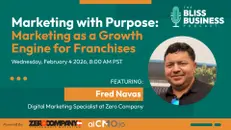
Fred Navas, digital marketing specialist at Zero Company, joins Michele Brasfield on franchise marketing at scale. A two location owner and a hundred location brand need different strategies, and in both cases the job is turning an expense into an investment you can quantify.
Franchise marketing at scale is not one strategy repeated more times, and that is where Fred Navas starts. Fred is a digital marketing specialist at Zero Company whose roots run back to the early days of paid search, and for the last three years he has focused on franchise and multi-location lead generation across Google, social, programmatic, and SEO. He joined host Michele Brasfield on the Marketing With Purpose series.
In this episode we explore:
• Turning marketing spend into an investment you can quantify
• Why a two location owner and a hundred location brand need different plans
• Holding national brand standards without flattening local relevance
• What local owners see before the national dashboard does
• The CRM gap that quietly breaks attribution
• Where franchise systems most often break in execution
Fred opens on the appeal, which is speed you can measure. Digital marketing is one of the fastest ways a franchise system sees results, and that puts a useful discipline on it. The goal of a campaign, in his framing, is to turn an expense into an investment, which only works if you can quantify what went in and what came back.
Scale is where he gets specific. A single location owner needs one plan. An owner running three or more locations needs another. The brand needs both to hold together, and Fred is clear that the strategy has to be designed to evolve rather than copied sideways.
The balance question gets a practical answer. Start with the recipe that made the business work, then, as the system grows from ten locations to twenty, give local owners a leadership group with real input into their own marketing materials. That is how a national brand keeps its identity and still sounds like it belongs in the neighborhood.
Two things he keeps running into. Measurement, because brands still arrive without a CRM tracking a lead through to first transaction and lifetime value, so the first party data that improves every campaign never gets built. And execution, which is where the model usually breaks, because local operators improvise on a recipe that was already working. Both are the gap between what a brand intends and what a customer experiences, which is where Zero Company spends its days.
Key Takeaways
• (2:03) The standard he sets for every campaign: “the goal of your campaign should always be to turn that expense into an investment.” Strategy also has to be scalable, because “the strategy for a single location owner is going to be different” from an owner with three or more.
• (3:21) Why the model has an advantage built in: “it’s a local business with the backing of a national brand.” The feet on the ground are the point, not a side effect.
• (4:29) On brand consistency: new franchises should “follow the recipe,” and at the same time, as a system grows from ten to twenty locations, “you want to empower those individual locations to have a leadership group where they can have some impact on their local marketing materials.”
• (6:58) Local insight changing national strategy, with a real case. A new owner facing high rent skipped the location entirely and drove to clients’ homes instead. It cut overhead and customers preferred it, so the service itself changed.
• (8:57) The gap he still finds constantly: “I’m surprised every time that I start working with a new company and they don’t have any CRM system.” Without lead to first transaction and lifetime value, there is no first party data to optimize on.
• (10:28) Where the model actually breaks: “the biggest struggle is implementation at the local level,” because operators improvise and “they forget the recipe that generated that initial success.” His fix is leadership teams built from local franchise owners.
FAQ
How is franchise marketing different from single location marketing?
Fred Navas points to stage. A single location owner and an owner with three or more locations need different plans, and a franchise brand has to design one strategy that scales across both rather than repeating one plan everywhere.
Why can franchise brands not measure marketing ROI?
Usually because there is no CRM tracking a lead through to first transaction and lifetime value. Fred Navas says that missing thread also starves the first party data that makes every later campaign smarter.
How do franchise brands stay consistent without silencing local owners?
Fred Navas recommends holding the national recipe while building a leadership group of local franchise owners who have real input into local marketing materials, so field insight shapes strategy instead of quietly diverging from it.
Scale is a design problem before it is a budget problem. Hear the full conversation with Fred Navas, watch it on the video page, hear pet franchise CEO Joe Dent on why following the system decides who thrives, and find more on the Marketing with Purpose Kit series.
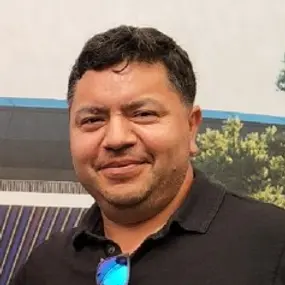
Digital Marketing Specialist
Fred is an experienced digital marketing and advertising professional with a long-standing background in the internet industry, dating back to the early days of paid search. He has led direct-response campaigns for both local and national brands, developing a strong reputation for performance-driven strategy and execution.
Over the past several years, Fred has specialized in supporting franchise and multi-location businesses with lead generation campaigns across Google, social platforms, and SEO. His expertise includes Digital Display Advertising, Pay-Per-Click (PPC), Programmatic Advertising, DFP, DMP, and Google Analytics, making him a well-rounded marketer focused on measurable growth and scalable results.