Turning Customer Connection Into Predictable Growth

Marketing becomes a revenue engine when it stops being treated as a collection of campaigns and starts being managed as part of the entire customer journey.
That shift matters more now because competition is intensifying across almost every category. Brands have more channels, more tools, more automation, and more access to customer data than ever before. Yet many organizations still struggle with the same fundamental problem: they can generate activity without creating enough sustainable growth.
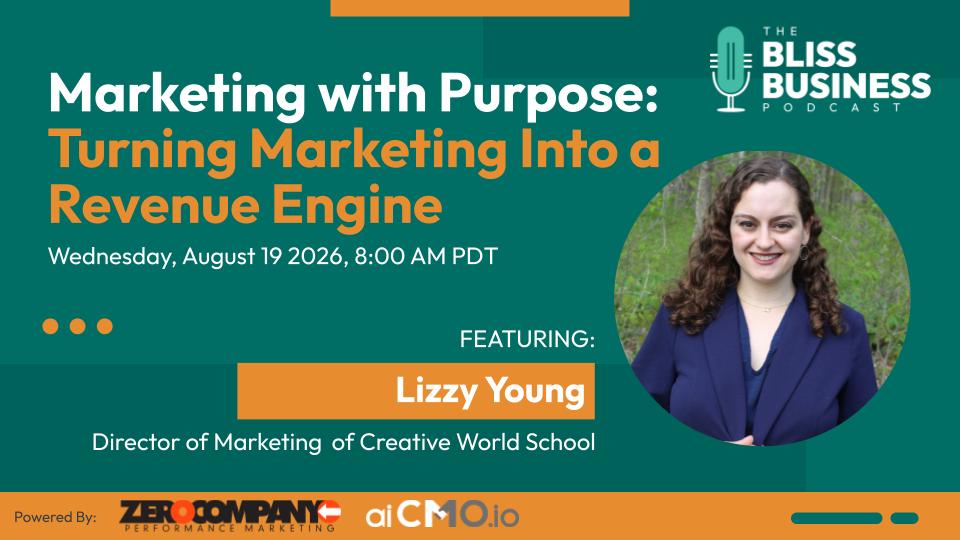
In a recent conversation with Lizzy Young, Director of Marketing of Creative World School, on the Marketing with Purpose series of The Bliss Business Podcast, that challenge came through clearly, and so did her case for customer connection and predictable growth working as one system. Lizzy has worked across franchise, education, healthcare, hospitality, wellness, technology, and agency environments, giving her a broad view of how marketing changes as markets become more crowded.
Her perspective is that great marketers think beyond acquisition. They understand how marketing contributes across the funnel, how it works with sales and franchise development, and how it influences whether customers return, refer others, and deepen their relationship with the brand.
That broader view is what makes marketing commercially valuable.
Revenue Growth Requires a Full-Funnel Mindset
For years, marketing teams have been evaluated primarily on their ability to attract new customers.
That responsibility still matters, but acquisition by itself is becoming less sufficient as markets become more competitive.
Customer acquisition costs rise when more brands pursue the same audience. Consumers have more options to compare. Digital channels become saturated. In that environment, growth depends increasingly on what happens after the first conversion.
Lizzy emphasizes the importance of lifecycle marketing because the economics of retention are becoming more important. Marketing has to help customers understand why they should stay, what value comes next, and why the relationship is worth continuing.
That changes the strategic question.
Instead of asking only how the organization can acquire more customers, leaders should examine where marketing can improve value across the whole relationship. A stronger customer journey can increase retention, strengthen referrals, and make acquisition efforts more productive over time.
Franchise Growth Gets Stronger When Consumer and Development Marketing Connect
One of the most interesting points in Lizzy’s perspective is the need for stronger alignment between consumer marketing and franchise development.
Those functions are often treated as separate disciplines.
Consumer marketing focuses on generating demand within local markets, while franchise development focuses on finding and attracting new owners. Both may have completely different targets, campaign strategies, teams, and reporting structures.
But ultimately, they are working toward the same broader outcome: expanding the brand.
When those teams share information, their work becomes much more useful. Consumer demand can reveal which markets have strong brand potential before franchise development begins actively selling territories there. Franchise development insights can help consumer marketers understand where future expansion will require stronger awareness.
That kind of collaboration improves the quality of strategic decisions because the organization sees growth as one connected system rather than two parallel funnels.
Alignment Needs to Continue After the Kickoff Meeting
Lizzy also makes an important point about launches.
Many companies treat a new market, product, or initiative as a project with a launch date. Cross-functional teams collaborate intensely during the buildup, everyone pushes to get the work live, and then the communication rhythm quickly disappears.
That is usually where problems begin.
A launch is not complete when something goes live. Early performance has to be monitored, ownership has to remain clear, and teams need a process for reviewing what worked and what needs to change.
Lizzy approaches this through phased project management. Teams may communicate more frequently in the earliest stages, then reduce the cadence as the operation stabilizes. Retrospectives create a structured moment to learn from the launch rather than simply moving on to the next initiative.
This may seem operational rather than marketing-specific, but it is exactly what makes growth more repeatable.
A revenue engine depends on execution discipline.
Data Can Show Performance Without Explaining Preference
Modern marketers have no shortage of data.
The challenge is understanding what that data actually means.
Lizzy shared an example involving SMS campaigns. Competitors had been using text marketing successfully, and the early performance data suggested the channel could work well. The campaigns produced respectable metrics, but something else began to happen: customers unsubscribed, and some sent direct feedback expressing frustration.
The quantitative data told one story.
The customer experience added another layer.
Instead of assuming the campaign was successful because the top-line numbers looked good, Lizzy’s team reached out to customers and asked why they were leaving. That qualitative feedback revealed issues such as message frequency, channel preference, and broader communication overload.
The lesson was not that SMS was ineffective. It was that optimization required a more complete understanding of the customer.
This is why data should inform judgment rather than replace it. Dashboards can reveal behavior, but conversations often reveal intention, emotion, and context.
Copying Competitors Can Quietly Weaken a Brand
One of Lizzy’s sharper observations is that growing market saturation has pushed many brands toward imitation.
When a competitor launches a new channel, promotion, or content strategy, the instinct is often to follow quickly. The reasoning feels safe: if it appears to be working for them, it should probably work for us.
But competitive imitation can gradually strip a brand of distinctiveness.
The danger is not simply that the copied tactic underperforms. It is that the organization starts allowing competitor behavior to shape strategy more than its own customer understanding.
Strong brands still monitor the market. They should absolutely understand what competitors are doing. But competitive intelligence should generate questions, not automatically dictate execution.
The better question is whether a tactic fits the organization’s audience, positioning, capabilities, and customer journey.
Marketing becomes less effective when keeping up replaces standing out.
Community Marketing Still Matters in a Digital-First World
As companies increase investment in AI, search, automation, and digital acquisition, Lizzy sees another risk: the erosion of grassroots and community marketing.
That is particularly important in franchise systems.
Local businesses often grow through trust, referrals, partnerships, events, community presence, and relationships that cannot be reproduced entirely through an algorithm. Those activities may be harder to measure than a paid campaign, but that does not make them less valuable.
In fact, as digital channels become more crowded, local connection may become even more differentiating.
A parent choosing a school, a family choosing a healthcare provider, or a customer choosing a local service often wants more than visibility. They want confidence that the organization understands their community and can be trusted within it.
Digital marketing can create discovery.
Community marketing can create belonging.
The strongest brands understand how to use both.
Customer Retention Starts With Understanding the Human Journey
One reason lifecycle marketing has become more difficult is that customers are surrounded by more messages than ever.
Every brand wants attention.
Every platform wants engagement.
Every inbox is full.
This changes what good marketing looks like.
Increasing communication volume is not necessarily the answer. Brands need to become more thoughtful about when they communicate, what value they provide, and how customers actually want to hear from them.
Lizzy’s approach is rooted in the idea that businesses are ultimately people businesses. That means understanding the emotional and practical context surrounding customer behavior rather than seeing the journey only as a sequence of funnel stages.
Retention grows when the customer continues to experience relevance.
That requires listening.
Marketing Talent Needs More Exposure to the Real Customer
Lizzy brings the same philosophy into how she develops marketers.
She encourages people to get away from the dashboard and spend time closer to the business itself. That might mean talking with customers, visiting locations, speaking with franchisees, or observing how the service experience actually unfolds.
That exposure matters because marketers can become surprisingly disconnected from the people they are trying to influence.
A person who spends all day inside campaign tools can become extremely proficient at optimization while slowly losing touch with the real customer experience. The more senior that marketer becomes, the more dangerous that disconnect can be.
Customer proximity improves judgment.
It also makes the work more meaningful because people can see how their decisions influence real experiences rather than abstract metrics.
Creativity Declines When Marketers Become Pure Executors
Lizzy also points to a leadership issue that affects retention within marketing teams.
Many talented marketers enter the profession because they enjoy creativity, experimentation, and building something new. Yet in some organizations, their role gradually narrows into executing decisions that have already been made.
Leadership sees a competitor doing something and tells the team to copy it. Strategy becomes prescriptive. The marketer becomes an operator rather than a contributor.
Over time, that can make strong people leave.
Emerging brands often attract talented marketers for the opposite reason. They offer the opportunity to create systems, shape the strategy, and influence how the business grows.
That tells leaders something important.
High performers do not only want responsibility.
They want meaningful ownership.
Purpose Is Most Visible When People Are Under Pressure
Lizzy’s experience working in pediatric healthcare during the pandemic offers an especially powerful example of purpose-driven marketing.
Parents were frightened. Children were suddenly removed from normal routines. Families were trying to navigate education, social development, healthcare, and uncertainty at the same time.
Marketing in that environment could not simply operate as promotion.
Lizzy’s team focused on educational content and practical support that helped parents navigate concerns about their children’s development and social wellbeing.
That kind of work illustrates what purpose-led marketing looks like when it is grounded in empathy.
The brand still has business objectives, but the immediate question becomes how communication can reduce uncertainty, provide something useful, and help the audience through a difficult moment.
That approach aligns naturally with the B.L.I.S.S. philosophy of Building Love Into Scalable Systems. Empathy becomes scalable when the organization creates processes that help teams consistently understand what people need and respond in a way that respects their reality.
Key Takeaways
Marketing becomes more valuable when it owns more of the customer journey. Acquisition matters, but retention, referrals, and lifecycle value are increasingly important to sustainable growth.
Consumer marketing and franchise development should inform one another. Shared market intelligence creates smarter expansion decisions.
Launches require ongoing alignment. Strong project management and post-launch learning turn one-time wins into repeatable systems.
Data needs human context. Analytics reveal behavior, while direct customer conversations often explain the motivation behind it.
Competitive intelligence should not become imitation. Brands grow stronger when they stay grounded in their own customers and differentiation.
Community remains a powerful growth channel. Digital reach and local relationships work best when they reinforce one another.
Marketing teams need customer proximity and creative ownership. Both improve the quality of decisions and help talented people stay engaged.
Final Thoughts
What this conversation with Lizzy Young, Director of Marketing of Creative World School, makes clear is that turning marketing into a revenue engine is not primarily about finding another channel or extracting more performance from the existing funnel.
It is about widening marketing’s understanding of how growth actually happens.
Revenue becomes more predictable when acquisition connects to retention, digital strategy connects to community, data connects to customer context, and teams understand how their work contributes to the larger business.
The organizations that build those connections will be much harder to compete with because their growth engine is not dependent on a single campaign or platform.
It is built around a deeper understanding of the people they serve.
Where to Go Next
Hear the full conversation with Lizzy Young on the episode page, or watch it on the video page. Customer connection and predictable growth start with treating the whole funnel as one system, not a set of disconnected campaigns. Explore more Marketing With Purpose Kit conversations.

Guest Development | Producer | Blog Contributor
Martha is a connector who brings over two decades of experience in engineering, sustainability, education, and public relations. She is part of the integrated go-to-market team at Zero Company and serves as Executive Producer and Guest Development Lead for The Bliss Business Podcast, where she connects with purpose-driven leaders to shape meaningful conversations. Martha also produces the Marketing With Purpose Kit segments with CMO guests and the ETF Marketing show.
Her career includes founding nonprofits, and speaking at global forums in Malaysia, Dubai, and Paris. A passionate community builder, Martha also mentors women entrepreneurs and supports environmental initiatives across Mexico and the U.S. Her work reflects a deep commitment to impact, inclusion, and authentic leadership.

Culture Becomes Real When It Becomes a System