Hospitality Begins With Making People Feel Seen

Some businesses sell products. Some sell services. And some create moments people remember long after the transaction is over.
Hospitality is often where those moments become visible. A cup of coffee, a warm greeting, a thoughtful gesture, or a small act of personalization can completely change the way someone experiences an event, a workplace, or a brand. What matters most is not always the product itself. It is how people feel while receiving it.
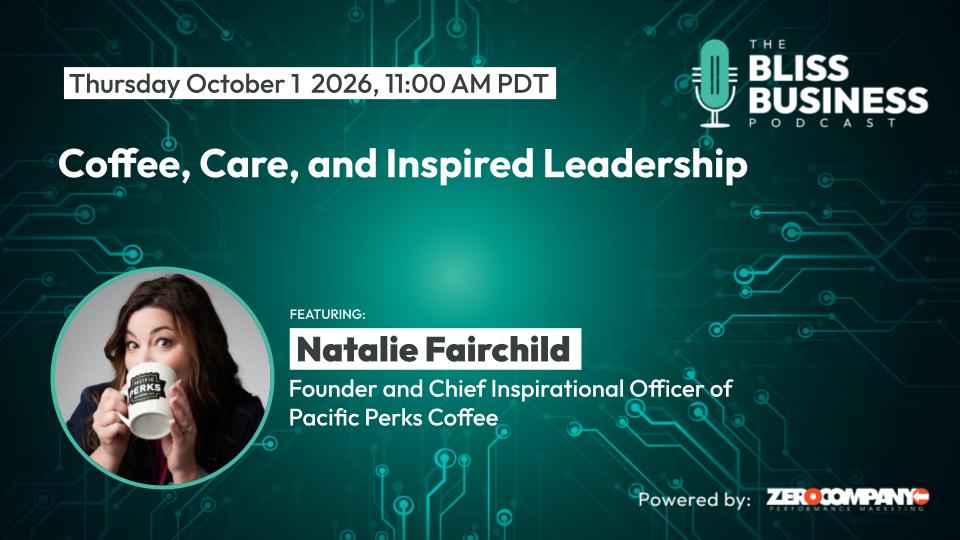
On The Bliss Business Podcast, we sat down with Natalie Fairchild, Founder and Chief Inspirational Officer of Pacific Perks Coffee, to explore empathy, hospitality, employee experience, caregiving, culture, and how leaders can build connection into the way a business operates. Natalie founded Pacific Perks in 2007 and has since grown the company into a mobile café experience designed to promote businesses, reward teams, and celebrate important moments. More recently, the company has moved into franchising. Coffee_ Care_ and Inspired Lead…
What stood out most from our conversation was how intentionally Natalie thinks about experience. For her, hospitality is not an extra layer placed on top of the business. It is the business.
The Experience Begins Before the Coffee Is Served
One of the most powerful ideas Natalie shared is that the customer experience begins long before the event starts.
If a client is hosting a company gathering, marketing activation, wedding, or celebration, they may already be carrying stress. They are thinking about timing, guests, logistics, weather, traffic, and whether everything will come together the way they hoped.
Pacific Perks tries to reduce that stress before the team ever arrives on site.
That means confirming details, communicating proactively, arriving early, making contact with the event organizer, and letting them know that everything is under control. Natalie put it simply: if a client has to call asking where the team is, something has already gone wrong.
That standard says a lot about empathy.
Empathy is not only understanding how someone feels after they tell you. It is anticipating what they might be feeling before they have to say anything.
That is one of the clearest ways businesses can make people feel cared for.
Small Gestures Create Disproportionately Large Experiences
The details Natalie described throughout our conversation were often surprisingly small.
A team member might ask the event organizer what their favorite drink is and have it ready for them. A perkologist may make eye contact immediately so a guest knows they have been seen. A team member may introduce two people during an event because they sense a business connection could happen while a latte is being made.
None of these things are expensive.
But they are memorable.
That matters because customers rarely remember every operational detail of an experience. They remember how the experience made them feel.
The old Maya Angelou insight that people remember how you made them feel comes alive in hospitality because emotional impressions are constantly being formed through small interactions. A missed acknowledgment can make someone feel invisible. A thoughtful greeting can make someone feel welcome. A proactive update can make someone feel relieved.
The experience is being created one micro-moment at a time.
Great Hospitality Depends on Seeing People
Natalie uses the word “see” frequently when talking about her employees and customers.
That is not accidental.
People want to feel recognized. They want someone to notice when they walk in, acknowledge that they are waiting, remember something about them, or take enough interest to ask how their day is going.
This does not require a complicated customer experience strategy.
Sometimes it requires eye contact.
Natalie described the frustration of entering a business where employees are busy behind the counter but no one acknowledges that you are standing there. Even if the staff cannot serve you immediately, a simple recognition changes the experience.
That principle applies to leadership too.
Employees want to feel seen.
They want leaders to notice the work they are doing, ask about their lives, remember something about their family, recognize their contributions, and follow up when something important is happening.
Seeing people is one of the simplest leadership practices available, yet it is often one of the first things lost when organizations get busy.
Appreciation Works Best When It Feels Personal
One of my favorite examples from the conversation involved a Pacific Perks company picnic.
Instead of purchasing only traditional prizes, the team created personal experiences and gifts based on what each person could offer. One employee offered a sourdough-making class. Someone else had chickens and offered fresh eggs. Another person offered babysitting or house-sitting. Natalie offered a day at the lake with swimming, miniature golf, dinner, and s’mores.
The gifts were not valuable because of their price.
They were valuable because they came from the people.
That is what made the appreciation feel genuine.
Leaders sometimes struggle with recognition because they treat it as another HR program. They create standard rewards, automate anniversary messages, or provide generic gifts that may be appreciated but do not necessarily create connection.
Personal appreciation carries a different emotional weight because it communicates that someone has been noticed individually.
The more human the recognition becomes, the more meaningful it often feels.
Culture Is Felt Before It Is Explained
As Pacific Perks moves into franchising, Natalie is thinking carefully about how to preserve the culture that made the company successful.
That challenge is familiar to almost every growing organization.
Processes are relatively easy to document. You can create manuals, checklists, operating procedures, training guides, and technology systems. Culture is harder because culture is partly emotional.
How do you teach someone to care?
How do you teach them to make people feel welcome?
How do you ensure that a future franchisee does not simply execute the operating model but also understands the spirit behind it?
Natalie’s approach begins with selection.
She is willing to turn away potential franchisees if she senses that their leadership style, priorities, or pace are inconsistent with the culture she wants to protect. She wants people who believe in building a business around relationships, employee well-being, and thoughtful growth rather than simply maximizing numbers.
That is an important lesson for any company scaling culture.
Training matters, but who you invite into the system matters first.
The Employee Experience Becomes the Customer Experience
Pacific Perks refers to its event staff as “perkologists,” and Natalie spends a great deal of time thinking about how those employees feel before they ever interact with customers.
That is because relaxed employees are better able to create relaxed experiences.
The company has detailed systems for loading, scheduling, timing, travel, checklists, and arrival. Those systems reduce unnecessary uncertainty and make it easier for team members to focus on hospitality rather than worrying about what they forgot.
Natalie also emphasizes flexibility.
Employees can manage availability around family commitments, trips, school schedules, and other parts of life. She described this as giving people permission to live their lives instead of making them feel guilty when they cannot take an event.
That kind of trust influences the way employees show up.
When people feel supported rather than controlled, they are more likely to extend that same care to customers.
This is where employee experience and customer experience become inseparable.
Systems Should Reduce Stress, Not Add to It
Natalie’s operating model includes detailed checklists, scheduling systems, training, and proprietary technology.
What is important is the purpose behind those systems.
They are not designed simply to make the company more efficient.
They are designed to reduce stress.
The clearer the process becomes, the more room employees have to focus on the guest. If the loading checklist is reliable, they do not have to worry about forgotten equipment. If the schedule clearly communicates when to leave the warehouse and when to arrive, they can focus on being present once they get there.
Good systems create emotional capacity.
That is something leaders often overlook.
A complicated process consumes energy. A confusing tool creates frustration. An unclear expectation causes anxiety. Every ounce of unnecessary operational friction reduces the energy employees can devote to customers.
The best systems do not make people feel more controlled.
They make people feel more capable.
Emotional Awareness Can Be Developed Through Reflection
Natalie looks for employees who naturally possess empathy, but she also trains for it.
One exercise asks new team members to think about a terrible customer experience they have had and describe why it felt so bad. Then they do the same with an exceptional experience.
That exercise is powerful because it does not simply tell employees what good service should look like.
It asks them to remember what good service feels like.
By reflecting on their own experiences, they begin identifying the small behaviors that made the difference. Maybe someone ignored them. Maybe someone remembered their name. Maybe a server noticed a problem before they mentioned it. Maybe someone went slightly beyond what was expected.
This creates empathy through perspective.
Instead of memorizing a customer service rule, employees connect the behavior to an emotional experience they already understand.
That kind of training can be far more durable.
Growth Should Never Come at the Expense of People
Natalie is thoughtful about the pace of Pacific Perks’ franchise growth.
She wants the business to expand, but she does not want growth that damages the culture or creates unnecessary pressure on the people involved.
That is why she pays attention to potential franchisees who appear overly focused on working constantly, scaling quickly, or pushing toward a number without enough consideration for quality of life.
She wants growth built on a strong foundation.
This is particularly important because hospitality businesses are deeply dependent on human energy. Employees who are exhausted or disengaged will eventually transfer that feeling into the customer experience.
A business can optimize itself so aggressively that it removes the very humanity customers originally loved.
Scale should strengthen the experience, not hollow it out.
Caregiving Can Teach Leaders About the Limits of Empathy
One of the more personal parts of our conversation involved Natalie’s experience as a caregiver and her work with the Alzheimer’s Association of Oregon and Southwest Washington.
Caregiving strengthened her understanding of empathy, but it also taught her something equally important: caring for someone else does not require destroying yourself in the process. Coffee_ Care_ and Inspired Lead…
That is a difficult lesson for many compassionate people.
There can be an unconscious belief that loving someone means absorbing their pain, matching their stress, or sacrificing your own well-being to prove that you care.
But exhaustion does not necessarily make someone more supportive.
Sometimes it makes them less able to help.
Natalie had to learn how to create healthier boundaries, take better care of herself, and recognize that she could support someone without becoming consumed by what they were experiencing.
That lesson translates directly into leadership.
Leaders can care deeply without taking every problem personally. They can empathize with employees without absorbing every emotion. They can create space for others while still protecting their own capacity.
Self-care is not separate from empathetic leadership.
It is one of the things that makes empathetic leadership sustainable.
Flexibility Is a Leadership Practice
Natalie also challenged the assumption that good work requires people to remain in an office for a fixed number of hours.
At Pacific Perks, the focus is much more on getting the work done and moving the business forward than on being physically present from eight to five.
She was candid that she does not perform well working extremely long hours and does not expect her team to treat exhaustion as evidence of commitment.
That philosophy shows up in the company’s flexibility around family schedules, personal commitments, and daily work rhythms.
Trust becomes the operating principle.
When someone’s schedule changes, the expectation is not that they apologize for having a life.
The expectation is that the team communicates clearly and fulfills the work.
That is a fundamentally different way of thinking about accountability.
Accountability does not have to mean control.
It can mean clarity, ownership, and trust.
Celebration Should Be Part of the Operating Rhythm
Pacific Perks begins weekly meetings with gratitude and celebration.
Employees share something they are grateful for or something they are celebrating personally or professionally. The team recognizes new jobs for spouses, pregnancies, successful events, client wins, leads, and everyday accomplishments.
These rituals may seem small, but repeated rituals shape culture.
They tell people what is worth noticing.
If every meeting begins with problems, targets, missed deadlines, and performance gaps, employees learn that those are the things leadership pays attention to.
If the organization also makes space for gratitude, recognition, progress, and personal milestones, people learn that they matter beyond their output.
The point is not to ignore performance.
It is to create a fuller picture of what work can be.
Love in Business Can Be Practical
When we asked Natalie what role love should play in business, she did not treat the idea as abstract.
For her, love shows up in kindness, flexibility, joy, recognition, connection, and the willingness to make work more human.
She also encouraged leaders not to overcomplicate it.
Try one small thing.
Change the way a meeting starts. Offer one sincere acknowledgment. Ask an employee how they are doing and actually listen. Personalize one part of the customer experience. Give someone more flexibility. Celebrate one thing that would normally go unnoticed.
Then see what happens.
This is one of the most practical ways to build love into scalable systems.
Culture rarely changes because of one enormous initiative.
It changes because enough small behaviors become normal.
Key Takeaways
- Hospitality begins before the service itself, and proactive communication can dramatically reduce customer anxiety.
- Customers often remember small gestures more than major operational details because those gestures shape how the experience feels.
- Making people feel seen can be as simple as eye contact, acknowledgment, personalization, and genuine curiosity.
- Employee appreciation is more meaningful when it reflects the individual rather than becoming a standardized recognition program.
- Strong cultures are protected first through hiring and franchisee selection, then reinforced through training and systems.
- Customer experience and employee experience are deeply connected because supported employees have more emotional capacity to care for guests.
- Good operational systems reduce stress so employees can focus more attention on the human experience.
- Empathy can be developed by asking employees to reflect on how exceptional and poor service experiences made them feel.
- Growth should never become so aggressive that it damages culture, employee well-being, or the quality of the customer experience.
- Empathetic leadership requires healthy boundaries because caring for others does not require leaders to absorb every problem themselves.
- Flexibility and accountability can coexist when teams operate with trust, communication, and clear expectations.
- Gratitude and celebration become cultural systems when they are built consistently into the rhythm of the organization.
- Love in business does not require a massive initiative. Small, repeated acts of care can gradually shape the entire experience.
Final Thoughts
Natalie Fairchild’s perspective reminds us that hospitality is not primarily about coffee, food, events, or even service.
It is about people.
The coffee becomes meaningful because someone remembered your favorite drink. The event feels different because the team arrived early and made the organizer feel confident. The employee experience becomes memorable because a leader noticed something happening in your life and cared enough to ask about it later.
These moments are easy to dismiss because they seem small.
But culture is built from small things.
Customer experience is built from small things.
Trust is built from small things.
And when those small things become consistent enough, they stop being random acts of kindness and become the way the business operates.
That may be one of the most important lessons in hospitality leadership: people do not need perfection to feel cared for. They need to feel seen, supported, and genuinely welcomed.
When a company can systemize that feeling without making it feel scripted, it has created something far more valuable than a good service experience.
It has created connection.
Check out our full conversation with Natalie Fairchild of Pacific Perks Coffee on The Bliss Business Podcast.

Executive Producer | Host | Blog Contributor
Tullio Siragusa is a strategic advisor, dynamic speaker, author, and EQ coach with 36 years of experience as a technology disruptor rooted in Design Thinking. Since 2018, he has been creating, producing and hosting live podcasts, interviewing over 1,000 C-suite executives across a wide range of industries. His work behind the mic reflects his larger mission: using conversation as a catalyst for human-centric innovation.
Tullio’s commitment to purpose-driven leadership and ethical transformation is reflected in his advisory roles at the University of California, Riverside’s Design Thinking Executive Program, and the University of San Francisco School of Management’s Digital Marketing Program. As a Board Advisor at AI2030.org, he helps guide the responsible advancement of AI toward ethical and sustainable outcomes. A founding member of RadicalPurpose.org, Tullio believes empathy isn’t just a trait, it’s a non-negotiable foundation for leadership.
Learning to See Is a Leadership Skill