The Real Value of a Fractional CMO Is Not Part-Time Marketing. It Is Executive Clarity.

Growing companies often reach an awkward stage where marketing activity has outpaced marketing leadership.
There may be a capable internal team, an agency, paid media running across several channels, a content calendar, email campaigns, social programs, sales enablement, and an increasing amount of technology supporting all of it. From the outside, the organization looks busy and well-equipped.
Yet leadership still struggles to answer a few basic questions with confidence.
Who is the priority customer?
What should the company be known for?
Which marketing investments are actually contributing to growth?
Why does sales believe lead quality is weak?
Why does marketing believe follow-up is the problem?
Who owns the larger system connecting all of this?
That gap is easy to misdiagnose. Companies often assume they need more execution when what they really need is stronger leadership.
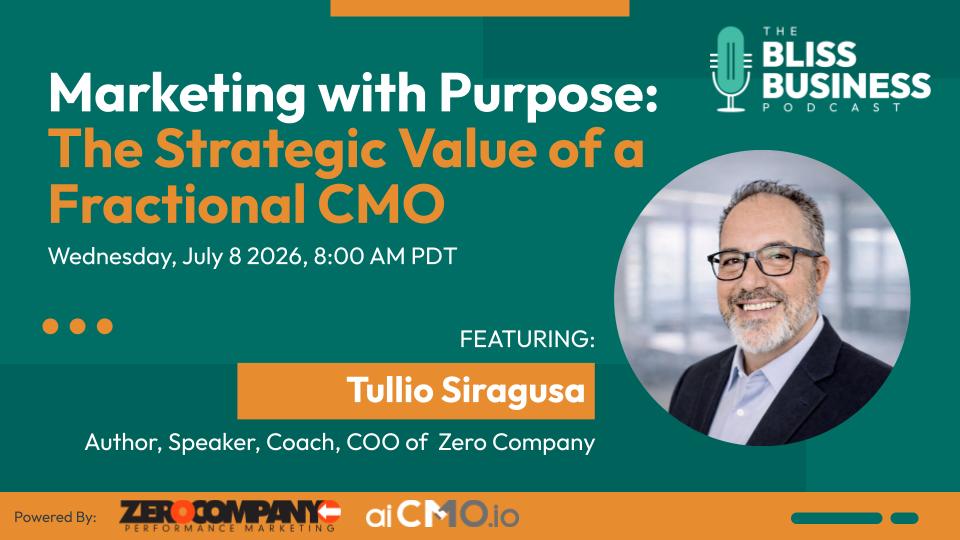
That is the central idea explored by Tullio Siragusa, COO of Zero Company, in a special monologue edition of the Marketing with Purpose series of The Bliss Business Podcast. His argument is that a fractional CMO should not be thought of as a cheaper or smaller version of a full-time marketing executive. The strategic value lies in bringing experienced executive leadership into an organization at the moment when complexity is rising faster than clarity.
That is a very different proposition from simply hiring another marketer.
Marketing Activity Can Grow Faster Than Marketing Maturity
One of the most common patterns in scaling businesses is that execution expands long before leadership structure catches up.
Early on, this rarely creates a problem. The founder understands the customer, carries the story, makes most of the key decisions, and personally connects marketing to the broader direction of the company. As the business grows, that model becomes harder to sustain.
More people join.
More channels are added.
Outside agencies enter the picture.
Sales becomes more formalized.
Different departments begin creating their own messaging and customer touchpoints.
The organization becomes more capable, but also more fragmented.
At that stage, the company can easily confuse increased activity with increased sophistication. It may have more content, more tools, and more campaigns than ever before, while the strategic foundation underneath them remains underdeveloped.
This is where a fractional CMO can be especially valuable. The role fills the gap between execution and executive ownership. It creates a place where the larger strategic questions are answered consistently rather than being handled informally by whoever has time.
“Fractional” Describes the Engagement, Not the Leadership
The term itself creates confusion.
Some companies hear “fractional CMO” and imagine a senior consultant who attends a few meetings, reviews a dashboard, and occasionally recommends a campaign. Others think of a highly experienced marketer who can step in and execute across every channel.
Neither definition gets to the heart of the role.
A strong fractional CMO operates as an executive. The engagement may be part-time, but the thinking cannot be part-time. The leader still needs to understand business economics, revenue goals, customer behavior, competitive position, sales performance, product realities, and operational constraints.
That broader context matters because marketing problems are rarely contained within marketing.
Weak demand may actually be a positioning issue.
Poor conversion may trace back to sales follow-up.
Customer acquisition may be expensive because brand awareness is weak.
Strong messaging may be wasted if the customer experience does not support the promise.
A capable executive sees the system, not just the campaign.
That is the real distinction between a fractional CMO and a senior tactical marketer.
The First Strategic Contribution Is Often Clarity
Growing businesses accumulate ideas quickly.
New segments look promising.
New channels appear attractive.
New campaigns get proposed.
New markets feel worth testing.
Internal teams develop their own priorities.
Eventually, everything begins to feel important.
This is where strategy becomes less about generating ideas and more about making choices. Tullio frames clarity as one of the core areas where fractional leadership creates value, and that is exactly right.
A strong fractional CMO helps leadership decide where to focus and where not to focus. That includes identifying the priority customer, clarifying the value proposition, determining which growth opportunities reinforce the company’s long-term direction, and removing work that adds noise without enough strategic value.
This is one of the most underappreciated forms of leadership.
Companies often assume growth comes from adding more. In reality, many organizations grow faster once they stop dispersing energy across too many competing initiatives.
Alignment Turns Marketing Into an Organizational System
A second major source of value is alignment.
Marketing, sales, product, customer experience, finance, and operations all influence growth, but they often work from different assumptions. One team may define a high-quality lead differently from another. Sales may hear objections that never make it back into messaging. Customer experience may know why clients stay, but that knowledge may never shape acquisition strategy.
Without leadership connecting those inputs, the business develops blind spots.
This is why Tullio’s point that many marketing problems are organizational problems in disguise is so important.
A fractional CMO can create the shared definitions and decision structures that reduce those disconnects. The goal is not to fill everyone’s calendar with more meetings. It is to make sure that the teams influencing growth understand how their responsibilities fit together and what information needs to move between them.
When that happens, the organization becomes less political because fewer problems are treated as someone else’s fault.
It also becomes more responsive because information moves faster and decisions become easier to make.
Accountability Is More Than Reporting Metrics
Marketing dashboards can create the illusion of accountability.
Impressions are reported.
Traffic is reported.
Leads are reported.
Engagement rates are reported.
But none of those metrics automatically explain what marketing is contributing to the business.
Real accountability requires a measurement model that connects activity to meaningful outcomes. Depending on the company, that may involve qualified pipeline, acquisition cost, retention, revenue contribution, lifetime value, sales velocity, market penetration, or some other measure that reflects the actual business model.
The important part is not choosing the same KPI for every organization.
It is creating a framework that helps leadership understand what happened, why it happened, and what decision should follow.
That is where executive marketing leadership becomes especially useful. It turns measurement into management rather than reporting.
A good fractional CMO is also willing to stop activity that no longer deserves investment. That may be one of the hardest things for organizations to do internally, especially when a program has history, political support, or a team built around it.
Sometimes accountability means improving the work.
Sometimes it means ending it.
A Fractional CMO Should Make the Organization More Capable
One of the most important ideas in the monologue is that fractional leadership should not create dependence.
If the company becomes unable to function without the fractional CMO, the engagement has missed part of its purpose.
The stronger model is capability-building.
That can involve coaching existing leaders, clarifying team roles, improving processes, evaluating agency relationships, strengthening decision-making, and identifying what the organization will need next. In many cases, what looks like a talent problem is actually a structural problem.
A marketing manager may be highly capable but operating without executive authority.
An agency may be producing mediocre work because the company has never provided a coherent strategy.
A team may appear inconsistent because priorities change every few weeks.
These conditions cannot be fixed simply by demanding better output.
They need leadership.
The best fractional CMOs create an environment where the people already inside the company are more likely to succeed. That is a much more durable form of value than simply taking over execution.
Fractional Leadership Is Especially Powerful During Transition
There are moments when companies need senior marketing leadership before they know what their permanent structure should look like.
That is often where the fractional model is strongest.
The business may be entering a new market, repositioning, preparing for investment, integrating an acquisition, launching a new service, or moving from founder-led growth toward a more mature operating model. Each of those situations creates strategic uncertainty alongside the need for faster decision-making.
Hiring a permanent CMO too quickly can introduce its own risk if the organization has not yet defined what kind of leadership it actually needs.
A fractional executive can help design that future state.
The right leader may determine that the company eventually needs a full-time CMO. In another situation, the better answer may be a VP of Marketing, a stronger demand generation leader, a product marketing function, or a different agency model.
That makes fractional leadership more than a temporary fix.
It can become a bridge into the company’s next stage of maturity.
The Model Works Only When the Executive Has Real Access
A fractional CMO cannot create meaningful change from the sidelines.
This is one of the most important conditions for success.
If leadership treats the role like an outside consultant, with limited access to financials, sales data, customer information, or executive conversations, the fractional CMO will be forced to operate with an incomplete picture. That dramatically limits the quality of the decisions they can make.
The same is true when the CEO wants validation rather than leadership.
A fractional CMO cannot help much if every strategic recommendation has already been predetermined or if the organization wants transformation without changing any priorities, processes, or behaviors.
The role works when there is trust, access, authority, and realistic scope.
That also means recognizing that fractional does not mean unlimited. The executive should not be expected to function simultaneously as strategist, copywriter, media buyer, designer, analyst, and project manager on an ongoing basis.
The value comes from executive leverage, not from trying to compress an entire department into one person.
The First 90 Days Should Reduce Confusion
The first phase of a fractional CMO engagement should not be dominated by immediate campaign recommendations.
It should begin with listening.
The executive needs to understand how the business makes money, where growth is supposed to come from, how customers move through the journey, what the competitive environment looks like, how the current team operates, what the sales process is, how agencies are being used, and what data is actually reliable.
This work matters because the leadership team’s view of the business may not fully match what is happening operationally.
That is not necessarily dishonesty. More often, it is proximity. Founders and CEOs can become attached to the intended version of the company rather than the lived version. An outside executive with enough access can help separate aspiration from reality.
From there, the job is prioritization.
The company does not need a giant audit cataloging every weakness. It needs to understand what should be addressed first, what can wait, what should continue, and what should stop.
By the end of the first 90 days, leadership should have a clearer strategic direction, stronger ownership, a more useful measurement framework, and an execution roadmap tied to business outcomes.
That is momentum with structure.
The Human Value of Executive Clarity Is Easy to Miss
The strategic case for a fractional CMO is usually framed in terms of efficiency, cost, or flexibility.
Those things matter, but they overlook the human impact of leadership clarity.
When marketing lacks direction, employees feel it.
Priorities change constantly.
People work hard without knowing whether the work matters.
Sales and marketing begin blaming one another.
Agencies receive conflicting feedback.
Customers encounter inconsistent messages.
Executives become frustrated because they cannot connect spend to growth.
Those conditions create unnecessary stress.
Tullio connects this directly to the B.L.I.S.S. philosophy—Building Love Into Scalable Systems—and it is a meaningful connection. A well-designed leadership system reduces confusion without reducing accountability. It gives people a clearer understanding of what they own and how their work contributes to a larger outcome.
That is more than good management.
It is a more respectful way to build a company.
Key Takeaways
A fractional CMO fills a leadership gap, not an execution gap. The greatest value comes from connecting strategy, revenue, customer insight, and organizational priorities.
The engagement may be fractional, but the leadership should be executive-level. The role requires business judgment far beyond channel expertise.
Clarity is often the first major unlock. Growing companies benefit from deciding which customers, opportunities, and initiatives deserve focus.
Many marketing problems are really alignment problems. Sales, product, operations, finance, and customer experience all shape marketing performance.
Accountability means connecting activity to business outcomes. Useful measurement helps leaders make decisions instead of merely reviewing dashboards.
The best fractional leaders build internal capability. They strengthen teams, processes, and decision-making so the organization is better prepared for the future.
Fractional leadership can bridge periods of transition. It gives companies executive guidance while they determine the permanent structure needed for the next stage.
Final Thoughts
What this monologue from Tullio Siragusa, COO of Zero Company, makes clear is that the strategic value of a fractional CMO has very little to do with getting part of a marketer for part of the cost.
The real value is getting the right level of leadership at the moment the organization needs it.
When a company has plenty of activity but not enough clarity, the answer is rarely another campaign. What the business often needs is someone who can connect the work, challenge assumptions, create accountability, and turn marketing into a system that leadership can actually govern.
That is what strong fractional CMO leadership provides.
It gives a growing company the executive discipline to mature before it is ready to make a permanent executive hire—and, just as importantly, helps the company understand what kind of marketing organization it should become next.

Guest Development | Producer | Blog Contributor
Martha is a connector who brings over two decades of experience in engineering, sustainability, education, and public relations. She is part of the integrated go-to-market team at Zero Company and serves as Guest Development Lead for The Bliss Business Podcast, where she connects with purpose-driven leaders to shape meaningful conversations. Martha also produces the Marketing With Purpose Kit segments with CMO guests.
Her career includes founding nonprofits, and speaking at global forums in Malaysia, Dubai, and Paris. A passionate community builder, Martha also mentors women entrepreneurs and supports environmental initiatives across Mexico and the U.S. Her work reflects a deep commitment to impact, inclusion, and authentic leadership.

Starting Over Deserves Community